Unseen Warriors: How Iran’s Agile ‘Mosquito Fleet’ of Caves Conquers the Strait of Hormuz Blockade

The ongoing U.S.-Iran conflict has become a protracted ordeal for the White House, which initially estimated that the military engagement would last just “four or five weeks.” Instead, the situation has devolved into a drawn-out struggle, exposing significant miscalculations by President Donald Trump’s administration regarding Iran’s military resilience, particularly its capabilities in air combat and naval operations in the strategically vital Strait of Hormuz.
Reports indicate that Iran’s low-cost Shahed drones and advanced defense systems pose a formidable challenge even to the U.S.’s most sophisticated aircraft, including the F-35. Despite U.S. and Israeli claims of having neutralized a significant portion of Iran’s naval assets, a smaller flotilla known as the “mosquito fleet” continues to threaten maritime activities in the region.
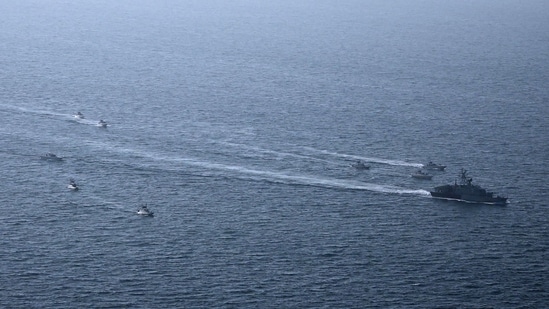
The “mosquito fleet” comprises fast, modified vessels engineered to assert control over strategic waters near the Strait of Hormuz. This innovative naval force, composed primarily of small attack boats under the command of the Islamic Revolutionary Guards Corps (IRGC), reflects a shift away from traditional naval warfare strategies. Saeid Golkar, a political science professor at the University of Tennessee at Chattanooga, emphasizes that the IRGC navy operates akin to a guerrilla force, employing asymmetrical warfare tactics rather than engaging in conventional naval battles. “It depends on hit-and-run attacks,” he explained.
Reports from the International Maritime Agency reveal that during the ongoing conflict, at least 20 vessels have been targeted. While U.S. and Israeli strikes have reportedly damaged half of the IRGC’s fast-attack boats, estimates suggest that hundreds to thousands of these small vessels remain operational. Their diminutive size renders them difficult to track via satellite; many are stored in concealed bases along Iran’s rugged coastline, with analysts estimating at least ten fortified locations for these attack boats.
The operational reach of this fleet is vast, allowing for swift deployments that pose a significant threat to both military and commercial vessels navigating the Strait of Hormuz. “It remains a disruptive force. You never quite know what they are up to and what their intentions are,” notes Admiral Gary Roughead, a retired chief of U.S. Naval Operations.
To counter the mosquito fleet, U.S. naval forces utilize high-caliber weaponry. However, commercial vessels in the strait typically lack such armaments, underscoring the vulnerability of commercial shipping in the region. The mosquito fleet continues to be a complex challenge for Washington, which grapples with the ramifications of a conflict that has proven far more challenging than anticipated.
As the U.S. seeks to navigate this intricate geopolitical landscape, the lessons learned from the resilience of Iran’s mosquito fleet and the efficacy of irregular maritime warfare could reshape future military strategies in the region. The conflict serves as a stark reminder of the unpredictable nature of modern warfare and the need for a nuanced understanding of an adversary’s capabilities.
The continuation of this conflict raises concerns not only for international shipping but also for regional stability. As both sides confront the unfolding complexities, the implications for U.S. foreign policy and military strategy may be profound, requiring careful reassessment in light of emerging realities on the ground.
As the situation evolves, it remains crucial for interested stakeholders and observers to monitor developments closely, given the stakes involved for both the U.S. and Iran in this ongoing strategic confrontation.
Original Source: https://www.hindustantimes.com/world-news/small-nimble-too-hard-to-trace-how-irans-mosquito-fleet-ensures-strait-of-hormuz-blockade-101776506296955.html
Category :
Tags:
Publish Date: 2026-04-18 15:48:00