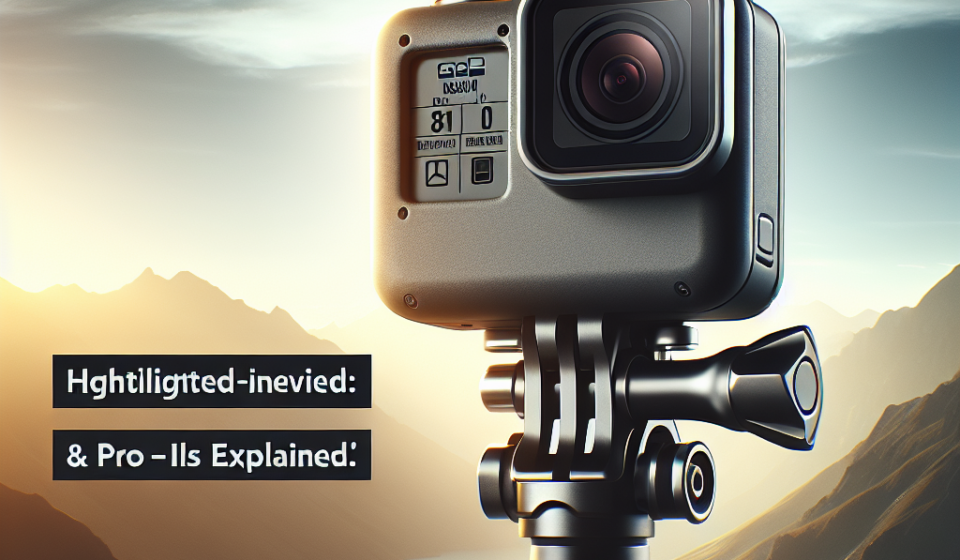

Hook – The hardware headline is tempting: action cameras with 1‑inch sensors, 8K, and micro four‑thirds lens mounts. But the more consequential story is a shift from closed, single‑purpose devices to modular, platform‑oriented capture systems – and that has lessons for architects, product leaders and content ecosystems alike.
The signal – GoPro’s new Mission 1 line introduces a much larger sensor, a new GP3 SoC with improved low‑light handling, expanded dynamic range and 10‑bit GP‑Log2 capture, interchangeable MFT lenses on the Pro ILS, longer Enduro 2 battery life, and extreme slow‑motion modes. These are not incremental spec bumps; they indicate a re‑positioning of the action camera from consumer novelty to a professional capture node.
Analysis – What this means for technology and product strategy
– Hardware + software co‑design matters now more than ever. The GP3 SoC and the sensor are deliberately a bundled promise: better low light, thermal management, and on‑device processing (color pipelines, denoising, frame rate conversion). For enterprises building media platforms, this reiterates a core architectural lesson: performance gains come from vertical integration where silicon, firmware and application stack are designed together – but that comes with increased responsibility for lifecycle support and thermal/battery constraints.
– Modularity unlocks composability – and new responsibilities. The choice to support MFT lenses materially expands creative workflows but also opens the product to a new class of integration complexity: mechanical interfaces, lens metadata, calibration, and support for external monitors and rigs. In software terms, this is a move from monolith to platform: higher capability but greater integration and support cost. Product leaders must weigh faster feature differentiation against the operational cost of an expanded ecosystem.
– Data gravity and workflow engineering become first‑class problems. 8K at 60 fps, 10‑bit Log capture, and bursty ultra‑slow modes aren’t just about higher fidelity; they explode storage, encoding, and metadata needs. Every studio, rental house or creator platform that ingests this footage must ask: how do we manage transfer, transcoding, color‑space conversion, and asset tagging at scale? Edge compute, smart proxy workflows and deterministic metadata schemas matter.
– Tradeoffs are real: thermal, battery, and weight. Longer battery life claims are promising, but high‑resolution capture and heat are adversaries. For teams integrating such devices into live operations (drones, remote rigs, long‑duration shoots), test for sustained performance, not just peak specs. Architect systems that can gracefully degrade – lower bitrates, reduced frame rates, or offload to external recorders – when thermal or power limits are reached.
Localization – Why this matters for India (and the Northeast)
For creators in India – from adventure tourism in the Northeast to documentary teams in remote districts – these devices offer a pragmatic way to capture cinematic footage without heavy, expensive rigs. The combination of better low‑light performance and longer battery life matters when power and connectivity are scarce. But to realise the value, local teams must pair capture devices with field‑ready workflows: lightweight editing nodes, standardized LUTs, and offline‑first ingest tools that sync when bandwidth is available.
Actionable takeaways
– Treat capture hardware as part of your platform stack. Include thermal, battery and firmware update policies in procurement and SLAs.
– Standardize on color pipelines early. If you accept Log and 10‑bit captures, define your LUTs, proxy rules, and archival strategy up front.
– Build edge ingest and proxy transcoding into field workflows to mitigate high‑bandwidth chokepoints.
– If you’re a product leader, consider partnerships (rental, accessory makers, post houses) rather than building every accessory inhouse – that’s the cost of a platform play.
– For regional creators, invest in training for Log workflows and lightweight hardware rigs to squeeze maximum value from smaller devices.
Closing thought – The Mission 1 family signals that capture devices are converging with professional toolchains. For architects, founders and content leaders, the question is no longer “can we get cinematic footage?” but “how do we stitch high‑fidelity capture into resilient, scalable workflows that serve creators everywhere – from city studios to the hills of Northeast India?”
About the Author
Sanjeev Sarma is the Founder Director of Webx Technologies Private Limited, a leading Technology Consulting firm with over two decades of experience. A seasoned technology strategist and Chief Software Architect, he specializes in Enterprise Software Architecture, Cloud-Native Applications, AI-Driven Platforms, and Mobile-First Solutions. Recognized as a “Technology Hero” by Microsoft for his pioneering work in e-Governance, Sanjeev actively advises state and central technology committees, including the Advisory Board for Software Technology Parks of India (STPI) across multiple Northeast Indian states. He is also the Managing Editor for Mahabahu.com, an international journal. Passionate about fostering innovation, he actively mentors aspiring entrepreneurs and leads transformative digital solutions for enterprises and government sectors from his base in Northeast India.

