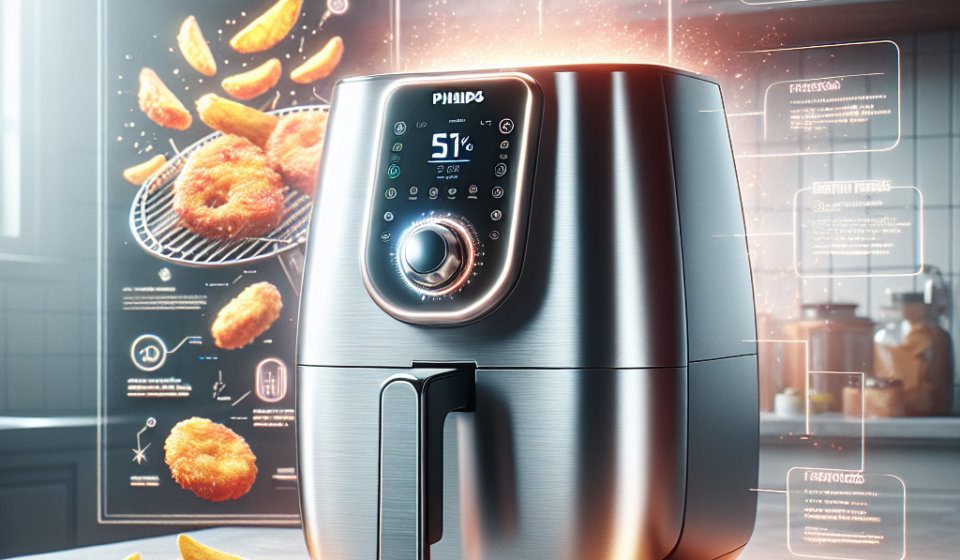

We spend an embarrassing amount of time arguing about specs and feature lists, while the single biggest driver of consumer choice often sits squarely in plain sight: design and perceived value. A recent review of the Philips Series 3000 air fryer – positioned against incumbent machines like the Instant Vortex and punctuated by a steep price cut – is a useful reminder that in product design, aesthetics, packaging and timing can be as decisive as technical capability.
Context (the signal)
I recently read a hands-on review of the Philips Series 3000: a dual-basket air fryer with a 9-litre total cooking volume, offered in a white-and-champagne finish, and aggressively discounted in some markets. The review contrasted that machine with a single large-basket rival, noting the trade-offs between a split-basket architecture and a single configurable chamber.
Analysis – what this means for product and enterprise strategy
1. Functionality vs. Form: The appliance market is a microcosm of larger product dynamics. Customers evaluate devices not only on how well they perform the job, but on how they make an environment feel. For consumer hardware and IoT products, form factor and finish are legitimate strategic levers – they influence placement (countertop vs. cupboard), frequency of use, and even the emotional bond a user forms with the product. As an architect I often counsel teams: don’t relegate design to “nice-to-have” – it changes adoption curves.
2. Trade-offs are the product roadmap
The Series 3000’s dual-basket design offers parallel-cooking benefits but limits the “single large-surface” workflows some users prefer. That’s a classical product trade-off: optimize for simultaneous diversity (two dishes) or for flexible monolithic capacity. The correct choice depends on user segments; a one-size-fits-all approach creates hidden technical debt – in this case, user friction and return/refund risk.
3. Pricing, promotions and perceived fairness
A steep discount does more than move inventory – it recalibrates perceived value. For engineering and product leadership this introduces two risks: cannibalisation of full-price sales and brand dilution. Operationally, leaders should model discount scenarios and their long-term impact on brand equity, warranty claims, and support load.
4. After-sales lifecycle & sustainability
Physical products age in ways software doesn’t. Repairability, modular spares, and firmware support cycles matter. As device ecosystems become smarter, the “platform” risk grows: who will maintain firmware, how long will security updates be supported, and how will privacy be protected if telemetry is involved? Architecture teams need a lifecycle plan at the point of design – define EoL policies, spare-part roadmaps, and clear KPIs for field reliability.
5. Build vs. Partner decisions
Startups and enterprises entering hardware should weigh the benefits of white-labeling or OEM partnerships against owning the IP and design. Owning design yields differentiation (like the champagne finish), but demands capabilities in industrial design, supply chain and after-sales. Partnering accelerates time-to-market but limits control over the user experience.
A note for Indian markets and Northeast India (a pragmatic bridge)
In India – and particularly in regions where kitchen space is at a premium – size, noise, energy consumption and color coordination matter a lot. Price elasticity is high; a well-timed local promotion or a value-engineered variant can unlock mass adoption. For enterprises designing products for Bharat, “frugal premium” – delivering aspirational design at price points aligned to local incomes – is a repeatable strategy.
Practical takeaways
– Prioritise design as a strategic choice, not an afterthought. It affects adoption and lifecycle costs.
– Explicitly model architectural trade-offs (e.g., dual-basket vs single-chamber) against user segments.
– Build disposal, repairability and update policies into the product SLA from day one.
– Use pricing experiments sparingly and measure long-term brand effects, not just short-term sell-through.
– For India-bound hardware, create locally optimised SKUs that respect space, power and price sensitivities.
Closing thought
Products live in contexts – physical, social and economic. The smartest product strategies are those that treat aesthetics, functionality and lifecycle as equal citizens in the architecture of value.
About the Author
Sanjeev Sarma is the Founder Director of Webx Technologies Private Limited, a leading Technology Consulting firm with over two decades of experience. A seasoned technology strategist and Chief Software Architect, he specializes in Enterprise Software Architecture, Cloud-Native Applications, AI-Driven Platforms, and Mobile-First Solutions. Recognized as a “Technology Hero” by Microsoft for his pioneering work in e-Governance, Sanjeev actively advises state and central technology committees, including the Advisory Board for Software Technology Parks of India (STPI) across multiple Northeast Indian states. He is also the Managing Editor for Mahabahu.com, an international journal. Passionate about fostering innovation, he actively mentors aspiring entrepreneurs and leads transformative digital solutions for enterprises and government sectors from his base in Northeast India.