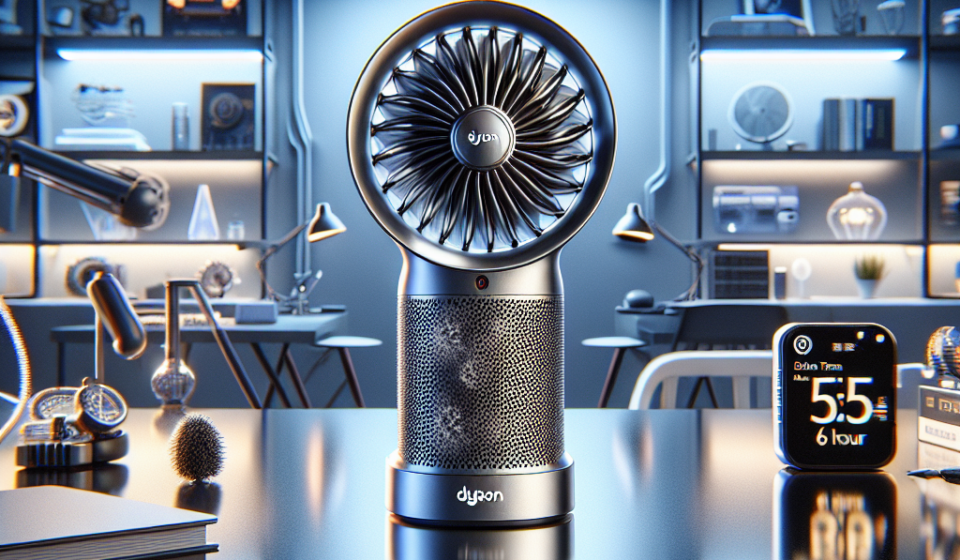

We often celebrate software breakthroughs – new models, faster runtimes, clever algorithms – and forget that meaningful user impact frequently begins with physical design. Dyson’s new HushJet Mini Cool is a timely reminder: when you rethink the physics of a problem (airflow, noise, efficiency), you can create a product that feels like a new category rather than another incremental update.
Context: Dyson has introduced the HushJet Mini Cool, a pocketable handheld fan that applies the company’s HushJet air-projection work to a compact form factor. The device claims focused airflow up to 25 m/s (≈55 mph), a brushless motor that spins as high as 65,000 RPM, weighs around 7.5 ounces, offers five speeds plus a boost mode, charges by USB‑C with a charging stand, runs up to six hours per charge, and is positioned at a $100 price point with staggered color availability.
Three strategic lessons for builders, architects and product leaders
1) The power of rethinking the physics – not just the software
Dyson’s move is a classic engineering-first play: rather than layering more software on a commodity fan, they reimagined how to move and shape air quietly and efficiently in a small volume. For product teams this is a reminder that differentiation often comes from the foundational layer – materials engineering, thermal dynamics, acoustics – not only UX or cloud features. As a chief architect, I’ve seen too many projects chase integrative bells and whistles while neglecting the physics that define the core experience. If the core physical experience is poor, the best software UX only paper‑over defects.
2) Trade-offs: miniaturization, power, noise and cost
Miniaturizing a high‑performance actuator (a motor rated to tens of thousands RPM) while maintaining battery life and acceptable acoustics is a non‑trivial systems problem. That’s a familiar balancing act for architects: speed vs stability, capability vs cost, short‑term market timing vs long‑term supportability. Dyson’s pricing – premium for a handheld fan – shows how companies can capture value when engineering creates a genuine capability leap. For startups and OEMs, the lesson is to be explicit about trade-offs: where will you concede on run-time, materials, or manufacturing complexity to hit your price target and distribution plan?
3) Product ecosystems and local market fit matter – especially in heat-stressed regions
In places like India, where heat waves are increasingly frequent, cooling is not a lifestyle luxury – it’s a resilience need. A premium handheld device may find an urban, aspirational audience, but broad impact requires thinking about affordability, repairability, after-sales networks, and energy constraints (long run-times, compatibility with common chargers, even solar charging in off-grid areas). For companies designing hardware for Indian markets, frugal engineering – simplified feature-sets that keep the core physics intact while dramatically lowering cost – is a strategic path to scale.
Actionable recommendations for CTOs and founders
– Prioritize the core user value: define the single physical property that must be excellent (airflow, noise, battery life) and optimize system design around it.
– Make trade-offs explicit in architecture docs: quantify how motor sizing, battery capacity, and enclosure choices affect cost and manufacturability.
– Plan for local manufacturing and repair: modular designs and standardized components (USB‑C, swappable batteries) reduce service friction and improve adoption.
– Evaluate build vs buy honestly: proprietary tech can be a moat but raises integration and support costs; licensing or partnerships may accelerate go‑to‑market.
– Design for sustainability and lifecycle: efficient motors and repairable designs reduce total cost of ownership and regulatory risk.
Takeaways
– Real product differentiation often starts with physical systems engineering, not just software.
– Explicit trade-off modeling (performance vs. cost vs. reliability) should be part of every architecture review.
– For markets dealing with climate risk, affordability, energy efficiency, and serviceability matter as much as raw performance.
Closing thought
Innovation is as much about choosing the right trade-offs as it is about inventing new ones. When we design with physical realities in mind – whether airflow in a handheld fan or latency in a distributed system – we create products and platforms that endure.
About the Author Sanjeev Sarma is the Founder Director of Webx Technologies Private Limited, a leading Technology Consulting firm with over two decades of experience. A seasoned technology strategist and Chief Software Architect, he specializes in Enterprise Software Architecture, Cloud-Native Applications, AI-Driven Platforms, and Mobile-First Solutions. Recognized as a “Technology Hero” by Microsoft for his pioneering work in e-Governance, Sanjeev actively advises state and central technology committees, including the Advisory Board for Software Technology Parks of India (STPI) across multiple Northeast Indian states. He is also the Managing Editor for Mahabahu.com, an international journal. Passionate about fostering innovation, he actively mentors aspiring entrepreneurs and leads transformative digital solutions for enterprises and government sectors from his base in Northeast India.