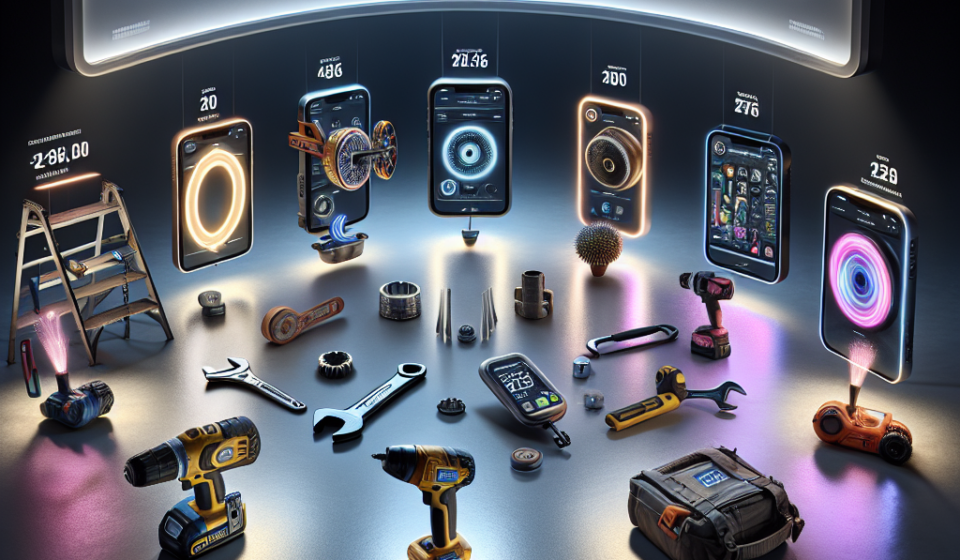

Strategic Zoom-Out: hardware is becoming software – but quieter, smarter, and far more interoperable.
I recently reviewed a roundup of Lowe’s 2026 non–power-tool introductions – items like a multi‑position Leveler ladder, USB‑C‑chargeable batteries for Kobalt tools, acoustic wall panels, modular storage add‑ons, and upgraded holiday animatronics. On the surface these are retail product updates. At a systems level they reveal three powerful trends that every technology leader and product strategist should be watching: platform thinking applied to physical goods, user‑centred modularity, and the convergence of electrical/connector standards with user expectations.
Context (the signal)
Lowe’s entries show more than new SKUs – they signal a retail ecosystem shift: batteries treated as shared power platforms (USB‑C charging and bidirectional outputs), tool and storage modularity that values backward compatibility, and personalization in household hardware (acoustics, printed wall panels). Influencer briefings and exclusive launches further tie product roadmaps to real‑time market feedback.
Analysis – why this matters for architects and founders
1. Platformization of hardware: When batteries become a cross‑device standard (USB‑C, bidirectional, laptop‑capable outputs), they stop being a feature of a single product and become a shared service. For product teams this implies new system boundaries – power management becomes an integration point, not an isolated component. CTOs must plan for hardware APIs, firmware update channels, and telemetry (safely) to manage performance and warranties.
2. Backward compatibility lowers adoption friction – and raises responsibility. Lowe’s Kobalt approach (new USB‑C batteries + adapters) demonstrates that compatibility accelerates ecosystem uptake. But it also creates complexity: supporting legacy cells, multiple chargers, and safety certification matrices. This is a trade‑off: faster adoption vs. greater testing and regulatory burden.
3. Modularity and personalization unlock new revenue and lifecycle models. Casestack add‑ons, acoustic panels with custom prints, and multi‑position ladders point toward configurable products that extend useful life and create upgrade pathways. For businesses, that translates to recurring aftermarket opportunities (accessories, printed panels, replacement parts) and deeper customer relationships – if you own the compatibility standard.
4. Influence-driven roadmaps and rapid merchandising: Creator Summits and influencer previews shorten the feedback loop between user desire and shelf. This is an opportunity – and a hazard – for enterprises. Speed to market can outpace quality assurance, and social‑first hype can mask supply chain fragility.
5. Sustainability and safety become harder, not easier. USB‑C ubiquity is convenient, but it raises questions: who owns safety testing? How are end‑of‑life batteries reclaimed? With increased power density (100W outputs), thermal management and certification are non‑negotiable. Architectures must embed product traceability and take‑back logistics.
Localization – why Bharat (and Northeast India) should care
These product principles map well to Indian realities. Urban Indian homes prize space efficiency and multi‑function gear – USB‑C batteries that double as power banks and modular storage systems are directly relevant. For Northeast India and similar regions, design for interoperability and robust certification (against humidity, variable grid quality) is essential. There’s also an opportunity for frugal reverse‑innovation: Indian OEMs can adapt modular, low‑footprint designs and export cost‑efficient variants globally.
Practical takeaways for leaders
– Treat hardware components that cross product lines (batteries, mounts, connectors) as platform services; define clear interface, testing, and update policies.
– Prioritise backward compatibility where it drives adoption – but budget for expanded QA and certification.
– Design aftermarket and customization paths early; they’re the low‑effort way to extend product lifetime and margin.
– Use creator/field feedback for directional product design, not as the sole QA gate. Maintain rigorous safety and compliance gates.
– Build end‑of‑life and take‑back plans before scaling battery‑powered SKUs.
Closing thought
The subtle innovations – a universal charging port, a clip‑on adapter, a modular bracket – often signal the largest architectural shifts. As physical products increasingly mirror software ecosystems, our role as architects is to design the safe, interoperable platforms that let innovation scale without creating systemic risk.
About the Author
Sanjeev Sarma is the Founder Director of Webx Technologies Private Limited, a leading Technology Consulting firm with over two decades of experience. A seasoned technology strategist and Chief Software Architect, he specializes in Enterprise Software Architecture, Cloud-Native Applications, AI-Driven Platforms, and Mobile-First Solutions. Recognized as a “Technology Hero” by Microsoft for his pioneering work in e-Governance, Sanjeev actively advises state and central technology committees, including the Advisory Board for Software Technology Parks of India (STPI) across multiple Northeast Indian states. He is also the Managing Editor for Mahabahu.com, an international journal. Passionate about fostering innovation, he actively mentors aspiring entrepreneurs and leads transformative digital solutions for enterprises and government sectors from his base in Northeast India.