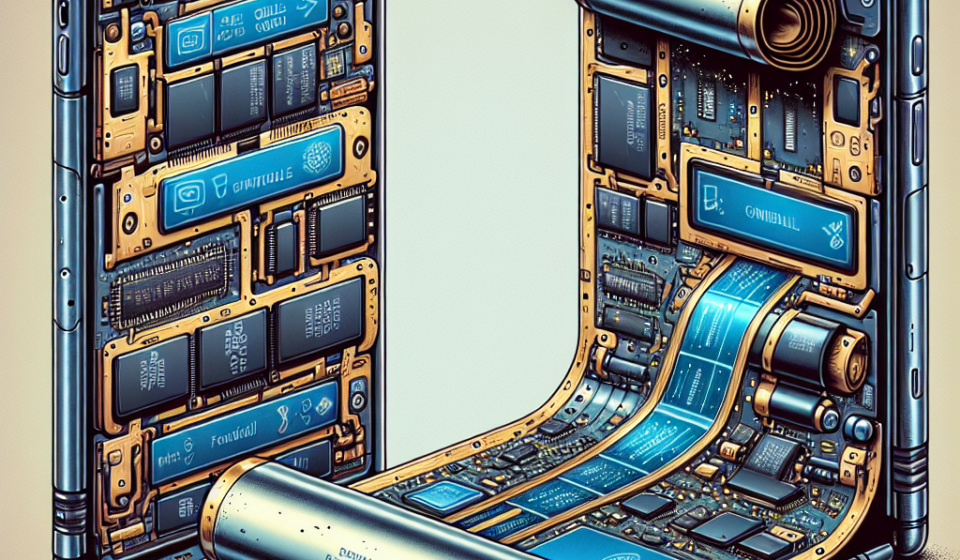

We tend to celebrate the devices that ship. But sometimes the most instructive product is the one that never reached store shelves. The recently surfaced teardown of LG’s rollable phone is one such artifact: a near-production-grade design that exposes not just clever mechanics, but a set of strategic questions every CTO, product leader, and hardware-minded founder should be asking today.
The signal: an internally used LG rollable prototype (work done around 2021) used a motorized roll mechanism, dual motors with a spring-loaded three-arm alignment system, and a secondary rear display created by rolling flexible OLED behind a transparent panel. LG exited the handset business before this could be scaled – leaving a sophisticated concept orphaned but instructive.
What it means for product and platform strategy
1. Prototype value is intellectual capital, not inventory. Even when a product is canceled, the engineering artifacts – mechanical designs, control algorithms, material choices – are reusable knowledge. Organisations that treat prototypes as “throwaway” lose more than sunk cost; they forfeit IP that can reduce time-to-market for future generations or adjacent products.
2. True innovation is co-design, not component substitution. The rollable isn’t just a display innovation; it required mechanical engineering, control software, materials science and new ergonomics. That intersection is where most surprises – both positive and negative – emerge. Enterprises should therefore budget cross-disciplinary spikes early in the roadmap rather than compartmentalizing hardware and software timelines.
3. Shipping ≠ solving durability and serviceability. The teardown shows elegant alignment mechanisms that avoid a fold crease, but mass production shifts the failure modes: repeated cycles, debris ingress, component sourcing, and repairability at scale. This is the classic speed-vs-stability trade-off: a working lab demo is not the same as a product that can be field-serviced across thousands of units in diverse climates.
4. Vendor and ecosystem risk is real. LG’s exit transformed this rollable from “future product” to “lost IP.” Companies building on third-party platforms should actively model “orphaned vendor” scenarios into their risk matrices – how will your product evolve if a key supplier stops shipping? Two practical mitigations: maintain design portability (modular subsystems) and secure documentation/IP transfer clauses during partnerships.
Actionable advice for CTOs and founders
– Treat prototypes as captured knowledge: mandate post-mortem artifacts, CAD/tooling archives, test reports, and control firmware in a searchable corpora so future teams can stand on those shoulders.
– Invest in early durability and field-simulation tests that reflect real-world cycles; these often reveal the majority of systemic failure modes before expensive tooling is built.
– Build abstraction layers in software to tolerate shifting hardware form factors – adaptable UI components, responsive layout engines, and feature-flagged behavior to decouple app logic from physical screen geometry.
– Model supply-chain exit scenarios and include contingency spend for alternate suppliers or reworkable mechanical interfaces.
A practical opportunity for India
There’s a natural bridge to India’s growing electronics and manufacturing ecosystem. As local capability in PCB assembly, display manufacturing, and component sourcing matures under initiatives that support electronics manufacturing, Indian startups and MSMEs can claim a seat in the hardware co-design loop. Instead of trying to perfect a full product vertically, a more pragmatic path is to own one high-value subsystem (e.g., control firmware, mechanical alignment, or modular UI) and partner for the rest – a “specialist node” strategy that reduces capital intensity while preserving strategic IP.
Closing thought
Breakthrough ideas are less about a single shipped SKU and more about the durable knowledge they create. The LG rollable’s real legacy isn’t a retail product; it’s a catalogue of engineering choices, trade-offs and unanswered questions. For leaders building the next platform, the lesson is to design not only for novelty, but for scale, serviceability and the long game of ecosystem resilience.
About the Author
Sanjeev Sarma is the Founder Director of Webx Technologies Private Limited, a leading Technology Consulting firm with over two decades of experience. A seasoned technology strategist and Chief Software Architect, he specializes in Enterprise Software Architecture, Cloud-Native Applications, AI-Driven Platforms, and Mobile-First Solutions. Recognized as a “Technology Hero” by Microsoft for his pioneering work in e-Governance, Sanjeev actively advises state and central technology committees, including the Advisory Board for Software Technology Parks of India (STPI) across multiple Northeast Indian states. He is also the Managing Editor for Mahabahu.com, an international journal. Passionate about fostering innovation, he actively mentors aspiring entrepreneurs and leads transformative digital solutions for enterprises and government sectors from his base in Northeast India.