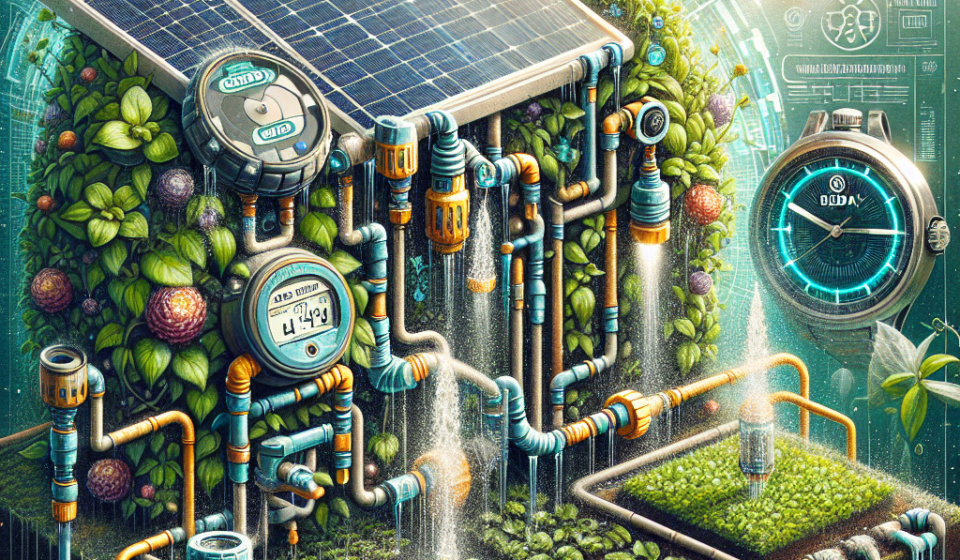

We love neat consumer gadgets because they make complex ideas feel simple. But a cheap solar drip-irrigation kit sold as an impulse buy on Amazon is more than a neat gadget – it’s a compact case study in how frugal IoT, energy resilience, and human-centered design collide when technology moves from hobbyists to real-world impact.
Context (the signal)
I recently came across a consumer-oriented product – a low-cost solar automatic drip irrigation system that combines solar charging with a USB backup, multiple watering modes (timer, manual, humidity-based), and a plug‑and‑play setup aimed at home gardeners. Reviews praise ease of use and water savings; criticisms focus on durability. That contrast – promising capability versus uncertain longevity – is the kernel worth unpacking.
Analysis – what this means for engineers, founders and policy makers
There are three important architectural lessons here that scale far beyond houseplants.
1) Resilience is not a Nice‑to‑Have – it is the Feature
Dual-power designs (solar + USB) are an elegant acknowledgement of real operational constraints: intermittent sun, seasonal variability, and user convenience. For any IoT product targeting semi-offline or rural settings, energy resilience must be a first-class requirement. As architects we should design for the worst‑case availability of power and connectivity, not the best case. That means local decision‑making on the edge (schedulers and threshold triggers that run offline), low-power firmware, and graceful degradation modes.
2) Frugal UX beats Feature Overload
A product that solves one problem reliably will be more impactful than one that promises many features poorly implemented. Timer + humidity + manual modes represent a pragmatic feature set; the problem reviewers highlight – durability and maintenance – reminds us that hardware UX includes replaceability, ease of cleaning, and simple diagnostics. For product teams, the trade-off is clear: invest in a few robust core capabilities and a consumable/repair model rather than packing features users rarely use.
3) Build vs. Buy (and the cost of operational debt)
For enterprises or social ventures planning deployments at scale (community gardens, smallholder farms), the consumer price tag hides operational costs: replacement parts, field support, calibration, secure telemetry and firmware updates, and data management. The decision to buy commodity devices or build a tailored platform must include lifecycle economics, not just upfront unit cost. Often the better path is to adopt a hybrid strategy: leverage commodity hardware for rapid pilots, then standardize on modular, serviceable components for scale.
Operational and governance considerations
– Security & data: Many low-cost devices ship with minimal security. Enterprises must insist on secure boot, encrypted telemetry, and ownership of data flows if analytics or advisory services are offered.
– Interoperability: Open protocols (MQTT, CoAP) and well‑documented APIs avoid vendor lock-in and simplify integration with farm-management platforms.
– Support model: Design for local serviceability – replaceable pumps, simple tubing, community technicians – especially where logistics are slow.
Relevance to Indian and Northeast contexts
This class of product aligns naturally with realities in many parts of India, including the Northeast: intermittent grid power, dispersed smallholdings, and the need for low-cost, low-maintenance solutions. Offline-first logic, solar resilience, and a service network of local MSMEs or SHGs (self-help groups) can turn a consumer gadget into a sustainable local offering. Frugal hardware + local assembly + training = higher adoption and longer device lifetimes.
Practical next steps for CTOs and founders
– In pilots, measure total cost of ownership (replacement rate, support calls, failure modes) not just purchase price.
– Require edge autonomy: devices must execute core functions offline for days.
– Specify modular, repairable hardware and a clear consumables supply chain.
– Lock down security and data ownership in procurement contracts.
– Partner with local service providers for last‑mile maintenance and user education.
Closing thought
Affordable automation is not about novelty – it’s an entry point. How we design for resilience, serviceability and governance determines whether a gadget becomes a disposable toy or a durable enabler of productivity and sustainability.
About the Author
Sanjeev Sarma is the Founder Director of Webx Technologies Private Limited, a leading Technology Consulting firm with over two decades of experience. A seasoned technology strategist and Chief Software Architect, he specializes in Enterprise Software Architecture, Cloud‑Native Applications, AI‑Driven Platforms, and Mobile‑First Solutions. Recognized as a “Technology Hero” by Microsoft for his pioneering work in e‑Governance, Sanjeev actively advises state and central technology committees, including the Advisory Board for Software Technology Parks of India (STPI) across multiple Northeast Indian states. He is also the Managing Editor for Mahabahu.com, an international journal. Passionate about fostering innovation, he actively mentors aspiring entrepreneurs and leads transformative digital solutions for enterprises and government sectors from his base in Northeast India.