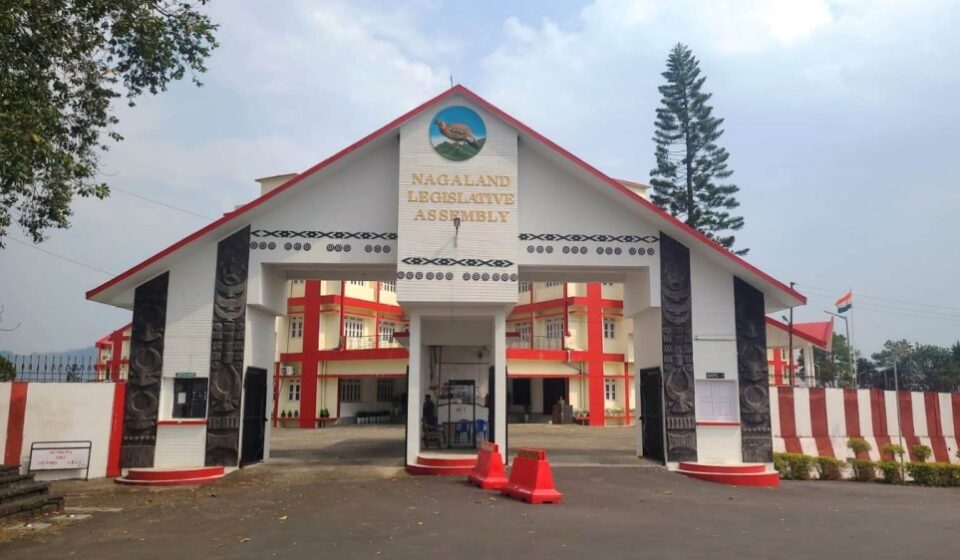

The Nagaland Legislative Assembly on March 27, 2026, deferred consideration and passage of the Frontier Nagaland Territorial Authority (FNTA) Bill, 2026, after a request from the Union government and an appeal by the Eastern Nagaland Peoples’ Organisation (ENPO). The Bill had been introduced by Deputy Chief Minister Y. Patton on March 26 and was scheduled for passage on March 27, but Chief Minister and Leader of the House Dr. Neiphiu Rio, supported by Parliamentary Affairs Minister K.G. Kenye, asked the House to refer the measure back to the state government for further examination.
NLA Speaker Sharingain Longkumer, exercising powers under Rule 93(B) read with Rule 313, formally referred the Bill to the state government following a communication from Minister Kenye that cited a letter from the Eastern Nagaland Legislators’ Union (ENLU). The ENLU flagged several provisions missing from the Bill when compared with the Memorandum of Agreement (MoA) signed on February 5, 2026, in New Delhi, between the Centre, the state government and ENPO, and described some discrepancies as “contentious issues” requiring reconsideration.
Dr. Rio told the Assembly the referral was prompted by the Centre’s request — a signatory to the MoA — and by the need to ensure that the MoA’s provisions are implemented in a legally sound and constitutionally tenable way. He stressed the state government’s ongoing consultations with the Ministry of Home Affairs and said the administration seeks equity and inclusiveness for all sections of the population while addressing historical developmental deficits in eastern Nagaland.
Under the MoA, the proposed Frontier Nagaland Territory (FNT) would cover six eastern districts — Tuensang, Mon, Longleng, Kiphire, Noklak and Shamator — and would function as a “unique self‑governing authority” to meet the region’s social, economic, educational, cultural and linguistic aspirations through democratic, decentralised regional governance. Dr. Rio said the State would allocate funds to the FNTA based on population and area, while the Centre would provide special development grants under its schemes; the FNTA would prepare its own annual plan, identify projects in consultation with the State, and set up its own planning and financing arrangements.
Rio outlined the drafting timeline and legal hurdles: the state began preparing the Bill after the MoA was signed on February 5, 2026; the Cabinet reviewed a draft on February 26 when the Advocate General advised that conferring legislative power on the FNTA by state law may not be constitutionally permissible. A revised draft was sent to the Centre on March 17 after further vetting. Rio also said he spoke with the Union Home Secretary on March 16 and that ENPO representatives had urged passage before the Central Executive Committee meeting scheduled for March 30, citing that “49 days has left.”
The Speaker said the Bill will be taken up in the “next earliest emergent session.” The referral pauses the legislative process and highlights unresolved legal questions over the conferral of legislative authority to the proposed FNTA, even as political leaders and stakeholders continue consultations.
Original Source: https://www.morungexpress.com/nagaland-assembly-defers-fnta-bill-2026
Category: Nagaland
Tags:
Publish Date: 2026-03-27 23:02:00