Discover the Astonishing Four: New Ancient Marine Snail Species Unearthed in Dwarka Basin Fossils!

A team of geologists has unveiled four new species of ancient marine snails, dating back approximately 20 million years, along the western coast of India. These fossils were discovered in the Dwarka Basin of the Kathiawar Peninsula in Gujarat, providing a glimpse into a time when the region was immersed in a warm, nutrient-rich shallow sea. The research was conducted by a collaborative team from the Indian Institute of Technology (IIT) Bombay, the Indian Statistical Institute, and the Indian Institutes of Science Education and Research (IISER) Kolkata.
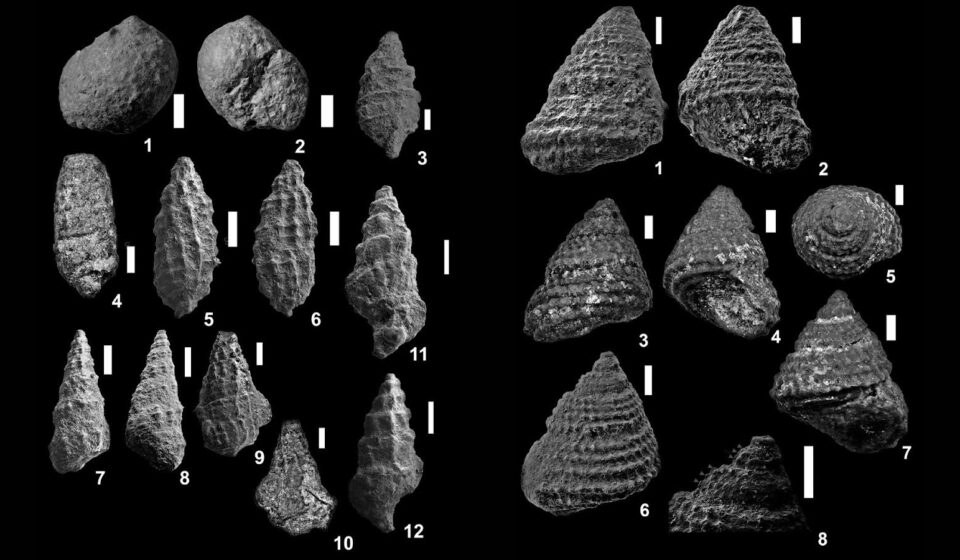
To uncover these diminutive fossils, many measuring less than five millimeters in length, the researchers meticulously sifted through bulk samples of ancient rock using fine mesh sieves. The remaining micro-fossils were then examined under high-powered scanning electron microscopes to ensure accurate identification. Among their significant finds is a new species of top-shaped snail named Jujubinus dwarkaensis, honoring the ancient coastal city of Dwarka where the fossils were located. Compared to its closest known ancient relative, Jujubinus keralaensis, discovered further south in India, J. dwarkaensis is notable for its unique shell surface. Unlike the southern relative, which features simple spiral lines and a distinct opening at the base of its shell, known as an umbilicus, the Dwarka snail presents a striking beaded pattern of intersecting vertical and horizontal ribs.
Another remarkable discovery is Cerithium bardhani, a slender, cone-like snail distinguished by its fifteen vertical ribs intercrossed with four spiral ribs, creating tiny, recognizable bumps. This unique texture sets it apart from similar species, including Cerithium deningeri from Indonesia, which does not possess these nodules. Named in honor of the late esteemed Indian palaeontologist Professor Subhendu Bardhan, C. bardhani highlights the team’s dedication to commemorating significant figures in the field. Additionally, two more new species were identified: Nassarius anisi, named after prominent Indian paleontologist Professor Anis Kumar Ray, and Clelandella saurashtraensis, which honors the Saurashtra peninsula itself.
The tiny shells discovered are part of what scientists refer to as a turritelline-dominated assemblage, a substantial collection of fossilized snails that ruled the ocean floor during the early Miocene epoch, approximately 25 to 5 million years ago. The discovery of such a dense and diverse collection of marine life provides geologists with vital insights into ancient climate conditions. Importantly, these filter-feeding snails thrive exclusively in highly productive waters, indicating that the ancient Dwarka coastline experienced significant ocean upwelling. This phenomenon occurs when deep, cold, nutrient-rich water rises to the sunlit surface, fueling the ecosystem.
Ultimately, these microscopic time capsules serve a purpose beyond mere analysis; they help map the shifting climate and ocean currents across Earth’s history, revealing how marine ecosystems adapted to global warming long before human influence. The implications of these findings are profound, illustrating the intricate relationship between geology and climate that continues to evolve. As researchers continue to study these remarkable discoveries, they unlock secrets about our planet’s past that can inform present and future environmental challenges.
Tags: marine snails, paleontology, climate change, ancient fossils, India, geoscience, ocean ecology, Miocene epoch
Original Source: https://researchmatters.in/news/four-new-species-ancient-marine-snails-identified-while-sifting-through-fossils-dwarka-basin
Category :
Tags:
Publish Date: 2026-03-24 10:00:00