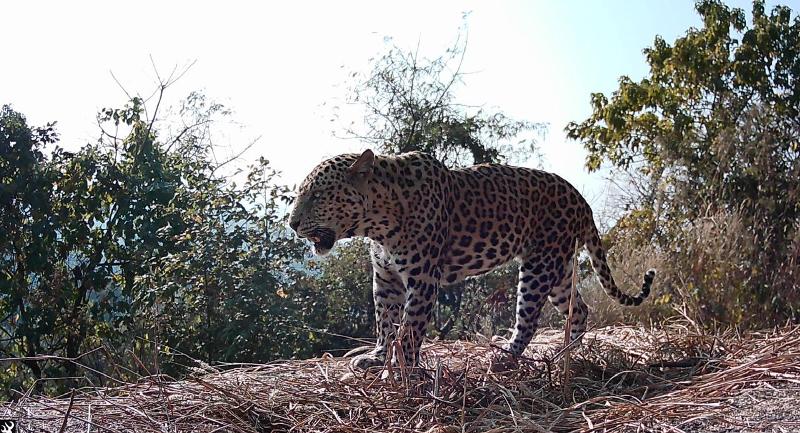

A camera-trap study by the Assam Forest Department has found at least 34 leopards living within Guwahati, underscoring the city as an important urban habitat for big cats. Conducted under the Assam Project on Forest and Biodiversity Conservation (Phase II), the survey was led by Project Director Anurag Singh, IFS, and implemented by Conservator of Forests Sunnydeo Choudhary, IFS, with wildlife biologist Kamal Azad playing a key role. Using camera-trap detections combined with statistical modelling, the research team estimates that the true leopard population in Guwahati may be as high as about 55 animals, suggesting many individuals remain undetected in the city’s fragmented green spaces.
The study shows leopards are not confined to isolated forest patches but move across a mosaic of habitats inside and around the city, including hill forests, reserve forests, wetlands and even tea gardens. Areas around Amchang Wildlife Sanctuary and adjacent hill systems emerged as critical refuges that help sustain the population amid rapid urban growth. Despite living close to people, the animals are mostly unseen: camera data indicate strong nocturnal behaviour, with peak activity between 10 pm and 2 am, likely an adaptation to avoid human contact.
Researchers observed leopards navigating forest corridors, resting on rocky hill slopes and using water sources shared with nearby communities. The survey also documented instances of urban prey use-one camera captured a leopard carrying a street dog-signalling shifting feeding patterns that could increase human-wildlife interactions. Beyond leopards, the study recorded over 25 wildlife species, including elephants, clouded leopards, pangolins and several primate species, highlighting the biodiversity that persists within Guwahati’s shrinking natural landscapes.
The findings raise urgent conservation concerns. Rapid urbanisation, encroachment, hill cutting and habitat fragmentation are pushing wildlife closer to settlements and degrading some areas; the study reported no leopard detections in zones such as Garbhanga and Rani, pointing to localized habitat loss. Maintaining connectivity between refuges and controlling destructive development will be crucial to preserve both leopards and the wider urban wildlife community.
The research frames Guwahati not only as a growing human metropolis but also as a leopard landscape, and it underscores the challenge ahead: balancing the city’s expansion with measures that allow people and one of India’s most adaptable big cats to coexist.
Original Source: https://nenow.in/north-east-news/assam/guwahati-leopard-population-study-captures-34-big-cats-estimates-total-at-55.html
Category: Assam,Environment,Northeast News,Top News
Tags:
Publish Date: 2026-03-18 00:29:00