Breaking: Loud Explosions Rock Dubai as UAE Central Bank Unleashes Resilience Package – Stay Informed!

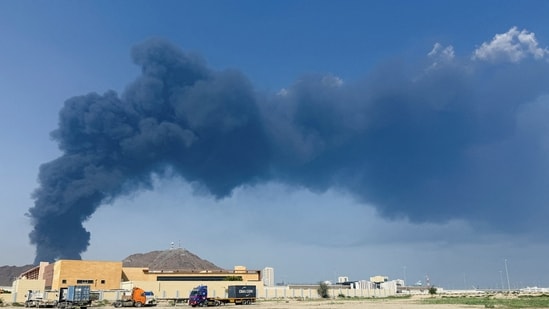
Smoke plumed from the Fujairah Oil Industry Zone in the United Arab Emirates following a drone strike linked to ongoing tensions in the region, exacerbated by the US-Israel conflict with Iran. According to local reports, the attack triggered a substantial fire, although fortunately, no injuries have been reported. This incident marks the third attack on the Fujairah port in just four days, leading to disruptions in oil loading operations at a facility typically responsible for exporting over one million barrels of Murban crude daily.
The UAE’s Ministry of Defence has confirmed that the country’s air defence systems are actively engaging Iranian missile and drone threats. Sounds of explosions reportedly heard across the nation stem from these interceptive actions, confirming that military personnel are responding rigorously to incoming threats. As a precaution, the General Civil Aviation Authority (GCAA) briefly closed the UAE’s airspace to ensure flight safety before reopening it shortly thereafter.
In a broader context, Gulf Arab nations have expressed a strong desire for the United States to sustain its military efforts against Iran. As Iran continues missile and drone strikes targeting energy facilities, including those in the UAE, economic strains are becoming more pronounced. The region’s oil exports have plummeted by at least 60% in recent weeks, leading to a sharp increase in crude prices to their highest levels in four years.
Despite the turmoil, the UAE remains a pivotal hub for oil transportation, particularly because it operates outside the heavily monitored Strait of Hormuz, which has been increasingly contested. Iran’s capacity to disrupt commercial aviation and target energy sites enhances the strain on UAE’s economy, further complicating the security landscape in a region already fraught with geopolitical tensions.
As tensions escalated, Iranian authorities confirmed retaliatory attacks across the Gulf. Recent reports indicate that the UAE’s air defence system intercepted numerous missiles and drones, with numbers surpassing 300 since hostilities began. Alongside these developments, incidents of falling debris due to missile interceptions have tragically resulted in casualties in the UAE and injuries to personnel in Kuwait.
In a recent high-level dialogue, Indian Prime Minister Narendra Modi discussed the situation with UAE President Sheikh Mohamed bin Zayed, reiterating India’s condemnation of attacks affecting civilian lives and infrastructure in the UAE. The geopolitical implications were underscored by a statement from US President Donald Trump, expressing disappointment with NATO and highlighting support from regional allies such as Saudi Arabia and Qatar in confronting Iranian threats.
As the situation unfolds, air traffic in the UAE has returned to normal after earlier disruptions stemming from security threats. However, the ongoing conflict has prompted Korean Air and other international carriers to extend flight suspensions due to safety concerns, reflecting the broader impact on regional travel and commerce.
The UAE continues to navigate these tumultuous waters while balancing its strategic partnerships and safeguarding economic interests in a volatile geopolitical climate.
Original Source: https://www.hindustantimes.com/world-news/dubai-abu-dhabi-news-live-updates-fujairah-uae-airports-saudi-qatar-missiles-drone-strikes-iran-us-war-flights-101773708972764.html
Category :
Tags:
Publish Date: 2026-03-18 04:39:00