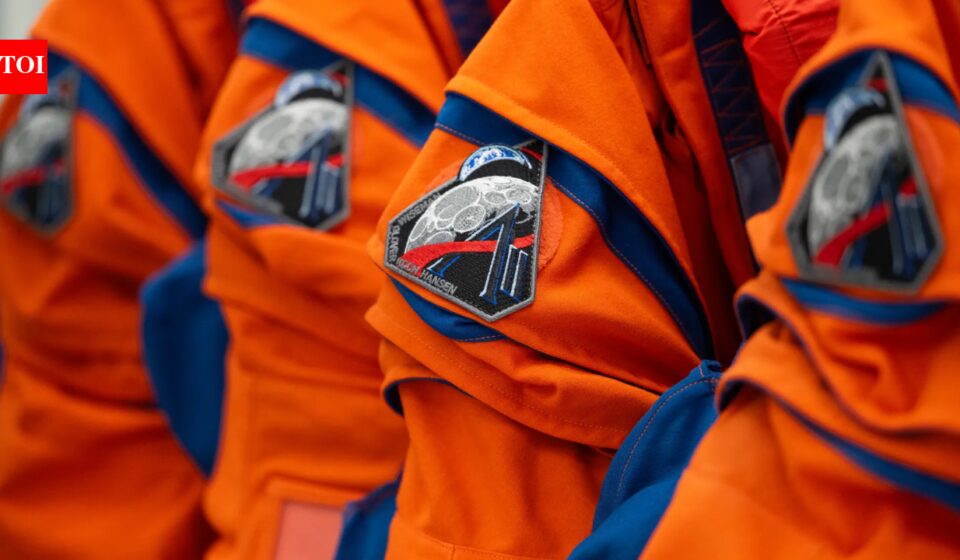

NASA’s Artemis II will carry four astronauts on a planned no-earlier-than-April 2026, 10-day test flight that will send the Orion spacecraft on a crewed loop around the Moon-the first time humans ride Orion since Apollo 17 more than 50 years ago. The mission, launching from Kennedy Space Center’s Launch Pad 39B on a Space Launch System (SLS) rocket, will test critical systems and procedures needed for future Moon and Mars missions. The crew includes NASA’s Reid Wiseman, Victor Glover and Christina Koch, and Canadian Space Agency astronaut Jeremy Hansen.
The mission begins with an eight-minute SLS ascent into orbit. After Orion separates from the rocket’s interim cryogenic propulsion stage (ICPS), the crew will run systems checks in high Earth orbit, verifying potable water, waste and carbon-dioxide removal systems and shedding their launch suits for comfort. A planned proximity operations demonstration will see Orion approach the repurposed ICPS as a docking target, validating procedures for future rendezvous and docking scenarios.
Crew sleep and a series of engine firings follow as teams prepare for the translunar injection (TLI) burn that sends Orion toward the Moon. At the orbit’s farthest point, crews will test communications with NASA’s Deep Space Network-a global array of antennas that maintains contact with spacecraft. NASA’s schedule notes the astronauts will have roughly 23 hours early in the flight for a detailed checkout of Orion’s systems while still relatively close to Earth.
On flight days two through five, astronauts will perform onboard workouts and life-support stress tests ahead of the TLI burn, which is powered by the European Service Module and produces about 6,000 pounds of thrust. That burn will place Orion on a free-return trajectory around the Moon. The crew will conduct trajectory correction burns, practice medical procedures like CPR in microgravity, and test medical kits and emergency communications.
Day-to-day activities include lunar observation training, geography targeting and space photography. By flight day five Orion will enter the Moon’s gravitational sphere of influence and carry out spacesuit demonstrations-donning, pressurization checks and trials of helmet-port feeding intended for emergency use over extended periods.
The mission’s closest approach to the Moon occurs on flight day six, roughly 4,000 to 6,000 miles from the lunar surface, with a 30–50 minute pass behind the Moon that will block Earth contact and give the crew a chance to photograph and video lunar features. Mission planners say Orion could approach distances that rival records set during Apollo-era flights.
Following the flyby, the crew will execute return trajectory corrections, demonstrate radiation-shelter procedures and practice piloting and attitude-control tasks. Final preparations on day nine focus on reentry studies, waste backups and fittings to counter post‑landing dizziness. On day ten Orion will separate from its service module, endure roughly 3,000°F during atmospheric entry, deploy parachutes and splash down in the Pacific for recovery by NASA and U.S. Navy teams. In a January 2026 news conference, mission official John Honeycutt emphasized, “Safety is to be number one,” underscoring the mission’s priority of risk-managed testing as Artemis paves the way for future deep-space exploration.
Original Source: https://timesofindia.indiatimes.com/science/nasa-reveals-how-artemis-ii-astronauts-will-live-work-and-fly-around-the-moon-during-the-10-day-mission/articleshow/129594301.cms
Category:
Tags:
Publish Date: 2026-03-16 02:30:00