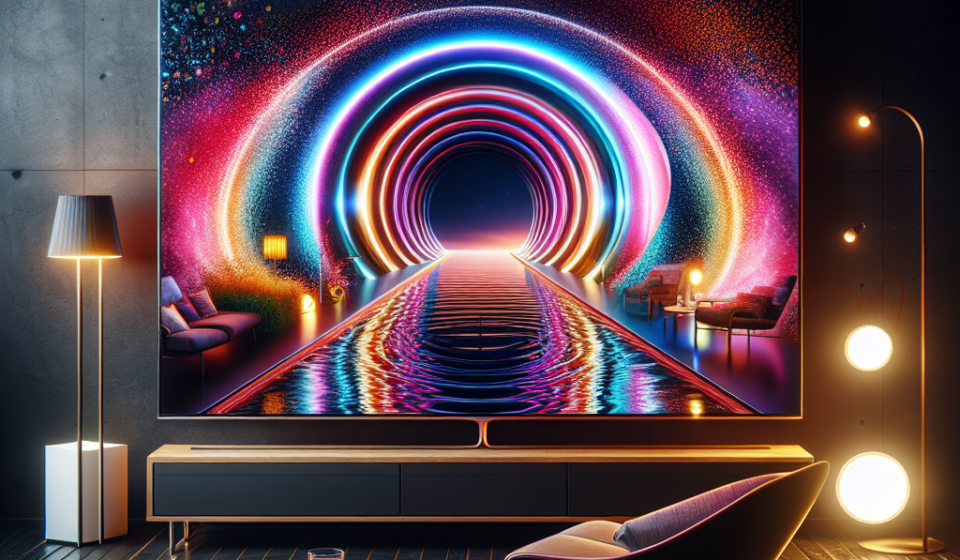

We obsess over pixels and frame rates – and yet one of the most effective ways to deepen a user’s engagement with video is not inside the display at all, but around it. Ambient technologies that extend the screen into the room are quietly shifting the interaction model from isolated consumption to context-aware experience. That shift has implications that matter to architects, product leaders and platform builders.
The signal: I recently came across a consumer product example – a camera-driven TV backlighting system that matches on-screen colors in real time, offers audio sync modes, Alexa integration, and the ability to expand the lighting ecosystem through a vendor app. It’s marketed as an immersion enhancer for movies, gaming and music, and it trades on accurate color matching and low setup friction.
Why this matters beyond home entertainment
At first glance this is a lifestyle accessory. Look closer and you see a compact case study in how sensing, local processing, cloud services and third-party integrations combine to create perceived product value. A camera + light strips + mobile/cloud control is a small, visible architecture: sensors at the edge collect high-bandwidth, noisy data (video + audio), immediate decisions require low-latency processing (color matching, audio-reactive patterns), and user mode/configuration and voice control live in the cloud and platform ecosystems.
Trade-offs and architectural lessons
– Privacy vs. capability: Cameras provide superior color matching compared with screen-capture approaches, but they introduce privacy and trust concerns. For any product combining cameras and microphones, the architecture must prefer local-first processing, clear opt-in flows, and minimal telemetry. As architects we should force the question: can the same UX be achieved with on-device capture and ephemeral processing rather than sending raw frames to the cloud?
– Edge compute matters: Real-time synchronization requires processing near the source. Systems that rely heavily on cloud loops for tight feedback introduce latency and fragile UX under poor connectivity. Design for graceful degradation: local illumination modes, offline profiles, and cached scenes.
– Interoperability and lock-in: Proprietary apps and ecosystems scale fast, but they also lock users in. For long-term product viability, support for open smart-home standards and well-documented APIs reduces integration pain for partners and enterprise reuse scenarios (digital signage, experiential retail).
– Security & update posture: Any device with cameras, microphones and network access must have a lifecycle plan: secure boot, signed firmware, timely OTA updates, vulnerability disclosure channels, and a clear deprecation policy. Technical debt here becomes literal consumer risk.
– Energy and sustainability: Additive ambient tech increases power draw and e-waste. Designers should optimize for low-power standby, modular replaceability, and minimal packaging – design choices that resonate with conscious consumers and regulators alike.
Actionable guidance for CTOs and founders
– Pilot before you buy: If adding ambient hardware to your product roadmap, run a small, instrumented pilot focusing on privacy, latency and UX degradation under poor connectivity.
– Insist on local-first modes: Require vendors to provide an on-device processing option or at least ensure sensitive frames are never uploaded in raw form.
– Demand open APIs and standards support: Prefer partners who offer SDKs and document data flows; this reduces integration time and future-proofs the platform.
– Build for graceful degradation: Define acceptable UX under “offline” and “low-bandwidth” conditions – don’t make features hinge on perfect connectivity.
– Factor lifecycle costs into TCO: Firmware maintenance, security patches and customer support often exceed the hardware margin. Account for those in contracting and procurement.
Final thought
Small, ambient technologies like smart backlighting are deceptively simple – they reveal how a handful of components and careful integration can change user perception dramatically. For architects and product leaders the lesson is clear: the next wave of differentiation will come from how systems extend into context, not merely from what happens inside the screen.
Takeaways
– Prioritize privacy and local processing when sensing is involved.
– Design edge-first for low-latency immersive experiences.
– Favor open integrations to avoid vendor lock-in.
– Include long-term maintenance and security in procurement decisions.
– Measure real-world UX across connectivity and power conditions.
About the Author Sanjeev Sarma is the Founder Director of Webx Technologies Private Limited, a leading Technology Consulting firm with over two decades of experience. A seasoned technology strategist and Chief Software Architect, he specializes in Enterprise Software Architecture, Cloud-Native Applications, AI-Driven Platforms, and Mobile-First Solutions. Recognized as a “Technology Hero” by Microsoft for his pioneering work in e-Governance, Sanjeev actively advises state and central technology committees, including the Advisory Board for Software Technology Parks of India (STPI) across multiple Northeast Indian states. He is also the Managing Editor for Mahabahu.com, an international journal. Passionate about fostering innovation, he actively mentors aspiring entrepreneurs and leads transformative digital solutions for enterprises and government sectors from his base in Northeast India.