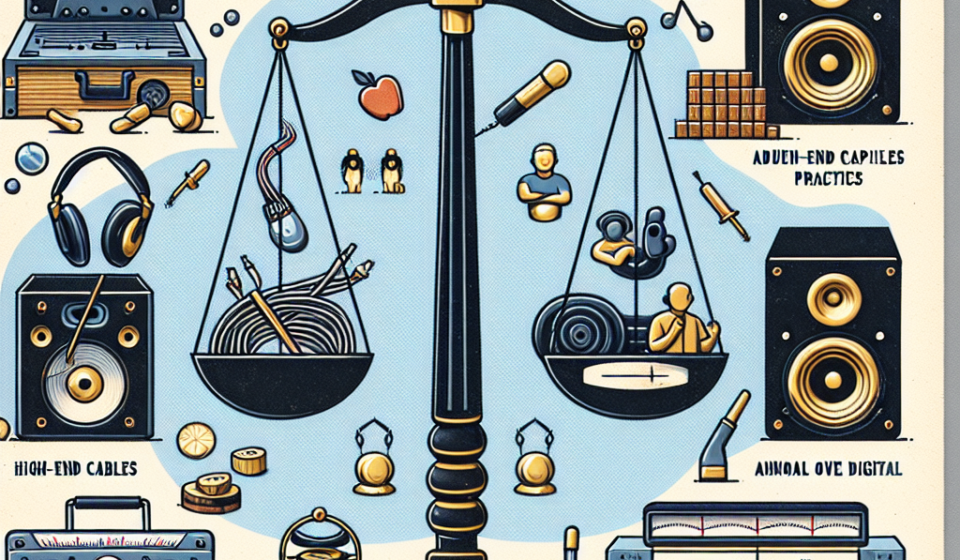

We obsess over glossy upgrades – whether for audio systems or enterprise stacks – and too often confuse price, size, or novelty with value. That instinct fuels many costly mistakes: buying the “biggest” server, the “most expensive” integration middleware, or the “latest” AI appliance without first validating fit. I recently read a short piece that catalogued common audiophile myths – premium cables, bigger speakers, burn‑in, analog vs digital, and the idea that price alone guarantees quality – and it crystallized a familiar pattern I’ve seen in software architecture and product decisions.
The signal: the article called out five widely held but shaky beliefs about audio gear and showed how perception, context, and measurement shape outcomes more than marketing or price. It’s a neat reminder that technology choices should be judged by deployment realities, not by aspirational claims.
Three architectural lessons from a handful of audiophile myths
1) Interfaces and connectors matter – but only to the point of adequacy.
The premium‑cable myth maps directly to vendor and integration fantasies. A flashy ESB, an over‑engineered API gateway, or an exotic proprietary connector rarely buys you business value if a simple, well‑tested integration will do. Spend on robustness where the system is fragile: observability, graceful failure, and secure authentication. Before upgrading, prove the deficiency with data (latency, error rates, bandwidth saturation) rather than marketing slides.
Actionable trade‑off: Measure first, then spend. Replace or upgrade only the components that show measurable impact on SLAs or user experience.
2) “Bigger” does not equal “better” – fit the solution to the environment.
Larger speakers boom in small rooms; similarly, massive monoliths, oversized clusters, or hardware‑heavy appliances can create more operational overhead than performance benefit. Right‑sizing reduces cost, complexity and technical debt. Consider workload profiles, concurrency patterns, and the physical constraints of your deployment (network, power, cooling, or intermittent connectivity).
Actionable trade‑off: Favor modular, capacity‑scaled approaches and autoscaling policies that match real traffic patterns.
3) Human perception and confirmation bias influence tech evaluation.
The burn‑in myth – that equipment “improves” because you get used to it – is a cautionary tale about subjective evaluation. Teams often declare an upgrade successful because users “feel” better, not because metrics improved. Build objective A/B tests, define success criteria up front, and guard against confirmation bias when you collect feedback.
Actionable trade‑off: Combine quantitative telemetry (latency, error budget, throughput) with qualitative feedback, and weight decisions toward the former for systemic changes.
A brief note for product teams in India and Northeast contexts
In resource‑constrained environments – common across many Indian states and the Northeast – the wrong interpretation of “premium” or “bigger” can be particularly costly. Frugal engineering and context‑aware design are not merely cost optimization exercises; they’re enablers of resilience. Offline‑first mobile apps, lightweight edge compute, and predictable, maintainable integrations often outperform “high end” alternatives that require heavy Ops investment.
Strategic takeaways for CTOs and Founders
– Test before you buy: benchmark and A/B where possible.
– Prioritize simplicity: observability and automated recovery yield higher ROI than marginal hardware upgrades.
– Right‑size to context: match capacity to real demand, not vendor pitchbooks.
– Institutionalize objective evaluation: define metrics before rollout and measure post‑deployment.
– Remember human factors: training, UX, and perceptual bias shape adoption as much as technical improvements.
Closing thought
Technical elegance without contextual humility is just expensive decoration. The better question isn’t “Can we buy something that’s bigger or pricier?” but “Does this solve a measurable problem in our environment – sustainably and with the least operational friction?”
About the Author Sanjeev Sarma is the Founder Director of Webx Technologies Private Limited, a leading Technology Consulting firm with over two decades of experience. A seasoned technology strategist and Chief Software Architect, he specializes in Enterprise Software Architecture, Cloud-Native Applications, AI-Driven Platforms, and Mobile-First Solutions. Recognized as a “Technology Hero” by Microsoft for his pioneering work in e-Governance, Sanjeev actively advises state and central technology committees, including the Advisory Board for Software Technology Parks of India (STPI) across multiple Northeast Indian states. He is also the Managing Editor for Mahabahu.com, an international journal. Passionate about fostering innovation, he actively mentors aspiring entrepreneurs and leads transformative digital solutions for enterprises and government sectors from his base in Northeast India.