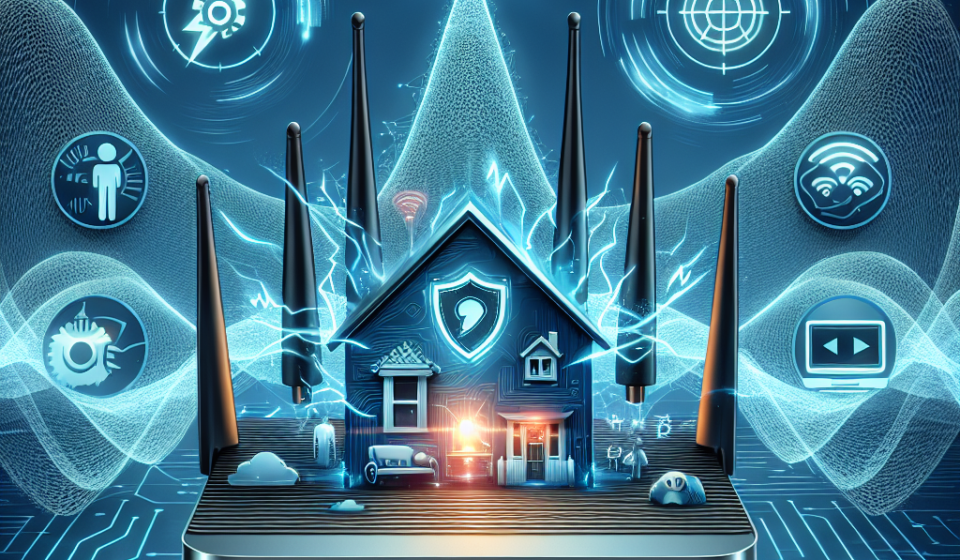

We obsess about last-mile speeds and fibre rollouts – and rightly so – but we often overlook the single most ubiquitous piece of edge infrastructure sitting in millions of homes and small offices: the Wi‑Fi router. That modest box is not simply a gateway; configured thoughtfully, it becomes a privacy appliance, a local cloud, an access-control plane and an edge security policy enforcer.
Context
A recent consumer piece highlighted five practical uses for modern home routers – shared network storage, printer sharing, an isolated guest network for IoT devices, router-hosted VPNs, and built-in parental controls. These are not gimmicks; they point to how much capability has been pushed to the network edge in recent years.
Analysis – why this matters for architects and technology leaders
1) Edge compute and local storage change the data gravity conversation.
Allowing an external drive to act as a local NAS through your router makes “private cloud” workflows accessible to households and micro‑businesses. Strategically, that’s important: local storage reduces dependence on third‑party cloud providers, improves latency for media serving and offline-first workflows, and preserves data locality – a growing concern for enterprises thinking about sovereignty and compliance. But it also creates operational debt: NAS attached to a consumer router is fragile unless you plan for backups, power protection, and firmware maintenance.
2) Peripheral sharing is a small productivity win with hidden costs.
Printer sharing via a router can simplify collaboration for small offices or home entrepreneurs. From an enterprise lens, however, every shared peripheral expands the attack surface and complicates driver and policy management. For distributed teams I advise combining simple network sharing with centralized management policies (secure print queues, authentication) to avoid ad hoc, insecure setups.
3) Network segmentation at home is a microcosm of Zero Trust.
Creating a guest SSID for IoT devices is not just convenience – it’s an elementary Zero Trust pattern: isolate untrusted endpoints from sensitive resources. Architects should treat home networks of remote employees like edge domains: require segmentation, limit lateral movement, and apply least privilege for device access. Teaching employees to create an IoT guest network reduces the chance of an innocuous smart bulb becoming a pivot point into corporate assets.
4) Self‑hosted VPNs illustrate the build vs. buy trade‑off.
Router‑level VPNs (WireGuard/OpenVPN support, or via custom firmware) let households and small teams reclaim privacy and circumvent device‑count limits imposed by commercial VPNs. But self‑hosting moves responsibility for key management, software updates and logging onto the owner. For organisations supporting remote workforces, it’s tempting to recommend everyone self‑host a VPN; a far better pattern is to standardize on centrally managed remote access – either a company router appliance, a SASE service, or an approved, patched router image – and avoid ad hoc, unsupported configurations.
5) Parental controls: policy meets UX.
Built‑in parental controls are a useful baseline, but they are not a substitute for education or endpoint controls. They show how policy enforcement is moving to the edge – a useful reminder for architects that enforcement points must be convenient, auditable and aligned to human behaviour.
Localization – why this matters in India (including the Northeast)
In India many households and micro‑enterprises use ISP‑provided or older routers. That creates both risk and opportunity: risk from default credentials and infrequent patches; opportunity to extend digital services affordably. In resource‑constrained settings, repurposing older routers as extenders or local NAS can be a pragmatic frugal innovation, but it should be paired with simple hygiene: change defaults, apply updates, and segment networks.
Practical takeaways for CTOs and founders
– Treat the home router as an extension of your perimeter: publish minimal configuration baselines for remote employees.
– Encourage segmentation – separate IoT and personal devices from work assets.
– Prefer centrally managed remote access (SASE/VPN appliances) over many self‑hosted consumer VPNs.
– Build simple runbooks for end users: password hygiene, firmware updates, and backup practices for any NAS attached to a router.
– For SMEs, consider managed edge appliances rather than ad hoc consumer configurations.
Closing thought
The router is a humble piece of infrastructure whose strategic value is often underestimated. As responsibility continues to shift to the edge, architects who design with the humble home router in mind will win on resilience, privacy and cost.
About the Author Sanjeev Sarma is the Founder Director of Webx Technologies Private Limited, a leading Technology Consulting firm with over two decades of experience. A seasoned technology strategist and Chief Software Architect, he specializes in Enterprise Software Architecture, Cloud-Native Applications, AI-Driven Platforms, and Mobile-First Solutions. Recognized as a “Technology Hero” by Microsoft for his pioneering work in e-Governance, Sanjeev actively advises state and central technology committees, including the Advisory Board for Software Technology Parks of India (STPI) across multiple Northeast Indian states. He is also the Managing Editor for Mahabahu.com, an international journal. Passionate about fostering innovation, he actively mentors aspiring entrepreneurs and leads transformative digital solutions for enterprises and government sectors from his base in Northeast India.