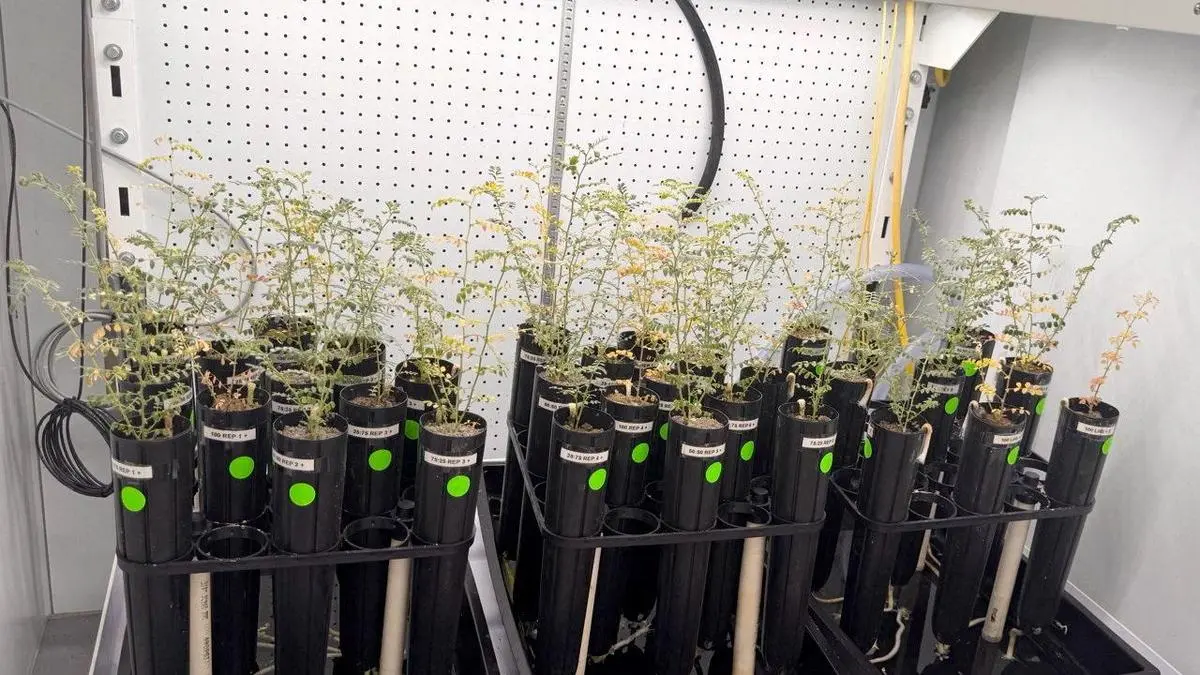
Revolutionary Breakthrough: Scientists Cultivate Chickpeas in Simulated Moon Soil for Future Lunar Missions!

Chickpeas cultivated in a soil mixture that includes simulated lunar soil represent a significant advancement in extraterrestrial agriculture, potentially paving the way for astronauts to grow their own food on the Moon. This groundbreaking research, conducted at Texas A&M University, utilized a soil mixture composed predominantly of “moon dirt,” modeled after lunar samples collected during NASA’s Apollo missions over 50 years ago.
In a controlled environment, researchers successfully grew a variety of chickpeas known as “Myles.” The seeds were enhanced with beneficial fungi and planted in a blend of simulated lunar soil, created by Space Resource Technologies, along with nutrient-rich vermicompost produced from earthworm decomposition of organic matter. The mixtures contained up to 75% lunar simulant, although as the proportion of moon soil increased, the yield of harvestable chickpeas diminished, despite the size of the chickpeas remaining stable. Seeds planted solely in lunar simulant did not flower or produce seeds, indicating the challenges of growing crops in such conditions.
With astronauts from the United States and China planning lunar missions in the coming years, developing sustainable food sources will be critical. “Chickpeas are high in protein and other essential nutrients, making them ideal candidates for space cultivation,” explained Jessica Atkin, a doctoral candidate at Texas A&M and the lead author of the research published in Scientific Reports. Establishing local food production is essential for supporting personnel at moon bases, as transporting all food from Earth is impractical and costly.
The study emphasizes the importance of cultivating crops on extraterrestrial bodies, as it aims to reduce dependence on Earth for vital supplies. “In our pursuit of establishing a lunar presence-possibly on Mars-we must learn to grow food in these environments, given the expenses and logistical hurdles associated with space transport,” stated co-author Sara Oliveira Santos, a postdoctoral researcher at the University of Texas Institute for Geophysics. Plants could also contribute to life-support systems by producing oxygen, enhancing the feasibility of human settlements beyond Earth.
Lunar soil, essentially crushed rock and dust formed over millions of years by meteorite impacts, lacks the organic elements found in Earth soil, making it inhospitable for conventional agriculture. Yet, prior studies have indicated that plants can germinate in lunar samples or regolith simulants, particularly when combined with organic matter. This study’s novel approach focused on enhancing soil conditions through microbial partnerships, aiming to improve regolith’s structure and reduce plant stress.
As for the taste of these lunar-grown chickpeas? That remains undisclosed for now. Atkin noted, “The chickpeas are under examination for metal accumulation, which is why they haven’t been tested for consumption yet.” Preliminary results suggest the lunar regolith and simulant contain elevated levels of metals like aluminum and iron. While iron is a crucial nutrient, aluminum poses potential toxicity.
Before any plans for “moon hummus” can commence, researchers need to validate the safety and nutritional value of the crops. This data is anticipated to be published later this year. The fungi applied to the seeds fostered a symbiotic relationship, enhancing nutrient absorption while minimizing heavy metal intake. Remarkably, these microorganisms thrived even in pure regolith simulant, helping restructure soil particles to mimic Earth’s soil properties.
In a lighthearted twist, Atkin even played lunar-themed music to inspire the plants during growth trials. “It may seem silly, but it provides motivation,” she remarked. Oliveira Santos encapsulated the significance of their work by stating, “This is a small first step toward growing crops on the moon, but we have demonstrated that it is feasible, and we are progressing in the right direction.”
Published on March 6, 2026.
Original Source: https://www.thehindubusinessline.com/news/science/scientists-grow-chickpeas-in-simulated-moon-soil-for-future-lunar-farms/article70713384.ece
Category :
Tags:
Publish Date: 2026-03-06 22:43:00