
Contrarian hook – quality at the median matters more than the flagship spectacle.
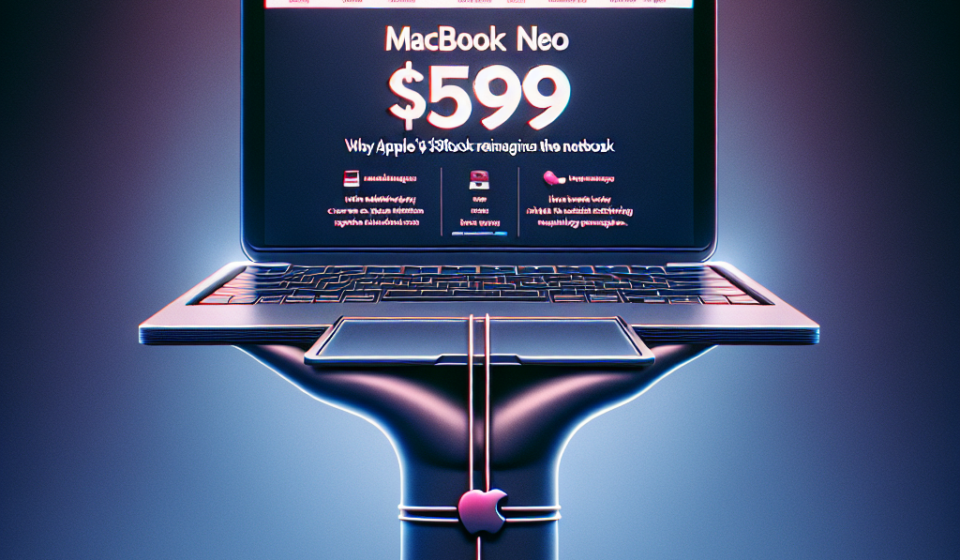
We tend to treat device launches as a two-horse race: the ultra-premium flagship and the cheap, underpowered commodity. A recent TechRadar piece about Apple’s new MacBook Neo (announced in early March 2026) illustrates a different, strategic pattern: when a vendor brings flagship-level design and ecosystem polish to a mass-market price point, it rewrites expectations across education, enterprise procurement, and developer priorities.
Context (the signal)
TechRadar contrasted the MacBook Neo with the netbook era – devices that democratized access but sacrificed usability and performance. The Neo, by contrast, aims to combine high quality (good keyboard, display, webcam) and acceptable specs at a sub-$600 price, creating a new baseline for what “affordable” should mean.
Analysis – what this means for architects, CTOs and founders
1. The commoditization of capability raises the software bar. When affordable devices start shipping with strong CPUs, reasonable RAM and decent displays, users expect desktop-class experiences from web and cloud apps. For enterprise architects this shifts priorities from compensating for poor client hardware (thin, conservative UIs) toward optimizing for scale, concurrency and rich UX – while still being mindful of aggressive power and network constraints in some deployments.
2. Security and endpoint management become central, not peripheral. More capable, inexpensive devices in the field multiply attack surfaces. Enterprises should assume heterogenous endpoints and invest in Zero Trust, device posture checks, mobile device management (MDM), and remote patching workflows. The economic appeal of a device is irrelevant if it increases operational risk.
3. Procurement strategy needs to think Total Cost of Ownership (TCO), not sticker price. A $599 device with longer useful life, fewer support calls, and better battery life can be cheaper over three years than a sub-$400 laptop. This matters for education programs, SMBs, and government initiatives where replacement cycles and support overheads dominate budgets.
4. Build vs buy: target platform convergence. When affordable hardware is also tightly coupled to ecosystems (macOS vs Windows vs ChromeOS), product teams face classic trade-offs: build native advantages on a single platform or prioritize web-first compatibility to reach all devices. My recommendation: design web apps as progressive enhancements – excellent offline behavior and responsiveness first, then native integrations where ROI justifies lock-in.
5. Sustainability and lifecycle thinking. A surge of affordable, well-built devices is positive – but it can also accelerate e-waste if refresh cycles shorten. Enterprises and public programs should include buyback/refurbish clauses, encourage modular repair where possible, and prefer vendors with clear EPR (extended producer responsibility) commitments.
Localization – why this matters to India and Northeast India
In India, large-scale education and digital inclusion programs are judged by reach and durability. A device that offers a genuinely usable keyboard, solid battery life and good webcam at a price accessible to state procurement can transform classrooms and remote work hubs. In regions with intermittent connectivity – including parts of Northeast India – the design emphasis must be on offline-first apps, graceful sync, and lightweight local caching. Device-as-service (DaaS) procurement models, combined with localized support hubs, can reduce downtime and make modern hardware sustainable for government and NGO deployments.
Practical takeaways for CTOs and founders
– Re-evaluate minimum supported device profiles: aim for baseline specs that reflect modern affordable hardware.
– Invest in Zero Trust + MDM early – assume endpoints will diversify.
– Design web apps with offline-first and progressive enhancement patterns.
– Use procurement models that favor lifecycle support (DaaS, warranties, refurbishment).
– Run developer testing across a representative matrix including “affordable premium” devices, not only flagships.
– Include e-waste and refurbishment clauses in vendor contracts.
Closing thought
When mass-market devices stop being compromises and start being credible platforms, the conversation shifts from “can we make it work?” to “what new experiences can we deliver?” That shift should be an invitation – for product teams, policy-makers and architects – to raise the baseline of digital services rather than lower expectations to meet old device constraints.
About the Author Sanjeev Sarma is the Founder Director of Webx Technologies Private Limited, a leading Technology Consulting firm with over two decades of experience. A seasoned technology strategist and Chief Software Architect, he specializes in Enterprise Software Architecture, Cloud-Native Applications, AI-Driven Platforms, and Mobile-First Solutions. Recognized as a “Technology Hero” by Microsoft for his pioneering work in e-Governance, Sanjeev actively advises state and central technology committees, including the Advisory Board for Software Technology Parks of India (STPI) across multiple Northeast Indian states. He is also the Managing Editor for Mahabahu.com, an international journal. Passionate about fostering innovation, he actively mentors aspiring entrepreneurs and leads transformative digital solutions for enterprises and government sectors from his base in Northeast India.