
U.S. President Donald Trump issued a stark warning to Iran on Sunday, stating that the United States would react with unprecedented force if the country retaliates against recent American strikes. In a post on Truth Social, Trump highlighted Iran’s declaration of intent to attack, saying, “Iran just stated that they are going to hit very hard today, harder than they have ever been hit before.” He added, “THEY BETTER NOT DO THAT, HOWEVER, BECAUSE IF THEY DO, WE WILL HIT THEM WITH A FORCE THAT HAS NEVER BEEN SEEN BEFORE!”
As tensions escalate, the aftermath of Supreme Leader Ayatollah Ali Khamenei’s death raises concerns about Iran’s political stability and economic outlook. Following Khamenei’s passing, analysts emphasized that his removal does not equate to a major shift in Iran’s governance. The Council on Foreign Relations noted, “Taking out Iranian Supreme Leader Ayatollah Ali Khamenei is not the same as regime change. The Islamic Revolutionary Guard Corps is the regime,” limiting prospects for immediate political or economic reform. Marko Papic, chief strategist at Clocktower Group, echoed this sentiment, advising that the Iranian economy could face severe challenges unless the next Supreme Leader is willing to engage with the U.S.
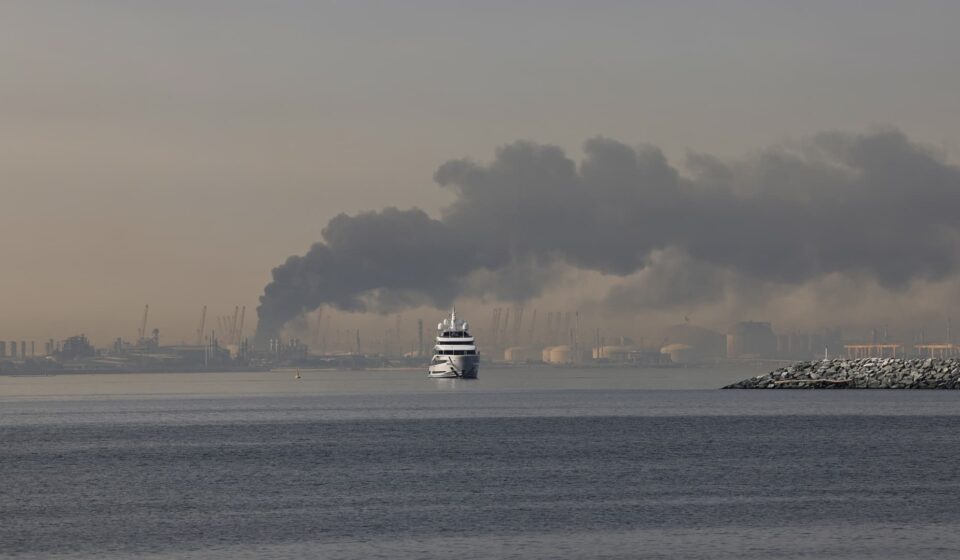
In a dramatic escalation of tensions, airports in Dubai and Abu Dhabi suffered damage from Iranian retaliatory strikes. “An incident” at Dubai International Airport injured four staff members, as most airport terminals were evacuated. Abu Dhabi authorities also reported interception of a drone that targeted Zayed International Airport, resulting in one death and multiple injuries. Iranian actions have spread across the Gulf, affecting countries like Qatar, Bahrain, Saudi Arabia, and Kuwait, all of which host U.S. assets. Notably, an intercepted Iranian drone ignited a minor fire on the iconic Burj Al Arab’s outer facade.
Simultaneously, Iran faced a near-total internet blackout, beginning early Saturday morning, according to monitoring group NetBlocks. National connectivity plummeted to just 4% of normal levels, with the disruptions coinciding with U.S. and Israeli military operations. This situation mirrors restrictions seen during last year’s conflict with Israel.
Reports from Iran indicate the death of the Commander-in-Chief of the Islamic Revolutionary Guards Corps (IRGC) as a result of the U.S.-Israeli strikes, with Ali Shamkhani, a key military figure, also reported dead. In the wake of these developments, President Trump remarked, “We are hearing that many of their IRGC, Military, and other Security and Police Forces no longer want to fight and are looking for immunity from us.”
As the conflict intensifies, the potential for broader regional repercussions remains significant. The dynamics between the U.S., Israel, and Iran continue to evolve, with diplomatic channels and military posturing playing critical roles in determining the next steps for all parties involved. The situation underscores the precarious balance of power in the Middle East, as the international community watches closely for further developments.
This evolving narrative reflects the challenging landscape of U.S.-Iran relations, underscoring an urgent need for strategic diplomacy and clarity amidst escalating tensions.
Original Source: https://www.cnbc.com/2026/03/01/us-iran-live-updates-khamenei-death-trump-gulf-strikes.html
Category :
Tags:
Publish Date: 2026-03-01 11:31:00