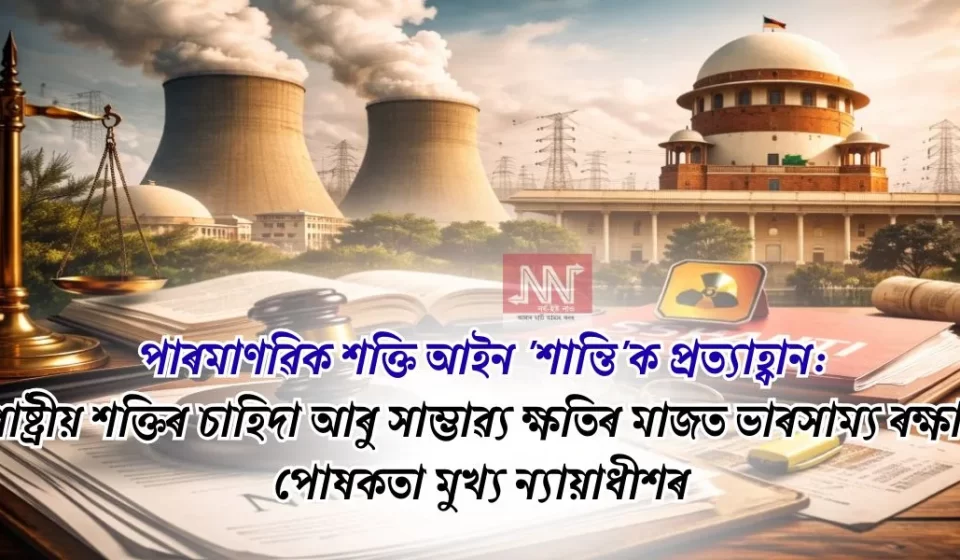

On Friday, India’s Supreme Court heard a high-stakes challenge to the 2025 “Sustainable Harnessing and Advancement of Nuclear Energy for Transforming India” (SHANTI) Act, with Chief Justice Surya Kant emphasizing the need to balance the country’s national interest against the risk of serious harm. The petition, filed by former IAS officer I.E.S. Sharma, argues that the law drastically limits compensation for nuclear accidents and shields suppliers from liability, raising profound safety and constitutional questions.
A bench led by Chief Justice Surya Kant noted that expanding nuclear power is being presented as essential to meet India’s growing energy demand. Addressing senior counsels Prashant Bhushan and Neha Rathik, the chief justice said that given obstacles to expanding coal, strict forest conservation rules and an inadequate domestic gas supply, for now the country cannot meet its needs without exploring nuclear options.
At the hearing, Prashant Bhushan argued that the SHANTI Act caps the government’s residual liability at just 30 million Special Drawing Rights (SDR) — roughly ₹3,000 crore (about $331 million) — an amount he described as negligible. Bhushan warned that such a cap would leave victims of death, injury or property damage unable to recover anything close to their true losses. He invoked the long-term, massive economic costs of past nuclear disasters, citing estimated losses from Chernobyl and Fukushima in the hundreds of billions of dollars to underline the mismatch between the cap and potential damages.
Petitioners also contend that the law’s provisions absolving suppliers from liability create perverse incentives: manufacturers and vendors could trade safety for higher profit if they face little or no financial responsibility after an accident. Bhushan urged the court to require that an operator engaged in hazardous activities retain full liability for any accident.
Justice Jaymalya Bagchi, a member of the bench, said the court must closely scrutinize the new statute. He indicated the judiciary will examine whether SHANTI’s mechanisms are arbitrary or violative of the Constitution, including whether the capped compensation contravenes Article 21, which guarantees the right to life.
The hearing focused on legal and policy tensions between facilitating private and foreign investment in nuclear projects and ensuring adequate protection for citizens and the environment. The case will continue before the Supreme Court, which must decide how to reconcile energy security goals with accountability, safety and constitutional safeguards.
Original Source: https://assam.nenow.in/shanti-nuclear-law/
Category: Popular Stories,দেশ,শীর্ষ সংবাদ
Tags:
Publish Date: 2026-02-28 19:45:00