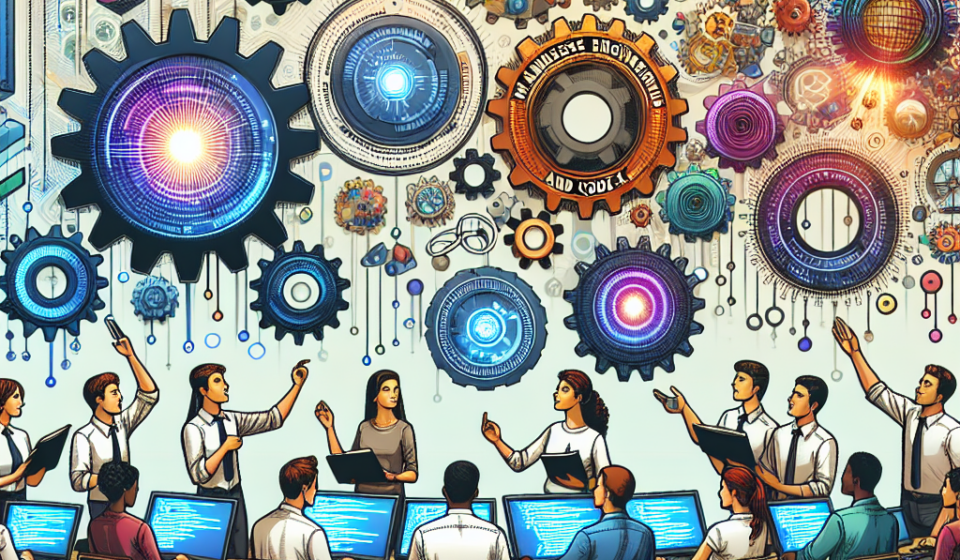

We are standing at the edge of a new chapter in software delivery: not merely faster code generation, but a redefinition of what it means to “author” software. The conversation is shifting from typing lines of code to encoding intent, constraints and observability into machine‑readable artifacts that AI agents can act upon.
Context
OpenAI’s internal experiment with what they call “Harness engineering” uses Codex agents to drive large parts of the development lifecycle – from generating application logic and CI configuration to reproducing bugs and validating fixes – guided by declarative prompts, structured docs and mechanical tests that enforce architectural boundaries.
Why this matters (the architect’s lens)
1. The locus of value is moving upstream. When agents can reliably produce code, the competitive advantage for organisations will be in how well they can express domain intent, define architecture constraints, and provide high‑quality telemetry. That means investment shifts from boilerplate implementation to “context engineering”: clear maps, execution plans, and machine‑readable policies.
2. Speed vs. governance trade-offs become explicit. Automating code production at scale accelerates delivery, but without strict structural tests, dependency rules and continuous verification, you multiply systemic risk. Harness engineering’s emphasis on enforced layering (Types → Config → Repo → Service → Runtime → UI) is an important lesson: automation must come with mechanical guardrails to prevent architectural erosion.
3. Observability becomes a first‑class input, not an afterthought. Agents iterating on reproducible bugs need deterministic environments, spans, logs and metrics. Organisations that treat telemetry as part of the specification (not just post‑mortem artefacts) will get better outcomes from agent‑driven workflows.
4. Software craftsmanship evolves into policy design. The “human” engineer’s role shifts toward defining acceptance predicates, cost functions, privacy constraints, and bias checks. This raises new skill requirements: prompt/context engineering, formalizing architectural rules, and robust verification pipelines.
5. Supply‑chain, provenance and auditability will decide adoption in regulated sectors. If an AI agent opens pull requests and changes behaviours, enterprises and governments will demand traceable approvals, signed artifacts, and immutable logs for compliance and legal accountability. Without these, adoption in finance, healthcare or public infrastructure will be constrained.
Actionable steps for CTOs and founders
– Start with a pilot that formalises a single vertical (e.g., internal tools or non‑critical services). Treat documentation, tests and observability as deliverables, not luxuries.
– Convert architecture constraints into machine‑readable rules and structural tests. Enforce them in CI so automation cannot bypass policy.
– Invest in telemetry-first engineering: standardized logs, traces and test harnesses that agents can use to reproduce and validate behaviours.
– Build provenance and human‑in‑the‑loop checkpoints for any changes that touch critical data or external interfaces.
– Upskill engineering leads in prompt and context engineering; reward design‑first thinking (intent, invariants, failure modes) as much as code output.
Relevance to India and public digital stacks
There is a direct, pragmatic parallel for government digital stacks and DPI initiatives: agent‑driven development could accelerate feature delivery for citizen services, but only if the stack enforces modularity, data sovereignty and audit trails. For states and agencies – including those I engage with – this means piloting agent‑assisted workflows in well‑scoped sandboxes, while mandating signed provenance and strict dependency rules before production rollout. In regions with intermittent connectivity, designs should also include reproducible, offline‑capable test harnesses to avoid brittle automation.
Takeaways
– Automation amplifies both productivity and risk; the multiplier is your governance fabric.
– Make observability and machine‑readable architecture first principles.
– Treat agent workflows as systems engineering problems: inputs, constraints, outputs, and auditability.
– Begin small, codify constraints, and mature governance before scaling.
Closing thought
The promise of AI agents is not that humans will be replaced, but that the craft of software will rise a level – from typing code to architecting intent. Those who master that translation will define the next decade of resilient, auditable software.
About the Author Sanjeev Sarma is the Founder Director of Webx Technologies Private Limited, a leading Technology Consulting firm with over two decades of experience. A seasoned technology strategist and Chief Software Architect, he specializes in Enterprise Software Architecture, Cloud-Native Applications, AI-Driven Platforms, and Mobile-First Solutions. Recognized as a “Technology Hero” by Microsoft for his pioneering work in e-Governance, Sanjeev actively advises state and central technology committees, including the Advisory Board for Software Technology Parks of India (STPI) across multiple Northeast Indian states. He is also the Managing Editor for Mahabahu.com, an international journal. Passionate about fostering innovation, he actively mentors aspiring entrepreneurs and leads transformative digital solutions for enterprises and government sectors from his base in Northeast India.