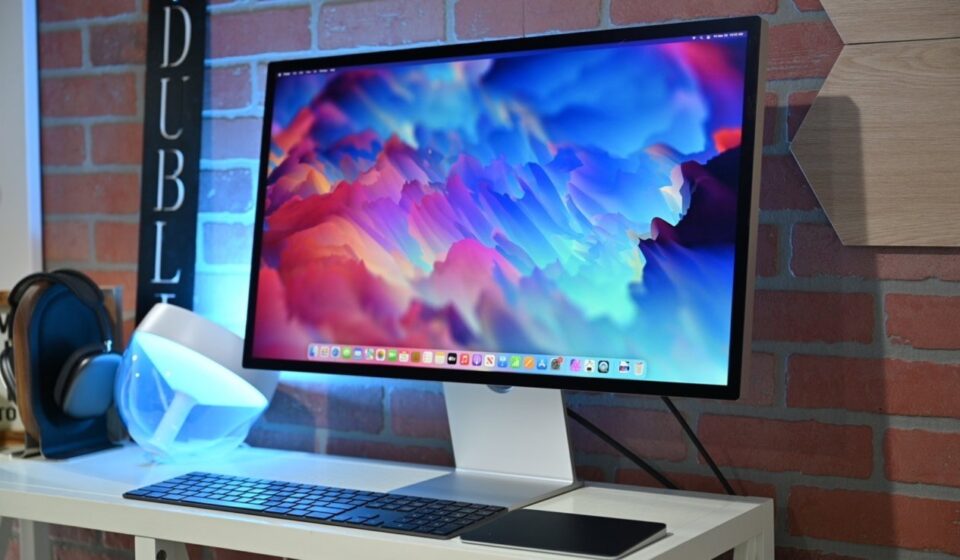

We think of displays as commodities – a screen is a screen – until one appears that changes how whole teams work. The potential arrival of not one, but two new Apple Studio Displays is a reminder that peripheral hardware still shapes the boundaries of productivity, security and total cost of ownership for modern enterprises.
The signal: recent references to codenames J427 and J527 in macOS 26.3 suggest Apple may be preparing two new Studio Display models. Apple has also scheduled a special event on March 4, 2026, and industry chatter links further announcements to the May 4, 2026 “Apple Experience.” Early rumors point to a low-cost MacBook as a headline item, but multiple display codenames indicate a broader refresh of Apple’s desktop ecosystem.
Why this matters beyond Apple fan blogs
Hardware refreshes are often treated as consumer theatre, yet they have real architectural consequences for organisations. High-quality displays are more than pixel count and colour accuracy; they are endpoints in a distributed system – points of trust, power delivery, collaboration and asset lifecycle that affect IT operations, developer ergonomics, creative workflows and sustainability commitments.
1) Productivity vs. Complexity
Premium displays reduce friction for knowledge workers: larger, calibrated screens increase task throughput for designers, analysts and engineers. The trade-off is device heterogeneity. Each new model adds drivers, firmware update paths and support matrices that IT must absorb. For CTOs this becomes a decision between short-term productivity gains and long-term operational complexity.
2) Security and Zero Trust for Peripherals
Modern displays frequently include cameras, microphones, speakers and even embedded compute – all of which expand the attack surface. Organizations that adopt such devices should treat them like any networked endpoint: enforce device authentication, keep firmware up to date, and include display peripherals in endpoint management and Zero Trust policies. A display with a mic is not just furniture; it’s a potential data plane.
3) Build vs. Buy – and Total Cost of Ownership
Buying the latest display can feel wise for user experience, but enterprises must account for docking standards (Thunderbolt/USB4), spare-part availability, repair ecosystem and power delivery. Decision-makers should compare gains in employee efficiency against lifecycle costs, warranty claims and recycling/replace schedules. In many cases, standardising on one or two validated models reduces support costs more than marginal gains from higher-spec displays.
4) Integration with Hybrid Work & Cloud Desktops
As hybrid work matures, displays play a role in seamless transitions between home and office. Single-cable solutions that carry power, video and peripheral signals simplify user experience and improve security posture for Virtual Desktop Infrastructure (VDI) scenarios. IT teams should prioritise displays that are validated for their chosen VDI/remote workspace stack.
A note for India – when it’s relevant
For Indian enterprises and startups, the calculus includes procurement cycles and total lifecycle value. In government and large enterprise deployments where budgets and approval processes are conservative, the arrival of multiple new models may be an opportunity to renegotiate bulk contracts or consolidate around a single, repairable model that meets accessibility and sustainability goals. For creative agencies across metros and for small tech teams in the Northeast, a high-quality display can be a force-multiplier – but plan for local support, calibration services and spare parts.
Actionable takeaways for CTOs and Founders
– Don’t upgrade reflexively: benchmark actual productivity gains for roles that will use the new displays.
– Standardise: pick 1–2 validated display models for procurement to simplify support and imaging.
– Treat displays as endpoints: include them in asset management, firmware-update cadence and Zero Trust policies.
– Validate docking and VDI compatibility before widescale rollout.
– Factor in repairability, spare parts and recycling to meet sustainability and TCO objectives.
Closing thought
A display is the frontier where human attention meets computation; small hardware choices cascade into operational and strategic consequences. When vendors refresh that frontier – even subtly – architects should listen, measure and plan rather than applaud or adopt on instinct alone.
About the Author
San jeev Sarma is the Founder Director of Webx Technologies Private Limited, a leading Technology Consulting firm with over two decades of experience. A seasoned technology strategist and Chief Software Architect, he specializes in Enterprise Software Architecture, Cloud-Native Applications, AI-Driven Platforms, and Mobile-First Solutions. Recognized as a “Technology Hero” by Microsoft for his pioneering work in e-Governance, Sanjeev actively advises state and central technology committees, including the Advisory Board for Software Technology Parks of India (STPI) across multiple Northeast Indian states. He is also the Managing Editor for Mahabahu.com, an international journal. Passionate about fostering innovation, he actively mentors aspiring entrepreneurs and leads transformative digital solutions for enterprises and government sectors from his base in Northeast India.