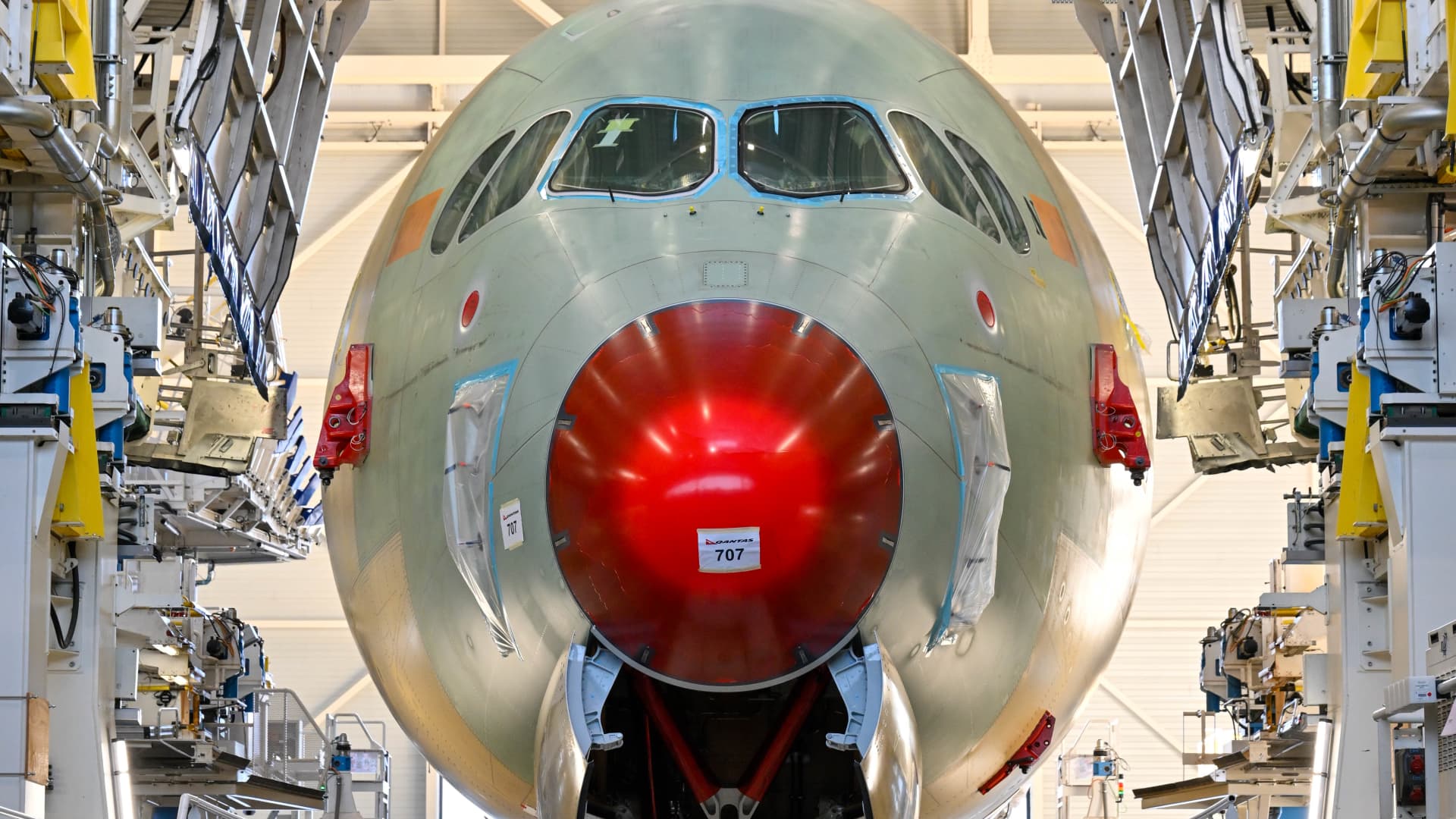

Airbus recently announced plans to deliver 870 commercial aircraft in 2026, slightly under the 880 deliveries analysts had anticipated. This projection underscores increasing pressure on the European manufacturer, especially as U.S. rival Boeing begins to show signs of recovery after a tumultuous period. CEO Guillaume Faury emphasized that global demand for aircraft continues to support Airbus’s ramp-up in production, despite significant shortages of Pratt & Whitney engines, a critical issue that has delayed their operational capacity.
The company’s shares fell 5.4%, reflecting growing concerns among investors, as they now find themselves in negative territory for the year. Barclays analyst Milene Kerner noted that improved clarity regarding Airbus’s 2026 delivery targets and the production of the A320 family of planes has alleviated some previous overhang. However, persistent engine supply challenges from RTX subsidiary Pratt & Whitney have hindered guidance for this year, impacting output rates. Airbus anticipates producing between 70 and 75 narrowbody aircraft monthly by late 2027, stabilizing at 75 thereafter, down from an earlier target of 75 per month.
Despite these challenges, Barclays analysts consider the current disruptions as “temporary execution setbacks,” asserting that Airbus’s long-term production ramp remains on track. The company delivered 793 commercial jets in the previous year, surpassing its adjusted target of 790. This figure, however, fell short of the original goal of 820 due to supplier quality concerns affecting A320 fuselage deliveries.
The situation at Airbus contrasts sharply with Boeing, which is beginning to recover from several years of crises related to its popular 737 Max model. Last year, while Airbus delivered 193 more planes than Boeing, the latter secured more orders for the first time since 2018, highlighting a notable shift in dynamics. Boeing’s leadership, under CEO Kelly Ortberg, who took charge in 2024, is optimistic about increasing production in the near future, especially after exceeding revenue expectations in its fourth quarter.
Supply chain challenges arising from the COVID-19 pandemic have significantly impacted order backlogs for both manufacturers. In January 2026, Boeing delivered 46 jets and recorded 103 net orders, compared to Airbus’s 19 deliveries and 49 net orders. UBS analysts have indicated that the weak start for Airbus in January was largely due to issues with fuselage panels, not engine delays, and cautioned that the projected delivery profile for 2026 may be back-end loaded again.
Despite the challenges, Airbus reported a robust performance for the fourth quarter, with adjusted earnings before interest and tax (EBIT) totaling €2.98 billion, exceeding estimates of €2.87 billion and reflecting a 17% year-on-year increase. Overall, the company achieved an EBIT of €7.13 billion on revenues of €73.4 billion for the year. Looking forward, Airbus anticipates an adjusted EBIT of approximately €7.5 billion and free cash flow of around €4.5 billion in 2026 while aiming for 870 commercial aircraft deliveries.
The landscape for aerospace manufacturers is evolving, with Airbus facing both challenges and opportunities as it navigates production hurdles and increasing competition from Boeing.
Original Source: https://www.cnbc.com/2026/02/19/airbus-earnings-fy-q4-boeing-deliveries-a320-airbus-2026-boeing-recovery.html
Category :
Tags:
Publish Date: 2026-02-19 14:42:00