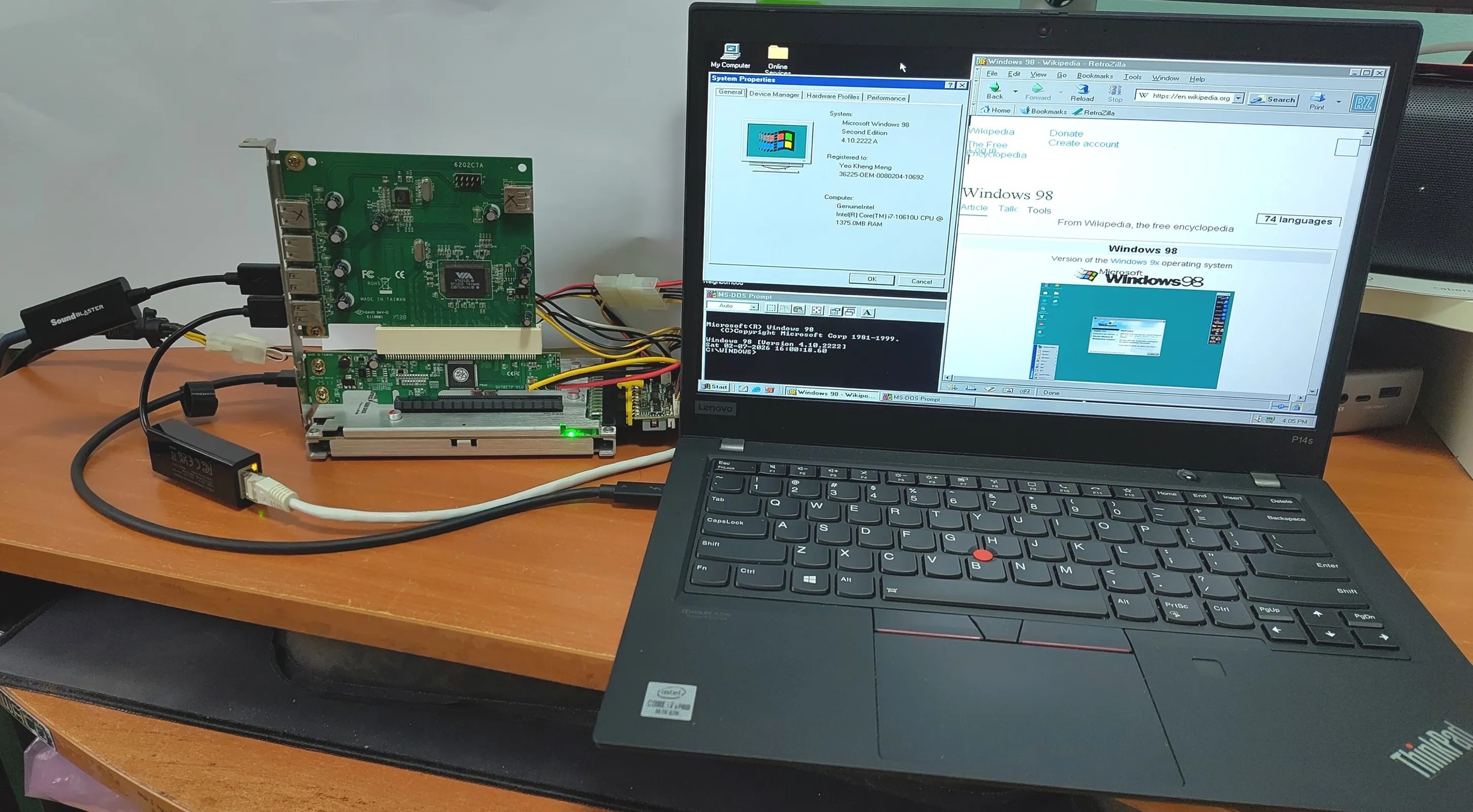

We celebrate progress – faster silicon, secure firmware, and cloud-first platforms – but we often underappreciate the engineering value and the hidden costs of backwards compatibility. A recent project that booted Windows 98 SE alongside Windows 11 and Linux on a 2020 ThinkPad P14s is more than a nostalgic trick; it’s a practical case study in how legacy software, firmware evolution, and vendor choices shape long-term architecture decisions.
The signal: a developer managed to run a 1998 OS on modern hardware by leaning on UEFI-CSM (classic BIOS) support, a stack of driver patches and adapters (including a USB 2.0 workaround via Thunderbolt), and a set of low-level fixes for RAM limits, ACPI quirks and registry smoothing. Where vendor drivers don’t exist, capability falls back to basic VESA graphics and BIOS-managed storage-functional, but far from optimal.
What this means for architects and technology leaders
1. Backwards compatibility is a double-edged sword. The ability of x86 platforms to execute decades-old binaries is a testament to stable ISA design and has enormous value for preservation, testing, and incident response. But it also masks brittle dependencies: undocumented behaviors, hardware-specific drivers, and firmware modes (CSM vs pure UEFI) that vendors can-and do-remove. When that happens, organisations face sudden migration costs that look like technical debt being called in.
2. Firmware choices are now strategic. Secure Boot, Kernel DMA protection, and the gradual phasing out of CSM are not mere BIOS options – they are architectural inflection points. They improve security and manageability, but they also accelerate obsolescence for legacy endpoints. CTOs must treat firmware roadmaps as part of procurement and lifecycle planning, not an afterthought.
3. “Compatibility through hardware hokey-pokey” is unsustainable. The ThinkPad project used physical adapters and driver hacks to bridge gaps. That’s fine for hobbyists and for forensic recovery; it is not a repeatable enterprise strategy. Enterprises need deterministic, auditable approaches: virtualization, emulation, application gateways, or refactoring.
Practical guidance – what a CTO should do tomorrow
– Inventory and classify: Map legacy apps by risk, business value, and portability. Treat firmware/driver compatibility as a first-class attribute in that inventory.
– Prefer containment over fragile compatibility: Where rewrite isn’t immediately feasible, host legacy apps in hardened VMs or emulators, isolate them from the network, and expose functionality through APIs or modern UIs.
– Bake firmware strategy into procurement: Demand visibility on UEFI and CSM support timelines from OEMs. Negotiate longer firmware support or warranty terms for systems that must run older workloads.
– Modernise incrementally: Use strangler patterns-replace backend services and expose modern endpoints while keeping legacy front-ends functional for a defined sunset period.
– Invest in application portability: Encourage developers to avoid hardware-tied assumptions; where unavoidable, encapsulate them behind abstraction layers.
A Bharat note (why this matters here)
In India, and particularly in public systems across many states, legacy desktop applications and specialised hardware drivers still power critical workflows. I have often argued in advisory forums that migration risk should be budgeted at procurement time for government and enterprise projects. Treating compatibility as a long-term cost – not just a nostalgic convenience – prevents sudden, expensive refresh cycles that strain both budgets and services at the last mile.
Takeaways
– Backwards compatibility is valuable but costly; protect it through planned strategies, not improvisation.
– Firmware and driver roadmaps belong in architecture reviews and procurement contracts.
– Virtualisation and API-led modernisation are pragmatic bridges; physical adapter hacks are not a strategy.
Closing thought
Technical nostalgia teaches us that the choices we make today-about firmware, vendor lock-in, and abstraction-will determine who can run our software ten years from now. Good architecture is not just about the new; it’s about making the old retire gracefully.
About the Author Sanjeev Sarma is the Founder Director of Webx Technologies Private Limited, a leading Technology Consulting firm with over two decades of experience. A seasoned technology strategist and Chief Software Architect, he specializes in Enterprise Software Architecture, Cloud-Native Applications, AI-Driven Platforms, and Mobile-First Solutions. Recognized as a “Technology Hero” by Microsoft for his pioneering work in e-Governance, Sanjeev actively advises state and central technology committees, including the Advisory Board for Software Technology Parks of India (STPI) across multiple Northeast Indian states. He is also the Managing Editor for Mahabahu.com, an international journal. Passionate about fostering innovation, he actively mentors aspiring entrepreneurs and leads transformative digital solutions for enterprises and government sectors from his base in Northeast India.