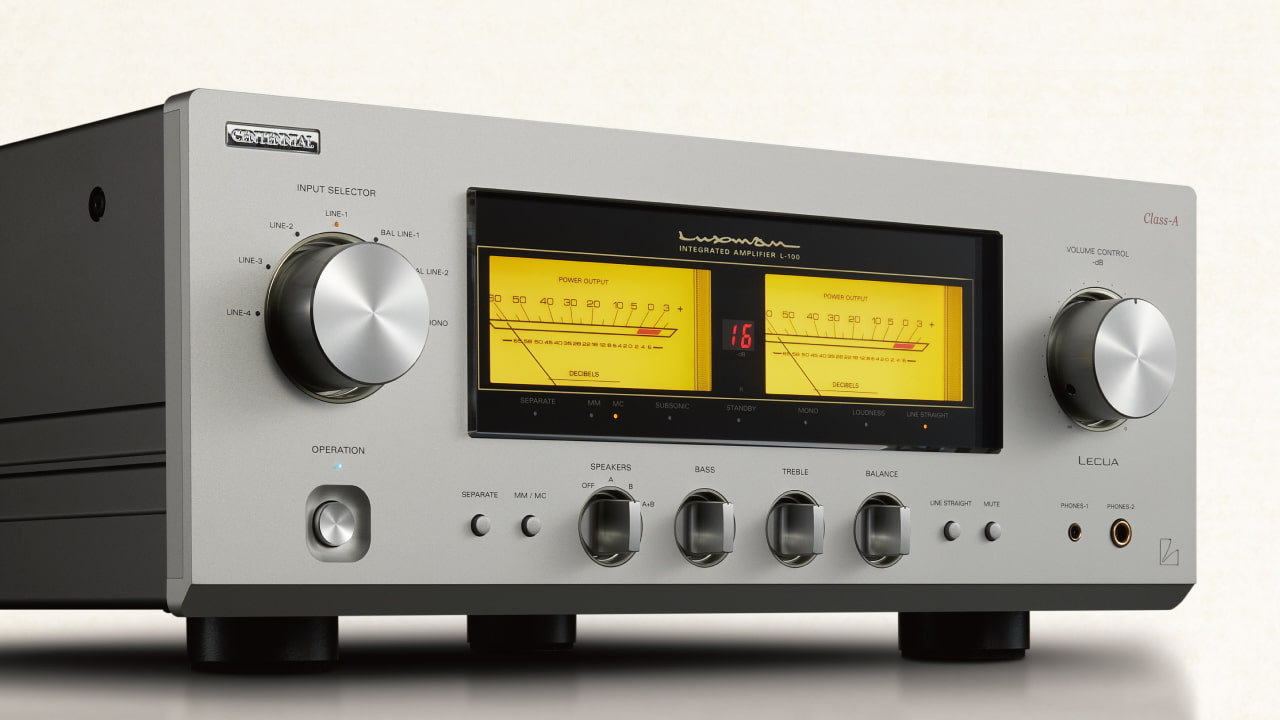

We celebrate velocity in tech – faster releases, quarterly feature sprints, and shrinking product lifecycles. Every so often a reminder arrives that an alternative model exists: engineering for longevity, clarity of purpose, and refusal to compete on specs alone. Luxman’s new D-100 SACD/CD player and L-100 Class A integrated amplifier are a timely case study in that philosophy.
The signal: Luxman has doubled down on deliberate choices – low headline power but continuous Class A operation, heavy mechanical overbuild, selective distortion correction (LIFES 1.1), and an emphasis on serviceable, long-lived hardware rather than iterative churn. The company isn’t trying to win on feature density or market share; it’s optimizing for lifetime value, tonal fidelity, and ownership experience.
Why this matters to architects and product leaders
There are three architectural lessons here that translate cleanly from high-end audio to software, hardware platforms, and product strategy.
1) Design trade-offs must be explicit and defensible
Luxman chooses Class A amplification – inefficient in watts-per-dollar terms and warm-running – because it favors linearity and tonal density. That’s a principled trade-off. In software terms, it’s the equivalent of choosing strong consistency and redundancy over raw throughput. As architects we must name these trade-offs publicly: when does a system need deterministic behavior and when can it favor efficiency and scale? Stakeholders can tolerate higher operational costs if the value delivered (reliability, user trust, fidelity) is clearly articulated.
2) Targeted feedback beats brute-force control
The LIFES approach – correcting only distortion components rather than applying global feedback – mirrors a modern operational pattern: targeted observability and remediation rather than blanket policies. Excessive global controls flatten behavior; targeted detection and correction minimize collateral effects. For cloud systems, this translates to context-aware monitoring, adaptive throttling, and surgical remediation rather than broad, disruptive fail-safes.
3) Overbuild where the user values longevity and serviceability
The D-100’s mechanical isolation, rigid chassis, and dual-mono DACs add cost and weight – and extend useful life and performance margin. In product design, there are categories (medical devices, industrial controllers, mission-critical systems) where overengineering is a commercial differentiator. Build with serviceability in mind: modular interfaces, clear upgrade paths (pre-out/main-in equivalents), and standards-based connectivity that allow components to be replaced rather than discarded.
Actionable guidance for CTOs and founders
– Decide where you compete: depth (quality, longevity) or breadth (features, scale). Don’t try to be both without the economics to support it.
– Make trade-offs visible: publish your TCO assumptions (energy, maintenance, service life) so buyers can rationalize premium pricing.
– Architect for surgical feedback: invest in observability that targets the true root causes instead of amplifying noise with global controls.
– Design modular upgrade paths: enable component-level evolution without forcing full replacements.
A short note for Indian product builders
There’s space in India for “buy once, keep for decades” propositions. For hardware startups and specialty manufacturers in the Northeast and beyond, emphasizing service networks, repairability, and long-term warranty can be a strong positioning strategy – especially for buyers frustrated by planned obsolescence. The economics differ from mass-market playbooks, but the value is real for a discerning segment.
Closing thought
Speed wins battles; resilience and fidelity win relationships. Luxman’s new models are a reminder that long-term trust – whether in audio gear or enterprise systems – is earned by clear engineering choices, visible trade-offs, and a willingness to invest in things that last.
About the Author
Sanjeev Sarma is the Founder Director of Webx Technologies Private Limited, a leading Technology Consulting firm with over two decades of experience. A seasoned technology strategist and Chief Software Architect, he specializes in Enterprise Software Architecture, Cloud-Native Applications, AI-Driven Platforms, and Mobile-First Solutions. Recognized as a “Technology Hero” by Microsoft for his pioneering work in e-Governance, Sanjeev actively advises state and central technology committees, including the Advisory Board for Software Technology Parks of India (STPI) across multiple Northeast Indian states. He is also the Managing Editor for Mahabahu.com, an international journal. Passionate about fostering innovation, he actively mentors aspiring entrepreneurs and leads transformative digital solutions for enterprises and government sectors from his base in Northeast India.