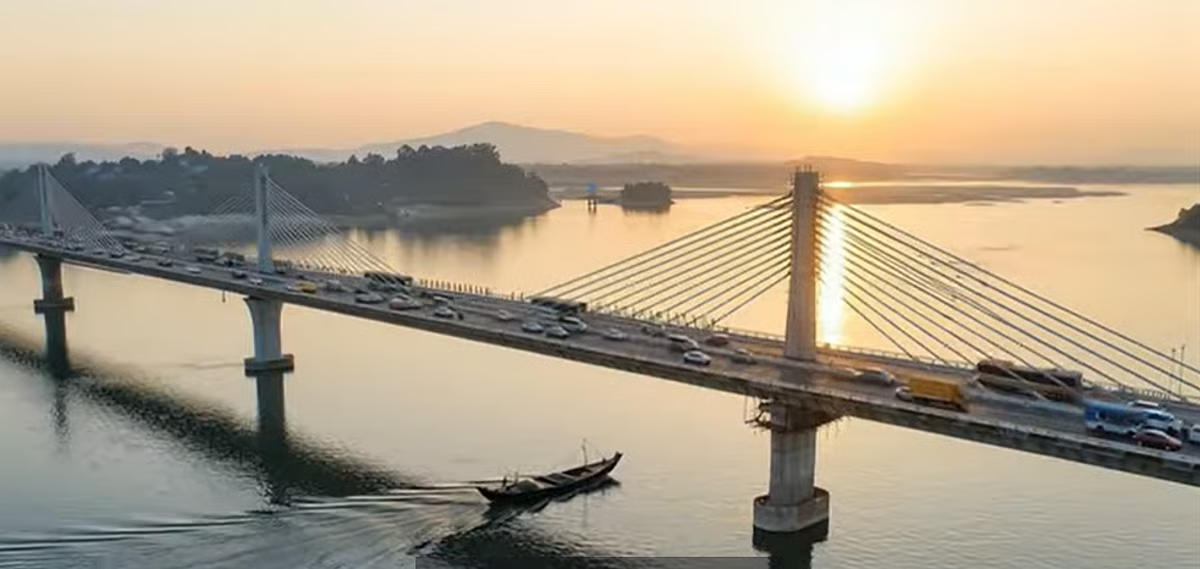

Prime Minister Narendra Modi is due to inaugurate the newly completed Guwahati–North Guwahati bridge, to be named Kumar Bhaskar Varma Setu, on 14 February 2026, officials said. The bridge, whose foundation was laid on 9 February 2019, will open first to pedestrians until 28 February; vehicular traffic will begin at a later date. On the same day the prime minister will also lay the foundation stone for the Indian Institute of Management Guwahati, marking a pair of high-profile infrastructure and education events for the state.
The bridge is being dedicated to Kumar Bhaskar Varma, the seventh-century king of Kamarupa who ruled roughly from 594 (some sources say 600) to 650 CE and is widely regarded in the source text as the region’s most illustrious ruler. The article highlights Kumar Bhaskar Varma’s outward-looking diplomacy, including documented contacts with the northern emperor Harshavardhana and the visit of Chinese traveler Hiuen Tsang between 640 and 643 CE, whose accounts praised Kamarupa’s fertile land, irrigation systems, learning culture and religious life.
According to the provided account, Kumar Bhaskar Varma extended Kamarupa’s influence into parts of Bengal, Sylhet and Tripura, maintained significant naval and military forces, and is traditionally credited as the start point of the Assamese calendar, Bhaskarabda. Hiuen Tsang’s travelogue is cited as one of the earliest written records describing the kingdom and its ruler’s stature at imperial gatherings such as the Dharma Sabha at Kannauj, where the king was reportedly accorded a place of honour beside Harshavardhana.
The article describes Kamarupa under Kumar Bhaskar Varma as economically prosperous, with industries producing bamboo and cane goods, paat and muga textiles, agarwood perfume, jaggery, metalware and gold ornaments. A list of gifts sent to Harshavardhana is cited to illustrate the kingdom’s material and cultural wealth, including silk-wrapped perfumes, textiles, manuscripts and a ceremonial umbrella called the Abhaga.
On the bridge project, the source explains that the state government sought design inputs from Singapore-based Surbana Jurong and financing from the New Development Bank (NDB). Under the agreed terms, the bank financed 80% of the roughly Rs. 3,000 crore cost while the state covered 20%; the loan component is to be repaid by the Government of India. The article states the main span is 1.2 km long, the deck is about 33 metres wide with six lanes and a dedicated pedestrian sidewalk, and the structure uses extradosed technology with 200-metre spans and friction pendulum bearings for earthquake protection.
The narrative emphasizes that the bridge was constructed by Assam’s Public Works Department and presents the project as a catalyst for urban expansion, reduced congestion, and the potential development of twin metropolitan hubs across the Brahmaputra. It also lists further planned projects in the state, including additional bridges, a semiconductor park, a 34-km elevated corridor near Kaziranga, a tunnel between Numaligarh and Gohpur, and expansions at Numaligarh refinery and Namrup Fertilizer Plant, framed as part of a broader development push for Assam.
Original Source: https://www.sentinelassam.com/topheadlines/kumar-bhaskar-varma-setu-a-symbol-of-unwavering-steadfast-and-progressive-assam
Category: Top Headlines
Tags:
Publish Date: 2026-02-14 07:35:00