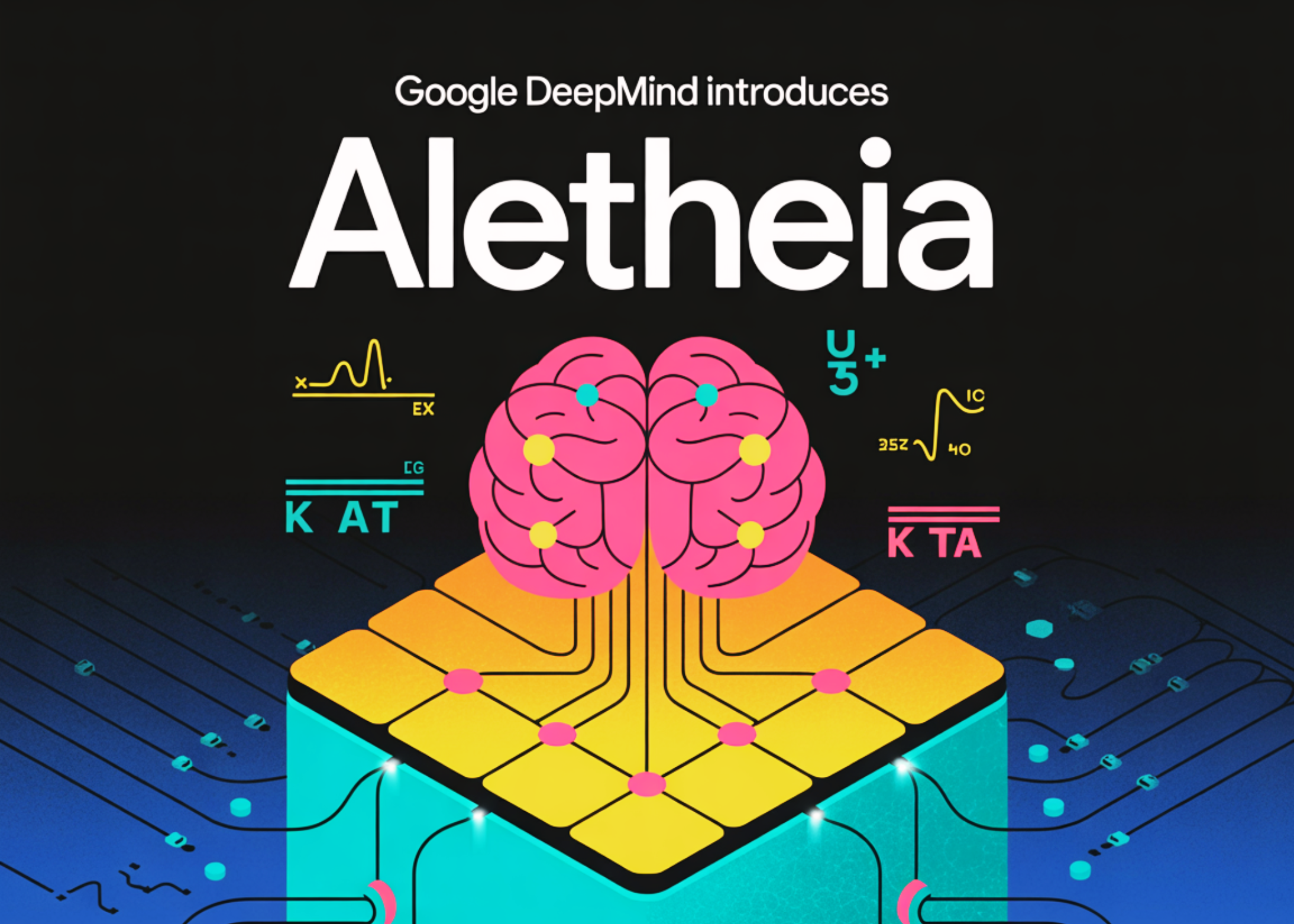

We often celebrate AI that wins contests – but the harder milestone is an AI that can participate credibly in professional research. DeepMind’s recent Aletheia project (announced in mid-February 2026) is a clear attempt to cross that threshold: an agentic system built on an advanced Gemini “Deep Think” backbone that separates generation, verification, and revision to produce long-horizon, research‑grade mathematical arguments. The technical claims are striking (high accuracy on proof benchmarks, inference-time scaling improvements, and examples of autonomous papers), but the real conversation for enterprise architects and research leaders should be about trust, reproducibility, and integration.
The signal, in two sentences: Aletheia demonstrates that explicit separation of duties – Generator, Verifier, Reviser – plus tool-enabled retrieval can push models from competition-level problem solving toward publishable research outputs. DeepMind also proposes a taxonomy for documenting degrees of AI autonomy, attempting to make claims about machine-generated research auditable and comparable.
What this means for architecture and strategy
– Separation of concerns is a practical pattern. The Generator/Verifier/Reviser loop is an architectural idea any organisation can re-use. In practice this translates to modular ML pipelines: a creative generation model, a separate verification model (or rule-based checker), and a corrective loop that iterates until an acceptance criterion is met. For enterprise systems this reduces single-model “magic” and makes behavior inspectable – a win for traceability and compliance.
– Tooling and provenance are non-negotiable. Aletheia’s reliance on web search and browsing to ground claims underscores that models must be coupled to high‑quality retrieval, citation validation, and tamper‑evident logs. For enterprises, that means investing in retrieval-augmented generation (RAG) infrastructure, canonical internal knowledge stores, and cryptographic or immutable logging for provenance.
– Inference-time scaling changes cost calculus – and risk posture. If “thinking longer” at inference can reduce raw compute by orders of magnitude for hard reasoning, R&D groups must rethink where they spend on pretraining vs. inference. However, longer inference windows may produce longer, harder-to-audit chains of reasoning; governance controls must be in place to validate outputs before they become policy or research claims.
– Build vs. buy becomes a contextual choice. Organisations with deep domain knowledge will benefit from custom agentic harnesses that encode domain constraints and verifiers tailored to domain logic. Others should prioritise integrate-and-go solutions with strong provenance guarantees from vendors. Either path requires clear SLAs, explainability metrics, and continuous benchmarking against held‑out domain tests.
Practical steps for CTOs and Heads of Research
– Prototype an agentic loop for a narrow, high-value problem: e.g., proofs-of-concept for internal algorithm design, regulatory interpretation, or complex optimisation problems. Keep scope tight to limit hallucination risk.
– Treat the Verifier as a first-class product. Invest in deterministic checks, counterfactual tests, and citation resolvers. Verification beats post‑hoc trust-building.
– Mandate immutable audit trails for model outputs used in decision-making. If a model claims a literature citation or a theorem, systems must persist the retrieval snapshot and verification steps.
– Re-evaluate compute budgets: model teams should model the trade-off between longer inference and additional pretraining/fine-tuning costs.
A note for the Indian research and product ecosystem
There’s an opportunity here for Indian universities, STPI-affiliated incubators, and startups to experiment with agentic loops on problems where domain expertise exists locally – from combinatorial optimisation in logistics to theoretical work in pure maths and cryptography. As someone who advises regional technology bodies, I believe we should pair access to compute with governance playbooks so innovation does not outpace accountability.
Takeaways
– The architectural lesson is simple but profound: separate generation from verification and revision to make reasoning systems auditable and actionable.
– Ground models in reliable retrieval and immutable provenance to reduce hallucination risk.
– Start small, measure thoroughly, and bake governance into any production path.
Closing thought
We are moving from AI that dazzles in contests to AI that must be defensible in journals, boardrooms, and courtrooms – and that shift changes the responsibilities of architects and leaders more than it changes the underlying model code.
About the Author Sanjeev Sarma is the Founder Director of Webx Technologies Private Limited, a leading Technology Consulting firm with over two decades of experience. A seasoned technology strategist and Chief Software Architect, he specializes in Enterprise Software Architecture, Cloud-Native Applications, AI-Driven Platforms, and Mobile-First Solutions. Recognized as a “Technology Hero” by Microsoft for his pioneering work in e-Governance, Sanjeev actively advises state and central technology committees, including the Advisory Board for Software Technology Parks of India (STPI) across multiple Northeast Indian states. He is also the Managing Editor for Mahabahu.com, an international journal. Passionate about fostering innovation, he actively mentors aspiring entrepreneurs and leads transformative digital solutions for enterprises and government sectors from his base in Northeast India.