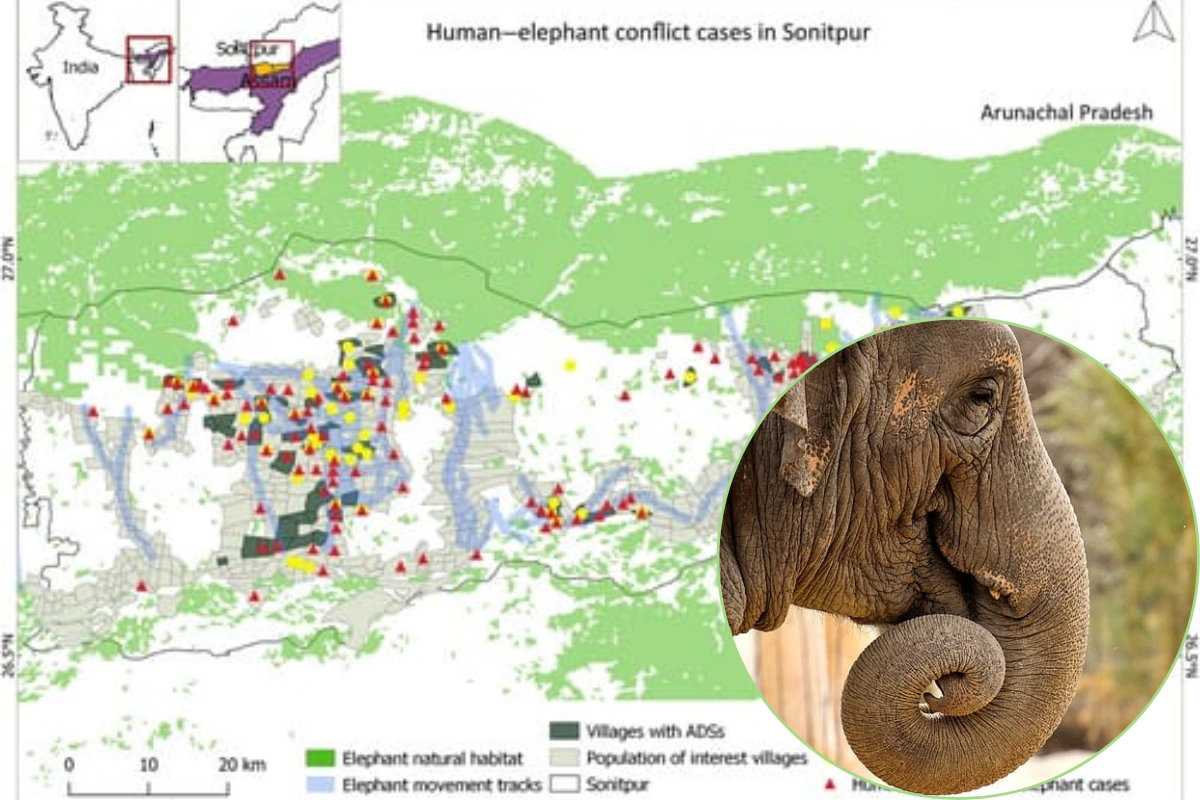

A 20-year study in Sonitpur district, Assam, published in the journal Conservation Biology, warns that organised crop-guarding and short-distance elephant drives may be linked to a rise in elephant deaths without clearly reducing human fatalities. Researchers report that community-based “antidepredation squads” (ADSs) and similar interventions were associated with a 2 to 2.9 times increase in elephant mortality, while their effect on preventing human deaths remained uncertain.
The study analysed two decades of conflict and mortality data from Sonitpur, a district chosen for its high frequency of human–elephant conflict (HEC) and long history of community-led responses to crop raiding. The researchers modelled outcomes while accounting for other influences such as land-use change and economic development to improve confidence in their findings.
Authors emphasise that the increase in elephant deaths did not appear to follow retaliatory killings after human fatalities. Instead, some excess mortality seemed accidental — for example, elephants falling into trenches during organised drives — rather than being shot or deliberately poisoned.
Organised guarding and drives are widely used to protect crops and livelihoods, especially during seasonal harvests. In Sonitpur, rice is harvested between October and December, a period that also sees a spike in elephant movement and conflict incidents. ADSs are intended to deter elephants from crop fields, but the study suggests they may introduce new risks for the animals.
Lead author Nitin Sekar, a conservation scientist, said the results were unexpected: “Most of us assumed these interventions would either reduce elephant deaths or have no effect. The possibility that they may increase elephant mortality shows why we need proper impact evaluations in conservation.” Co-author Prof. Somanathan noted the difficulty of evaluating such programmes: “It is extremely difficult to separate the effect of a programme from other influences, especially when deaths are relatively rare events.”
The researchers caution that their analysis focused solely on mortality records. They could not assess other important outcomes — such as crop loss, household economic impacts, community trust in conservation institutions, or public support for wildlife protection — because reliable data were unavailable. As a result, while ADSs may help protect crops, they could involve trade-offs that include occasional elephant deaths.
Human–elephant conflict is a growing concern across India, driven by habitat loss from deforestation, agricultural expansion and urban development that pushes elephants closer to settlements. National estimates cited in the study say HEC affects more than one million hectares of farmland and nearly five lakh families each year; many farming households lose about 15% of their annual produce, and some lose entire harvests. Government data from 2020 show elephants kill over 500 people annually, a rise of more than 25% since 2010.
Assam is particularly vulnerable, with more than 5,000 wild elephants — the country’s second-largest population — concentrated in regions where human and elephant ranges overlap. The authors say their findings underline the urgent need for carefully tested, evidence-based strategies to manage HEC that protect both human lives and wildlife.
Original Source: https://www.guwahatiplus.com/assam/research-finds-rise-in-elephant-deaths-in-sonitpur-despite-conflict-management-efforts
Category: Assam
Tags:
Publish Date: 2026-02-09 17:15:00