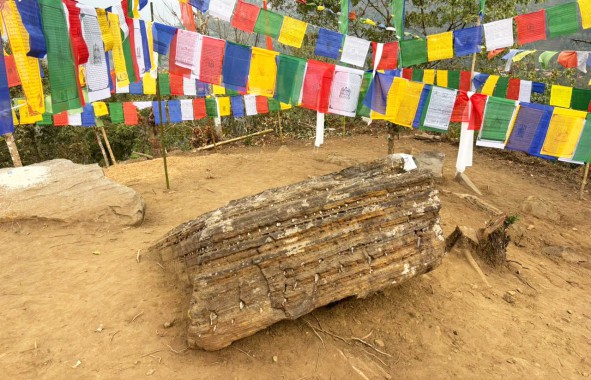

An ancient burial site in Mangmu village, located in the Maneybong-Dentam constituency of Geyzing District, has gained attention from archaeologists following the discovery of megalithic structures. Preliminary observations by the Archaeological Survey of India (ASI) suggest that this may be one of the oldest megalithic sites discovered in Sikkim.
Hari Chandra Sharma, a researcher with ASI, began investigating the site about a month ago after encountering unusual images on social media. The formations in the pictures resembled megalithic structures, prompting him to visit the site for further examination.
During his visit, Sharma identified several stone structures that could potentially represent stone platforms, pillars, or remnants of a residential complex. He emphasized that these observations are preliminary and have not yet undergone scientific validation.
Sharma explained that features like upright standing stones (dolmens), slab-like formations, and almond-shaped arrangements are characteristic of megalithic cultures. He noted that when comparing these structures to other known megalithic sites in regions such as Meghalaya and parts of South India, it appears this location could be a late megalithic burial site.
Local legends also point to the area potentially serving as a burial ground in ancient times. However, community members no longer retain a vivid cultural memory of the site, suggesting it may be extremely old and neglected over the years.
Adding to the site’s importance, reports indicate that fossil-like remains and aligned stone structures were discovered during nearby construction. While these findings need scientific verification, they highlight the area’s archaeological potential.
Sharma mentioned that the ASI can only initiate a formal investigation after receiving an official request from the State government. “Once permission is granted, ASI will conduct an intensive survey, followed by excavation if necessary,” he said, noting that this initial process could take several weeks.
Basant Gurung, a local villager, stated that until recently, the community was unaware of the megalithic significance of the site. He explained that ancestors believed visiting the area could lead to illness, leading to its avoidance. Historically, the entire site was shrouded in dense forest.
Gurung also shared that Ganit Gurung Lama originally chose the site for meditation following his monastic studies. He advocated for clearing the area to construct a monastery, and villagers collaborated in the effort. Gurung mentioned that elders in the community still advise against visiting the site at night due to reported paranormal occurrences, including sightings of glowing lights.
It was only after Sharma’s assessment that villagers recognized the archaeological significance of the location. Gurung further added that after clearing the forest, rock imprints with inscriptions in ancient Pali and Dzonga, as well as Tibetan inscriptions like “Om Mani Padme Hum,” were observed around 2005. Unfortunately, these smaller carved stones have since become invisible, believed to have fallen down a nearby cliff.
“Our activities were limited to developing the monastery area, and we had no idea about the megalithic structures,” Gurung expressed. “Now, we are happy and proud that such an important site has been identified in our village.”
If confirmed, this site could offer valuable insights into early human settlements, migration patterns, and cultural transitions in the eastern Himalayan region, revealing new facets of Sikkim’s lesser-known prehistoric past.
Original Source: https://www.sikkimexpress.com/news-details/possible-megalithic-site-uncovered-in-maneybong-dentam-in-west-sikkim
Category:
Tags:
Publish Date: