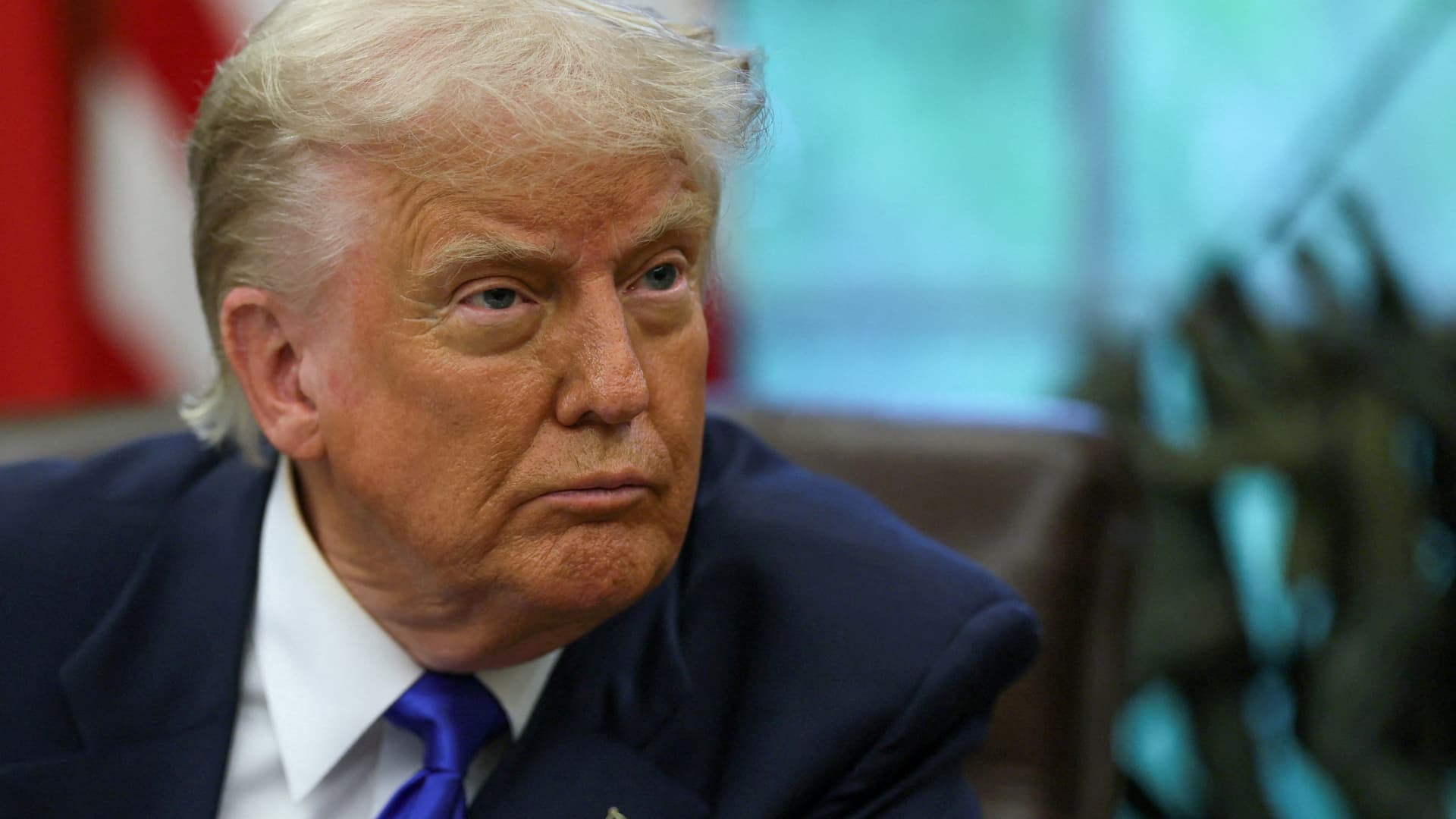

President Donald Trump’s recent assertive stance on Venezuela and threats toward other nations have spotlighted divisions among congressional Republicans as they approach a challenging midterm election year. Trump faced a setback when a majority of House Republicans opted not to override one of his vetoes, effectively halting two nonpartisan infrastructure bills aimed at benefiting Colorado and Florida. Despite this, GOP leaders continue to project confidence amid signs of instability within their ranks.
“This isn’t an unusual situation, especially as midterm elections approach,” said Senator Bill Hagerty (R-Tenn.) during an appearance on CNBC’s “Squawk Box.” A senior official from the White House characterized the dissenting Republicans as merely a “tiny fraction” of their party, emphasizing that it’s natural for party members to hold differing views from the president.
However, the week showcased notable fractures in GOP unity. Seventeen House Republicans broke from party lines to support Democrats on a vote extending enhanced Affordable Care Act tax credits for three years. This move came despite House Speaker Mike Johnson’s (R-La.) opposition and the party’s general discontent with these subsidies. The White House official indicated that while Trump is against the extension, the vote is not regarded as a defeat within the administration.
These tax credits, introduced by President Joe Biden in 2021, have become central to Democratic messaging on health care affordability. With the credits due to expire at the end of 2025, millions using ACA marketplaces face higher premiums unless action is taken. Rep. Derrick Van Orden (R-Wis.), who supported the bill, acknowledged the damage caused by the Affordable Care Act but refused to let his constituents lose their health coverage, especially as he faces a competitive reelection bid.
On the Senate side, five Republicans defied the president’s wishes by voting with Democrats on a procedural measure that might limit his military powers regarding Venezuela. Trump reacted sharply, stating on Truth Social that “Republicans should be ashamed” of those senators and insinuating they should not be elected again. Senator Todd Young (R-Ind.), one of the dissenters, sidestepped the president’s remarks, questioning why he would revise his voting stance on future War Powers resolutions.
Another Republican, Sen. Thom Tillis (R-N.C.), publicly criticized senior White House adviser Stephen Miller for what he deemed “amateurish” comments about a potential U.S. acquisition of Greenland. The White House expressed disappointment over Tillis’s remarks. In a separate move, he announced a hold on all Department of Homeland Security nominees, unrelated to a recent incident involving U.S. Immigration and Customs Enforcement agents, insisting instead on the need for respect towards Senate committees.
Despite these conflicts, Tillis partnered with Senator Jeff Merkley (D-Ore.) to pass a resolution honoring police officers who defended the Capitol on January 6, 2021. The language for this plaque was included in a larger appropriations bill in 2022 but faced obstruction from House Republicans. As the five-year anniversary of January 6 approached, Trump and his allies attempted to reshape the narrative, blaming Democrats and others while highlighting police bravery.
While the GOP grapples with internal divisions, the broader implications for the party loom large as they prepare for the upcoming midterms, where survival and unity may dictate their electoral fates. As congressional Republicans navigate their path forward, the dynamics between Trump and his party will undoubtedly remain a focal point.
Original Source: https://www.cnbc.com/2026/01/10/trump-venezuela-congress-republicans.html
Category :
Tags:
Publish Date: 2026-01-10 20:55:00