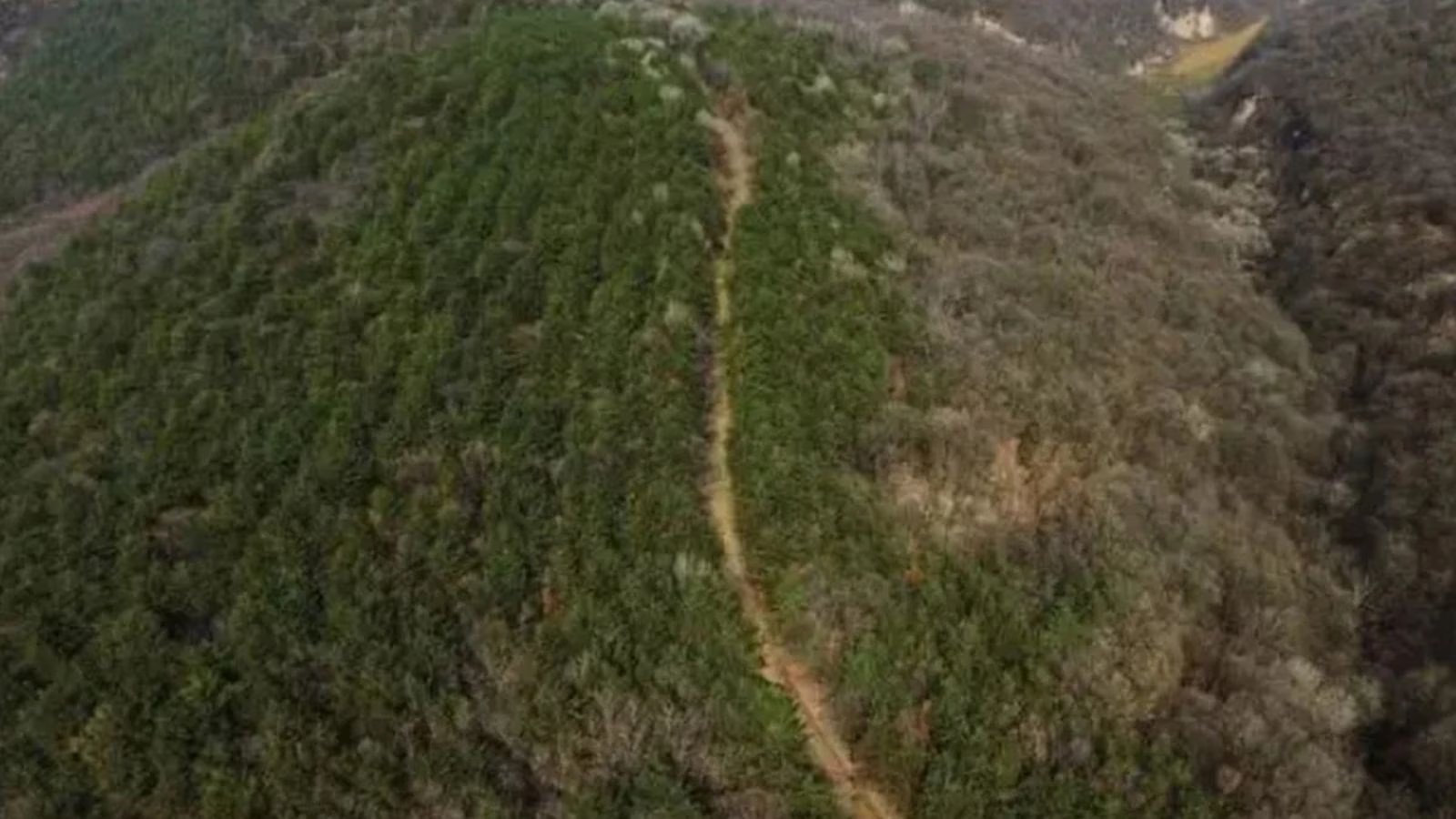

Chinese archaeologists have uncovered a newly identified section of the Qin Straight Road, one of the most ambitious infrastructure projects in the ancient world. This 13-kilometer (8-mile) stretch offers new insights into a vast highway built over 2,200 years ago to unify the core and borders of China’s first empire. The discovery was announced on December 9, following a survey conducted last year by the Cultural Heritage Protection and Research Institute of Yulin in Shaanxi province, northwest China. This newly found segment bolsters historical accounts of the Qin Straight Road, which originally spanned nearly 900 kilometers through northern China.
According to historical records, Qin Shi Huang, the first emperor of China, commissioned the construction of this road, which was remarkably completed within five years. The main objective was to establish a direct north-south route from Xianyang, the capital of the Qin dynasty in present-day Shaanxi, to Jiuyuan, now Baotou in Inner Mongolia, enabling swift movement of troops and supplies to counter the Xiongnu nomads.
Excavations along the newly identified section reveal advanced engineering methods that were quite sophisticated for their time. Archaeologists found straight, continuous trench passes, reinforced slopes composed of rammed earth, compacted roadbeds, and deliberately filled valleys that maintained a level path. The road typically measured around 40 meters (130 feet) in width, sufficient for a four-lane capacity by today’s standards, with some areas widening to as much as 60 meters.
Research teams also noted numerous trampled surfaces indicating sustained and heavy use, with the distance between the road and surrounding mountain passes ranging from 50 to 90 meters, highlighting the careful planning involved in navigating challenging terrain. Nearby, a small auxiliary site thought to serve as a relay station was discovered. Ceramic fragments indicate that this station was operational from the Qin dynasty through the subsequent Han dynasty (206 BC-AD 220). This finding reinforces the notion of the road as a long-term logistical artery instead of a mere temporary construction.
As noted by China Cultural Heritage News, a publication linked to the National Cultural Heritage Administration, the Qin Straight Road ranks as the second-largest national defense project in ancient China, following the Great Wall. It has been described as “the ancestor of the world’s highways.”
Historical texts vividly depict the immense scale of the undertaking. Ancient accounts detail how builders “filled valleys and leveled mountains” to create a straight alignment through rugged landscapes. After unifying six rival states to form China, Qin Shi Huang ordered General Meng Tian to mobilize hundreds of thousands of soldiers and civilians to complete the project as part of a broad northern defense strategy. The historian Sima Qian recorded the project’s progress in his work, Records of the Grand Historian, noting that construction began in 212 BC, continuing until the emperor’s death, with completion in 207 BC under his successor, Qin Er Shi.
Throughout the Qin era, the Great Wall and the Straight Road were paramount for military strategy. The road facilitated rapid troop and supply deployments, becoming a crucial element in resisting northern attacks, while the wall functioned as a comprehensive defensive barrier. Ironically, the route eventually allowed the very tribes it aimed to deter to penetrate deep into Chinese territory as central authority waned. To curtail this, Han authorities reportedly destroyed sections of the road multiple times.
Over the centuries, shifts in dynasties and sparse documentation caused the routing of the Qin Straight Road to become obscured. Although portions were uncovered in 1974 and additional sections in Fu County in 2009, many stretches remained unverified.
The newly identified Yulin section faced unique challenges due to the encroaching Mu Us Desert. Only in recent decades have re-greening efforts rendered investigation possible. Archaeologists utilized historical records alongside modern satellite imagery to pinpoint faint linear features where vegetation had taken root over former desert land. Field surveys confirmed well-preserved remains, including nine continuous trench sections aligned in a distinctly straight line.
Despite erosion and human activities obscuring some areas, this discovery helps fill in long-standing gaps in the known route and may inform future efforts to locate additional sections between Yulin and Ordos. Collectively, these findings validate ancient texts and enhance our understanding of pre-industrial engineering, confirming that over two millennia ago, China established one of the world’s earliest long-distance land transport networks, a crucial artery that once helped sustain an empire.
Original Source: https://indianexpress.com/article/technology/science/archaeologists-uncover-a-2200-year-old-highway-that-once-connected-chinas-first-empire-10440246/
Category: Science,Technology
Tags:
Publish Date: 2025-12-26 17:39:00