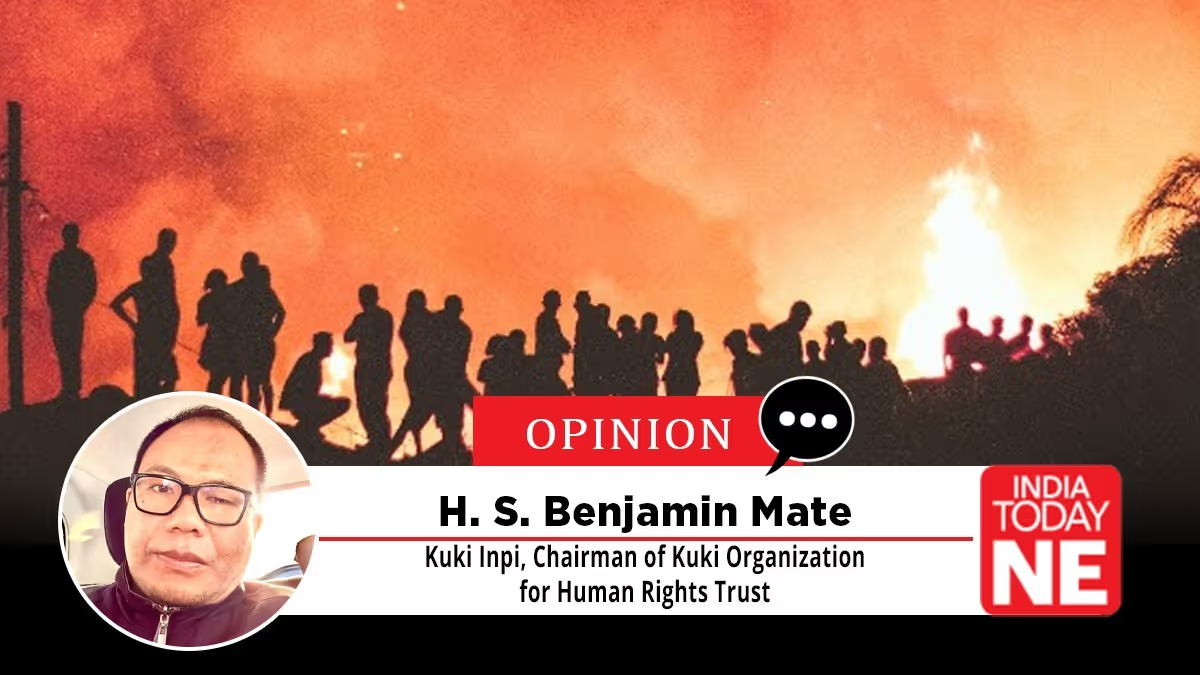

As Manipur responds to President Droupadi Murmu’s visit on December 12, 2025, which was celebrated in Imphal as a symbol of unity yet boycotted in Kangpokpi by 60,000 displaced Kuki-Zo people, tensions rise within the state. The valley’s elite are reconsidering a 58-year-old law: the Manipur Hill Areas (Acquisition of Chiefs’ Rights) Act, 1967. This previously inactive legislation aimed to “democratize” tribal lands by transferring rights from hereditary chiefs to the state with minimal compensation. Although it was passed during a euphoric post-merger period, strong opposition from hill communities led to its long-term shelving. Its renewed consideration amidst ethnic divisions suggests a strategy of erasing tribal authority over approximately 92% of Manipur’s mountainous terrain, which constitutes 40% of the state’s 2.85 million residents.
The Kuki-Zo Council (KZC) voiced strong opposition on December 1, denouncing “renewed attempts” to activate the Act as a defiance against cultural genocide rather than mere tribal resistance. With more than 4,700 homes and 386 churches destroyed in the violence of May 2023, forcing tribal chiefs to give up their lands without agreement could ignite a revolution in a region already fragile. Historical precedents warn of the dangers of undermining customary institutions, recalling past insurgencies in Nagaland and Tripura that stemmed from similar actions.
Tribal chieftainship is not a relic of feudalism; rather, it serves as the foundation of the Northeast’s pre-colonial governance, practiced long before British colonialism and Indian integration. Since independence in 1947, these systems have adapted, integrating grassroots democracy through the Sixth Schedule of 1950, which established Autonomous District Councils (ADCs) in states like Assam, Meghalaya, Tripura, and Mizoram. These councils uphold traditional practices while allowing for elected representatives. As of 2025, Nagaland’s Legislative Assembly incorporates 16 tribal councils, resolving the majority of disputes through customary laws. The Village Councils Act in Mizoram guarantees a balance between elected leaders and tribal chiefs, decreasing land conflicts significantly.
Meghalaya serves as an example of this evolution. In the Khasi and Jaintia hills, where traditional chiefs held all village lands akin to feudal lords, the establishment of ADCs in 1972 transitioned land governance to elected councils while integrating traditional chiefs. This hybrid model has led to stability, with less than 50 annual ethnic conflicts compared to over 200 in Manipur since 2023.
The Kuki-Zo people inhabit over 500 villages in districts like Churachandpur and Kangpokpi, embodying similar traditions but facing sharper challenges due to historical exclusion. The Haosa, or chief, has responsibilities that extend beyond simply holding a title; he manages communal lands and resources while serving as a leader elected from the founding clan. The Haosa administers through a council, ensuring equality and resolving the majority of disputes internally.
Kuki traditions regard land as a collective ancestral heritage, making decisions through community assembly. This framework acts as a safeguard against external influence, crucial in a region dependent on shifting cultivation, which supports a large population. Unlike the Naga system of communal land ownership, Kuki chiefs maintain authority over land rights, which explains the lack of enforcement of the 1967 Act, as it offered meager compensation that was never fulfilled.
The historical injustices in Manipur are rooted in its post-1949 merger agreements, favoring the Meitei maharaja with a monetary settlement that left over 300 tribal chiefs with no compensation, thereby making tribal lands inaccessible without their consent. Such inequities aggravate the ongoing tensions, with valley representatives branding tribal chiefs as outdated under the pretense of progress.
Enforcing the 1967 Act without safeguards poses severe risks. With 10 Kuki MLAs advocating for a Union Territory and retracting support from national movements, abolishing the Act could incite widespread armed resistance among Kuki-Zo individuals. The Supreme Court has condemned the lawlessness in Manipur and urged for an expansion of the Sixth Schedule, but the ruling party hesitates due to fears of backlash.
To prevent further conflict, a resolution modeled after Meghalaya is necessary. Granting the Kuki-Zo a Union Territory or Separate State, along with compensatory settlements, fosters a hybrid governance structure that respects historical rights while promoting equitable development. This strategy can honor regional safeguards while ensuring the consent of affected communities.
The chieftains of Manipur are not relics of the past; they are vital leaders within a dynamic framework, poised to mediate and prevent inequities from leading to violence. Ignoring their role could provoke a severe upheaval, reshaping the political landscape in a violent manner. Thus, it is crucial for New Delhi to take lessons from Meghalaya: prioritize the establishment of equitable governance and compensation to pave the way for lasting peace.
Original Source: https://www.indiatodayne.in/opinion/story/mini-kingdoms-on-the-brink-manipurs-assault-on-kuki-chieftainship-risks-a-northeastern-uprising-1316618-2025-12-12?utm_source=rssfeed
Category:
Tags:
Publish Date: 2025-12-12 22:49:00