
Unleashing Evolutionary Intelligence: Crafting the Future of Algorithm Discovery
I used to believe that the most complex problems in technology required equally intricate solutions crafted solely by expert hands. Yet, as I stand here amid the lush tea gardens of Jorhat and the vibrant woven textiles of Sualkuchi, I recognize a radical truth: the future lies not in our meticulous designs but in allowing machines to evolve on their own. Imagine this-what if we could release our grip on algorithm design and instead cultivate a creative ecosystem that shapes code as naturally as the monsoon shapes our landscape?
This shift in thinking informs our work with OpenEvolve, a revolutionary open-source evolutionary coding agent that marries the power of large language models (LLMs) with a groundbreaking quality-diversity search framework. In a world inundated with traditional, hand-crafted algorithms-where human ingenuity often drags along cumbersome heuristics-we’re flipping the script. OpenEvolve empowers machines to explore, adapt, and, most importantly, discover algorithms through a process akin to natural selection.
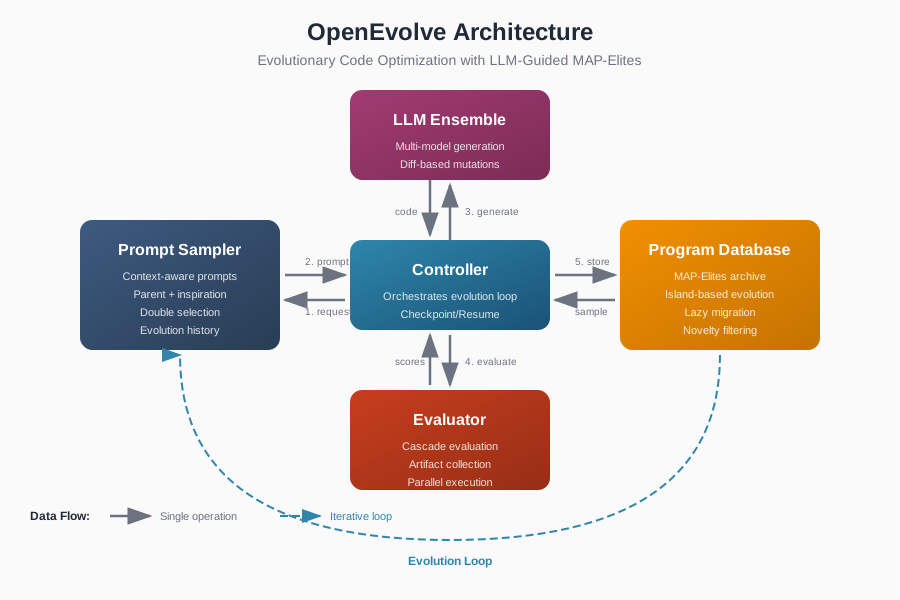
At its core, OpenEvolve comprises an interconnected structure resembling an evolving organism, comprised of five core components that facilitate a seamless evolution loop: the prompt sampler, the LLM ensemble, the evaluator, the program database, and the controller. Each of these elements plays a vital role, collectively mimicking nature’s creative processes. The prompt sampler, like a curator of ideas, enriches prompts with context and historical insights. The LLM ensemble functions as our “creative brain,” producing diverse candidate programs. Meanwhile, our evaluator serves as a discerning judge, weeding out weaknesses and nurturing the strongest contenders.
As we push the boundaries of algorithmic discovery, we find ourselves standing at the intersection of ambition and innovation. The results speak for themselves. OpenEvolve has achieved remarkable breakthroughs across various domains-from systems optimization to scientific discoveries and even GPU kernel enhancements. Take, for instance, the Algorithmic Discovery challenge. OpenEvolve has autonomously identified algorithms that accelerated computational tasks by extraordinary margins: achieving over 300 times speedup in specific calculations without any human interference. This is not merely a function of technological prowess; it’s a dramatic reinvention of how we can think about evolution in coding.
Furthermore, the versatility of OpenEvolve shines through in its capability to optimize not just algorithms but also the very prompts that guide the language models. Evolved prompts have pushed accuracy metrics on various benchmarks to unprecedented levels, demonstrating that the same principles of evolution we apply to code can similarly refine our interactions with language. This dual capability underscores a critical point: at a time when technology is often seen as a close-ended solution to open-ended problems, we can instead perceive it as an ongoing dialogue-one that we can cultivate through intelligent design and machine initiative.
The foundation of our process is rooted in an island-based evolutionary model. Just as life flourishes in distinct environments, our system evolves multiple isolated populations-each with its own trajectory, allowing for rich parallel explorations. This carefully orchestrated structure mitigates premature convergence while encouraging diversity. With each iteration, the landscape shifts-merging insights from the best-performing programs, feeding artifacts back into future generations, and infusing new life into forgotten dimensions of innovation.
Such an ecosystem reflects our local reality-much like the weavers of Majuli who create vibrant tapestries by intertwining threads of diverse colors. Their craft is not unlike the approach we take with OpenEvolve; it harmonizes complexity while remaining rooted in fundamentals. This concept of collaborative evolution serves not only the technical community but also engages those of us from Northeast India, who understand the value of nurturing rich, interwoven cultural legacies.
What lies ahead is not merely a series of algorithmic advancements; it’s an evolution of thought. We are moving from a model where human engineers attempt to control the outcome to one that embraces unpredictability, opportunity, and exploration. As we welcome this evolutionary paradigm, we find that not only can machines innovate, but they can also teach us as we learn from them-a true reflection of our shared journey toward an uncharted future.
- Takeaways:
- OpenEvolve exemplifies a paradigm shift, allowing machines to discover algorithms autonomously.
- Its evolutionary framework encourages diversity and adaptability, akin to nature’s own processes.
- The dual capability for algorithm and prompt optimization illustrates the broader potential for intelligent machine collaboration.
The future is not just about creating algorithms; it’s about nurturing a culture where evolution and innovation coexist, redefining what’s possible in technology.
About the Author
Sanjeev Sarma is the Founder Director of Webx Technologies Private Limited, a leading Technology Consulting firm with over two decades of experience. A seasoned technology strategist and Chief Software Architect, he specializes in Enterprise Software Architecture, Cloud-Native Applications, AI-Driven Platforms, and Mobile-First Solutions. Recognized as a “Technology Hero” by Microsoft for his pioneering work in e-Governance, Sanjeev actively advises state and central technology committees, including the Advisory Board for Software Technology Parks of India (STPI) across multiple Northeast Indian states. He is also the Managing Editor for Mahabahu.com, an international journal. Passionate about fostering innovation, he actively mentors aspiring entrepreneurs and leads transformative digital solutions for enterprises and government sectors from his base in Northeast India.