
The Art of Clustering: Lessons from DBSCAN and the Local Context
I used to think that complex algorithms were meant for large datasets alone, a realm where those with advanced degrees and unfathomable computational power reigned supreme. Little did I realize that tucked away in the intricacies of data science lay simple yet profound insights that apply universally-from my home in Guwahati to bustling tech hubs worldwide. This notion has been vividly illustrated by a humble algorithm known as DBSCAN.
DBSCAN, or Density-Based Spatial Clustering of Applications with Noise, proclaims its essence through its name. It reveals something crucial: density is not a uniform concept. Like the shifting landscapes of the tea gardens in Jorhat or the winding paths of weavers in Sualkuchi, data is shaped by its context. Instead of relying on an overarching parametric model, DBSCAN reveals clusters based on localized patterns and interactions, a lesson that rings strong amidst the evolving data dialogue.
As I contemplated this, I realized that DBSCAN’s approach resonates with how we perceive our surroundings. We naturally categorize experiences based on proximity and relationships: two friends chatting on a bench become a cluster of camaraderie, while the lone stranger walking by signifies something else entirely. In the same vein, DBSCAN takes a multipoint approach, gauging how many neighbors each point has within a predefined radius, a concept beautiful in its simplicity yet powerful in its implications.
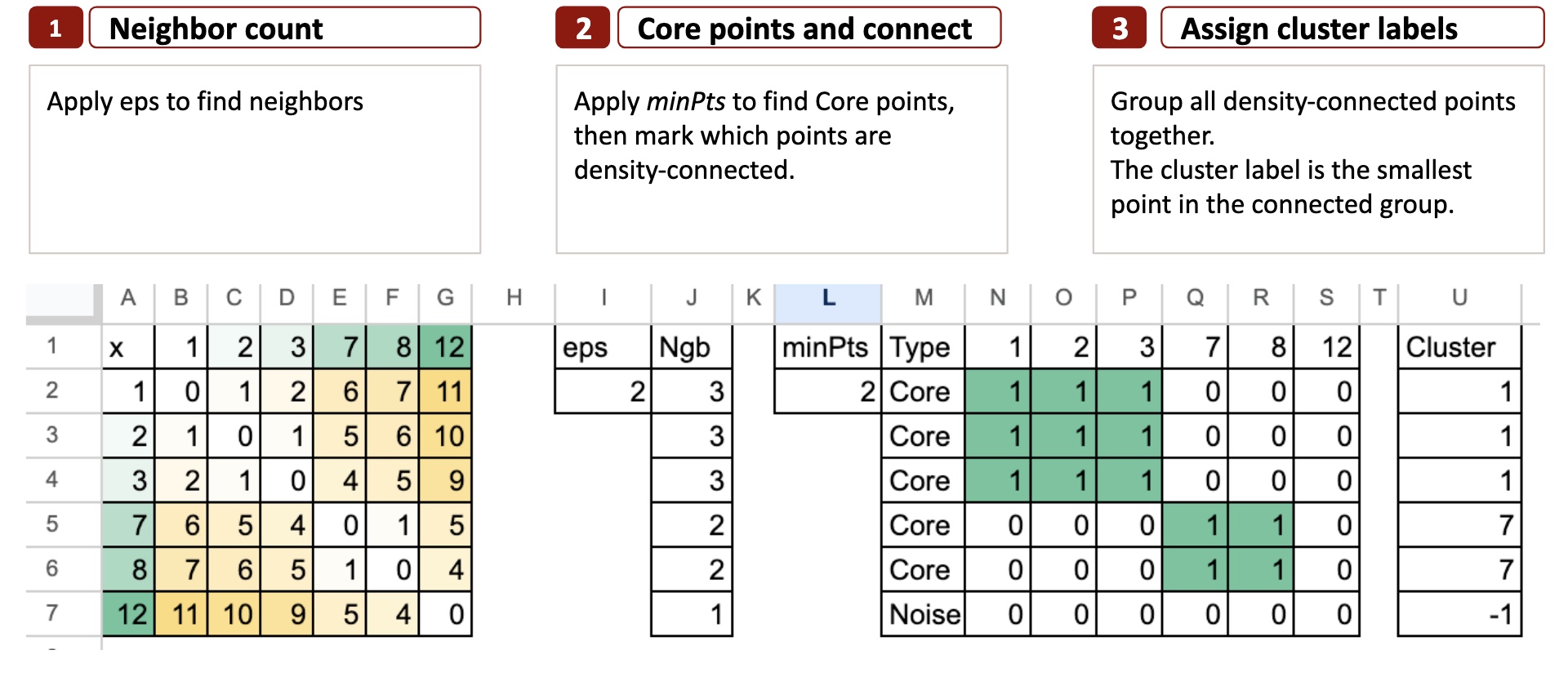
To visualize this, consider a tiny dataset: the numbers one through twelve. Within these seemingly simple digits lie implicit structures, much like my community’s social fabric. There’s a connection among 1, 2, and 3; they form a tight-knit group. Then there’s another mix of 7 and 8, while 12 stands isolated, alone. DBSCAN effectively captures these intuitions by first calculating how many neighbors each point has, thus shedding light on the underlying density in the dataset.
This process of clustering and anomaly detection is critical in today’s context, as we navigate a world inundated with information. Much like Northern India’s flood management strategies, where localized responses are essential for major outcomes, DBSCAN provides a framework that illustrates why understanding the nuances of density can guide more effective solutions.
When breaking down DBSCAN, one sees that it asks vital questions. How many neighbors do you have? Do you qualify as a Core point? Who can reach you based on these connections? These queries, seemingly simplistic, hold profound implications for how we can interpret our world, both digitally and socially. The algorithm converges to a point where connections among Core points facilitate our understanding of clusters, illuminating paths that mirror the interconnectedness of human relationships across Majuli’s river islands.
In this dance between connectivity and structure, we find the beauty of labels emerging. DBSCAN cleverly assigns a group a name based on the smallest point within that cluster. It reflects an innate human craving for categorization, reminiscent of how we label our friendships or professional connections: the “tight crew,” the “network of advisors,” the “support circle.” Yet, it also introduces noise-those points that don’t neatly fit into established categories, reminding us that every community has its anomalies and not everything can be classified.
Yet, this algorithm’s simplicity is its limitation. By operating with a single fixed radius, DBSCAN struggles when faced with clusters of varying densities, a parallel to how sometimes we force our experiences into preconceived molds. The adaptive nature of HDBSCAN emerges as a solution, echoing our need for flexibility in understanding the complexities of human behavior and relationships.
As I reflect on these nuances, my perspective continues to evolve. The strength of a clustering algorithm doesn’t solely reside in its mathematical elegance-it lies in its capacity to teach us about the world. When applied within the diverse context of Northeast India, from the fertile plains of Assam to the vibrant artisanship of Sualkuchi, DBSCAN highlights that each point, each connection, is part of a grand narrative.
In a world increasingly driven by data, let us not forget that behind every number lies a story. Each point of data is a voice that contributes to the richness of our collective experience.
Takeaways:
- DBSCAN illustrates the importance of localized understanding in clustering and pattern recognition.
- The algorithm’s focus on neighborhood density parallels human behavior, emphasizing connections in our communities.
- Flexibility in approach, as seen in HDBSCAN, is crucial for adapting to the complexities of various datasets and real-life situations.
In the end, every cluster tells a story, and every point reminds us that connection is the heart of understanding.
About the Author
Sanjeev Sarma is the Founder Director of Webx Technologies Private Limited, a leading Technology Consulting firm with over two decades of experience. A seasoned technology strategist and Chief Software Architect, he specializes in Enterprise Software Architecture, Cloud-Native Applications, AI-Driven Platforms, and Mobile-First Solutions. Recognized as a “Technology Hero” by Microsoft for his pioneering work in e-Governance, Sanjeev actively advises state and central technology committees, including the Advisory Board for Software Technology Parks of India (STPI) across multiple Northeast Indian states. He is also the Managing Editor for Mahabahu.com, an international journal. Passionate about fostering innovation, he actively mentors aspiring entrepreneurs and leads transformative digital solutions for enterprises and government sectors from his base in Northeast India.