China’s November Exports Soar Beyond Expectations Amidst U.S. Trade Truce: A Moment of Triumph!

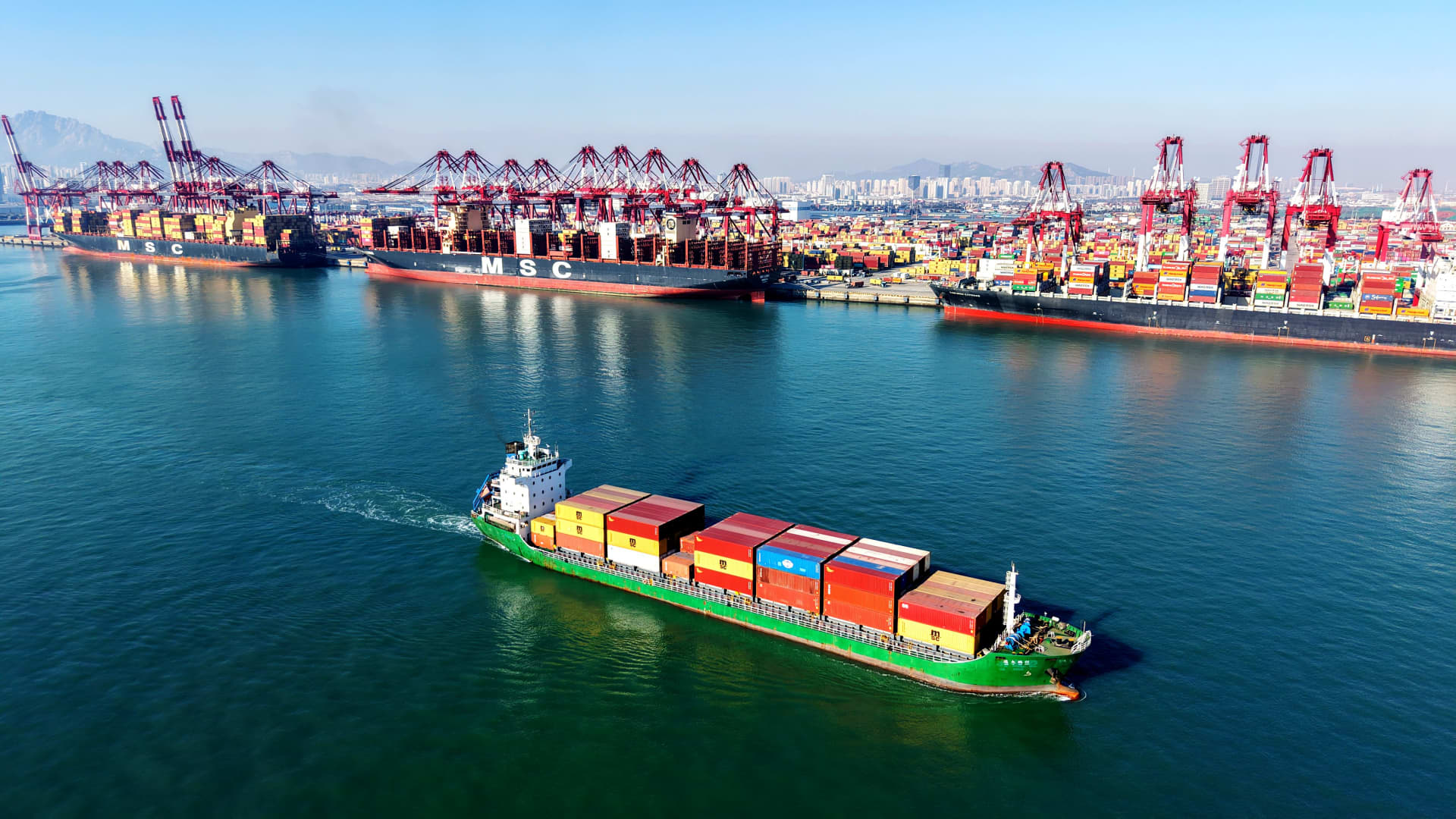
A cargo ship loaded with containers departed from Qingdao Port in Shandong Province, China, on December 4, 2025, amid a continuing trend of declining exports to the United States. Despite a recent trade agreement between Washington and Beijing, November marked the eighth consecutive month of falling U.S.-bound goods from China. This downturn comes even as overall Chinese exports exceeded projections, with outbound shipments rising 5.9% year-over-year in dollar terms, as reported by China’s customs data. This growth surpassed economists’ expectations of 3.8%, rebounding from a surprising 1.1% drop in October-the first contraction since March 2024.
On the import side, China experienced a modest 1.9% rise in November, although this fell short of the anticipated 3% growth. The ongoing issues in the housing sector and rising job insecurity remained significant obstacles to domestic consumption. While this figure reflects improvement compared to October’s 1% increase, it highlights the continuing challenges for the Chinese economy. In response to criticism over its export strategies, Chinese officials have reiterated their commitment to expanding imports and balancing trade.
Exports to the U.S. dropped 28.6% in November, marking consistent double-digit declines in shipments to the world’s largest consumer market, despite a trade deal reached by President Xi Jinping and U.S. President Donald Trump in late October. Imports from the U.S. also saw a sharp contraction of 19% year-over-year. Gary Ng, a senior economist at Natixis, noted the persistent issue of high tariffs, stating, “Despite the trade truce, the U.S. still imposes higher tariffs on China than on many other countries.” He added that Chinese exporters may increasingly rely on alternative routes via third markets to maintain access to U.S. consumers.
Current tariffs on Chinese goods are approximately 47.5%, while Beijing imposes around 32% on imports from the U.S. So far this year, China’s exports to the U.S. have fallen by 18.9%, with imports declining by 13.2%. However, this decline was more than offset by robust growth in shipments to other regions, notably the European Union and the Association of Southeast Asian Nations (ASEAN), where exports surged over 8% and nearly 15%, respectively.
In the year’s first eleven months, China’s total exports increased by 5.4% compared to 2024, while imports fell by 0.6%, resulting in a substantial trade surplus of $1.076 trillion-up 21.6% year-over-year. Following the recent trade agreement, Beijing and Washington consented to roll back tariffs, and China pledged to import more U.S. soybeans and enhance collaboration on curtailing fentanyl trafficking.
Additionally, China’s exports of rare earth minerals saw a significant increase in November, with shipments reaching 5,494 tons-up 24% from a year earlier. However, soybean imports, while growing by 13% to 8.1 million metric tons, fell short of expectations, causing concerns about China meeting its commitment to purchase 12 million tons of U.S. soybeans by year-end.
As policymakers prepare for the annual Central Economic Work Conference, discussions will focus on economic growth targets and priorities for the upcoming year. Analysts predict that China’s export recovery could help buffer the economy against weak domestic demand, potentially aiding in achieving a growth target of around 5% in 2025. Zhiwei Zhang, president and chief economist at Pinpoint Asset Management, emphasizes that these export gains may provide some relief. Furthermore, it is expected that continued policy easing will be necessary to stimulate growth as the Chinese economy faces pressures from declining manufacturing activity and a sluggish housing market.
As currency markets shift, the recent strengthening of the yuan, which has risen nearly 5% since April, poses questions regarding its influence on export activity. Weijian Shan, CEO of PAG, articulated the need for China to pivot towards domestic consumption, urging that a stronger yuan could enhance purchasing power and stimulate economic growth.
This evolving narrative in China’s trade landscape reflects a complex interplay of international relations, economic strategies, and market dynamics that continue to shape the global economy.
Original Source: https://www.cnbc.com/2025/12/08/china-export-imports-trade-november-us-tariff-truce-.html
Category :
Tags:
Publish Date: 2025-12-08 11:36:00