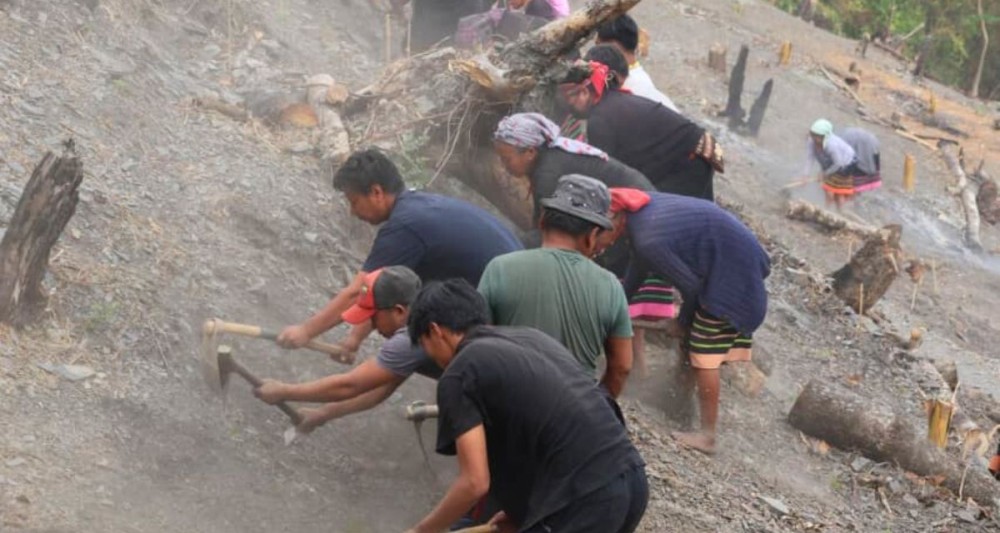

Kohima, Nagaland: After nearly 40 years of decline, millet cultivation is experiencing a revival in Kezoma village, located about 40 kilometers from Kohima. This resurgence is driven by Nagaland’s National Food Security Mission (2024-25) and the International Year of Millets. Approximately 400 farmers have cultivated 10 hectares this year with support from modest government incentives, machinery, and technical guidance.
Despite the progress, challenges remain, including labor-intensive farming, limited seed access, and a lack of branding or market ties. However, the success of Kezoma’s inaugural Millet Festival, which generated sales of over Rs 14 lakh, has motivated farmers to persevere in growing this once-neglected crop.
Kekhrieletuo Yhome, the District Agriculture Officer (DAO) of Kohima, noted that the Department of Agriculture has prioritized millet cultivation under the National Food Security Mission, emphasizing the need to restore this declining practice. The department has supplied financial aid, technical assistance, and equipment, including a millet separation and de-husking mill to streamline labor-intensive processes.
“The financial support is modest, approximately Rs 10,000 for each of four farmer groups,” Yhome explained. “We’ve distributed machinery like de-husking mills and plowing machines.”
In the 1980s, millet cultivation nearly vanished as farmers shifted their focus to rice and garden vegetables. Kikrosa Naki, Chairman of the Kezoma Village Council, recalled, “By the 1980s, millet farming was mostly abandoned. Those without enough land for rice used to grow millets in the forests, but rice gradually took over.”
Village elder Zadeho Rikha remarked that millets were once considered food for the poor, with people preferring rice due to its texture. Those with sufficient rice often used millets as animal feed, and cultivating millets in the jungle was linked to social status.
While jhum cultivation was communal, rice farming became more individualized, contributing to millet’s decline.
A turning point occurred in 2023 when members of the village council attended the International Year of Millets event at the 24th Hornbill Festival in Kohima. Naki recounted, “Chief Minister Neiphiu Rio discussed the health benefits and economic potential of millets. We returned determined to cultivate them on a larger scale, as our village was familiar with the crop.”
Until 2024, millet farming had been restricted to small patches, with Yhome stating, “There were no records, likely less than one hectare in total. Farmers were growing millets on tiny plots of 10-20 square feet.”
Due to decades of neglect, the village had a scarcity of seeds. Naki shared, “We worked hard to collect seeds throughout the year. Varieties native to our village include Vipoho Chü, Chütole, Mezhochü, and Chüyole Chü.”
This year, the village launched an extensive cultivation drive involving local clans, churches, and self-help groups. Nothutso Thami, leader of Yohotsomi B Khel, noted that roughly 70 farmers planted millets over two hectares in March. They harvested around 400 kilograms by late July.
Thami confirmed that four varieties of millets native to Kezoma were cultivated, yielding a total of four to five tonnes, according to the Village Council Secretary, Vizovo Yongo. “About 400 farmers participated in the cultivation,” Yongo reported.
In line with the National Food Security Mission, agriculture officials organized a millet demonstration in March. Yhome pointed out that Kezoma’s climate, characterized as arid-humid and moderate, is conducive to millet growth. “Kezoma, along with Chiechama and Mima, has enhanced millet farming. Cultivation fell to nearly zero but has now reached about 10 hectares, and we anticipate further growth,” he stated.
The department also provided logistical support, with Naki mentioning that government-provided mills have made de-husking faster and easier.
Thami added that financial aid was instrumental during the mass cultivation and for the logistics of the Millet Festival on August 30. Yet, challenges linger. Farmer Eyosanu remarked, “Once the millets begin bearing seeds, we must protect the fields day and night from birds. This period is critical in the weeks leading up to harvest.”
Despite the dwindling of cultivation, villagers have continued to celebrate their traditional millet festival, Chünyi, meaning “Millet Festival.” Naki explained that it marks the first millet harvest and the completion of paddy transplantation, celebrated every year on July 20 in Kezoma and neighboring areas.
Chünyi spans two days: Kide, a day of ritual, and Kreuo zha, a day for relaxation and celebration. “A key aspect is the sacrifice of a dog or piglet,” Rikha noted. “Eating the meat is believed to restore strength after the hard work of harvest and planting.” During the festival, elders would also pray for rain. In the past, neighboring villages sought Kezoma’s participation to pray for needed rainfall.
This year, Kezoma partnered with the Departments of Agriculture and Tourism to host its inaugural Millet Festival. Experts and visitors from neighboring areas attended to buy millets and sample various millet dishes.
“Government support was crucial during the festival,” Thami reiterated. According to the village council, the event brought in approximately Rs 14 lakh from millet sales and Rs 80,000 from cooked dishes, with Yongo adding, “Millets sold out within hours.”
The festival also enabled farmers to market other local products and revive interest in millet cultivation, creating income opportunities and demonstrating high demand. Visitor Mezatso remarked, “As a diabetic patient, my wife and I prefer millet over rice. Fresh millets at this price are rare.”
Most millets are now sold directly to individuals or local vendors who resell them at higher prices in town. “Given the demand, most of our stock sold out right after the festival,” Yongo mentioned.
While Kezoma has no immediate plans to market its millets formally beyond the village, farmers are optimistic about sustaining cultivation. “As long as farmers keep working their fields, millet farming is viable,” Yongo noted. “It requires less financial input, although it’s labor-intensive.”
He mentioned that many farmers plan to transition from collective to individual cultivation next year, saying, “With good returns this season, optimism is high for increased production.” The DAO underscored that ongoing collaboration among departments and the community will be critical for scaling up. “Success will hinge on consistent support for farmers,” Yhome concluded.
Yongo indicated that the village has already planted a second batch of millets in August for a late harvest, expressing hope for positive results. Rikha observed a shift in the perception of millets: “In the past, you would get twice as much millet for a kilogram of rice. Now, millets cost around Rs 300 per kilogram due to their recognition as a healthy food, but they remain scarce on the market.”
By fusing traditional agriculture with modern support, Kezoma demonstrates how an ancient crop can pave the way for a more resilient food future in Nagaland.
Original Source: https://www.morungexpress.com/in-nagalands-kezoma-an-old-grain-finds-new-ground
Category: Public Space
Tags:
Publish Date: 2025-11-28 19:09:00