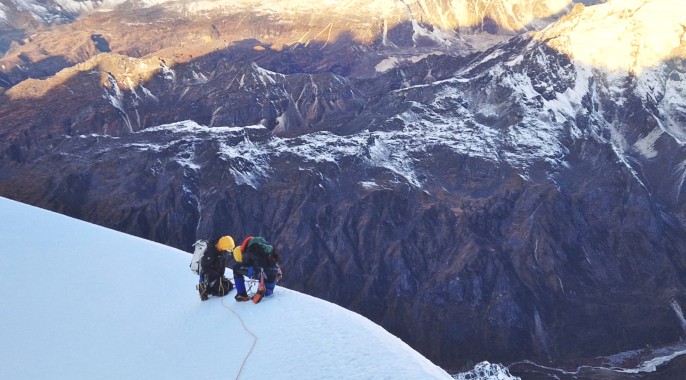

The Sikkim Mountaineering Association (SMA) has urged the state government to open additional mountain peaks for expeditions, highlighting their potential to enhance adventure tourism, local employment, and Sikkim’s mountaineering heritage. In a statement titled “Appeal to Open Peaks for Sikkim’s Future,” SMA president Kunzang Gyatso Bhutia expressed concerns that, despite housing over 325 identified mountain peaks, Sikkim has not fully reentered the mountaineering scene.
Bhutia emphasized, “As a mountaineer, I believe that Sikkim is yet to fully return to the mountaineering field.” He noted that mountain climbing, while risky, continues to forge strong connections between climbers and the land. Acknowledging the religious significance of 12 permanently closed peaks, he pointed out that, despite six years of discussions with government officials, the proposal to open more peaks has yet to be addressed.
The SMA president identified deeply entrenched cultural sentiments as a significant barrier. “Mountaineering is often viewed as desecration,” he stated, noting that the local population perceives mountains as sacred. The government faces a complex dilemma: balancing the economic benefits of adventure tourism while respecting local opposition, often reinforced by laws like the Places of Worship Act, which prohibits climbing on sacred peaks. In 2019, local protests against a proposal to open 14 peaks led to a reversal of the policy, underscoring the sensitivity of the issue, he added.
Despite this, the SMA remains committed to the ban on the 12 sacred peaks, including the main summits of Mt. Khangchendzonga. Bhutia advocates for opening non-sacred peaks, stating, “By focusing on non-sacred mountains, we can foster a sustainable mountaineering industry that respects cultural values.” The association has proposed around 87 peaks, ranging from 6,000 to 7,999 meters, for expeditions. Bhutia pointed out that other Indian states, such as Ladakh, Himachal Pradesh, and Uttarakhand, have already made strides in promoting mountain tourism, with Ladakh opening 115 peaks in 2018.
“Sikkim stands to gain immensely once its peaks are opened,” he remarked, asserting that mountain tourism can boost visitors and generate income, especially in regions like Lachen, Lachung, and Yuksam. Drawing lessons from Nepal’s successful mountain tourism model, he asserted that Sikkim could significantly uplift government revenues and improve livelihoods for those working in tourism-guides, porters, homestay owners, and transport providers alike.
Bhutia pointed out that Nepal has invested heavily in local guiding, rescue, and tourism infrastructure, suggesting that Sikkim could adopt similar strategies to better accommodate international climbers. He emphasized the need to modernize and simplify the permit process to attract more global mountaineers.
He also mentioned that a significant portion of tourism revenue in Nepal goes directly to local communities, a model Sikkim could emulate. However, he warned that Sikkim must steer clear of the mistakes made by Nepal regarding overcrowding and environmental damage and instead focus on sustainable, low-impact tourism.
Encouraged by Nepal’s initiatives, which open lesser-known peaks and provide free permits for climbing to draw visitors to less-explored areas, Bhutia urged Sikkim to recognize its mountains as potential growth engines rather than solely sacred deities. He affirmed, “The SMA is ready to implement a responsible ‘Sikkim Model’ that harmonizes tradition, ecology, and economic prosperity for the lasting benefit of the state and its people.” He concluded by underscoring that opening more peaks could solidify Sikkim’s identity as a prominent mountaineering destination and lay the groundwork for a sustainable tourism framework for generations.
Original Source: https://www.sikkimexpress.com/news-details/beyond-the-sacred-peaks-sma-draws-attention-towards-sikkims-untapped-mountains
Category:
Tags:
Publish Date: