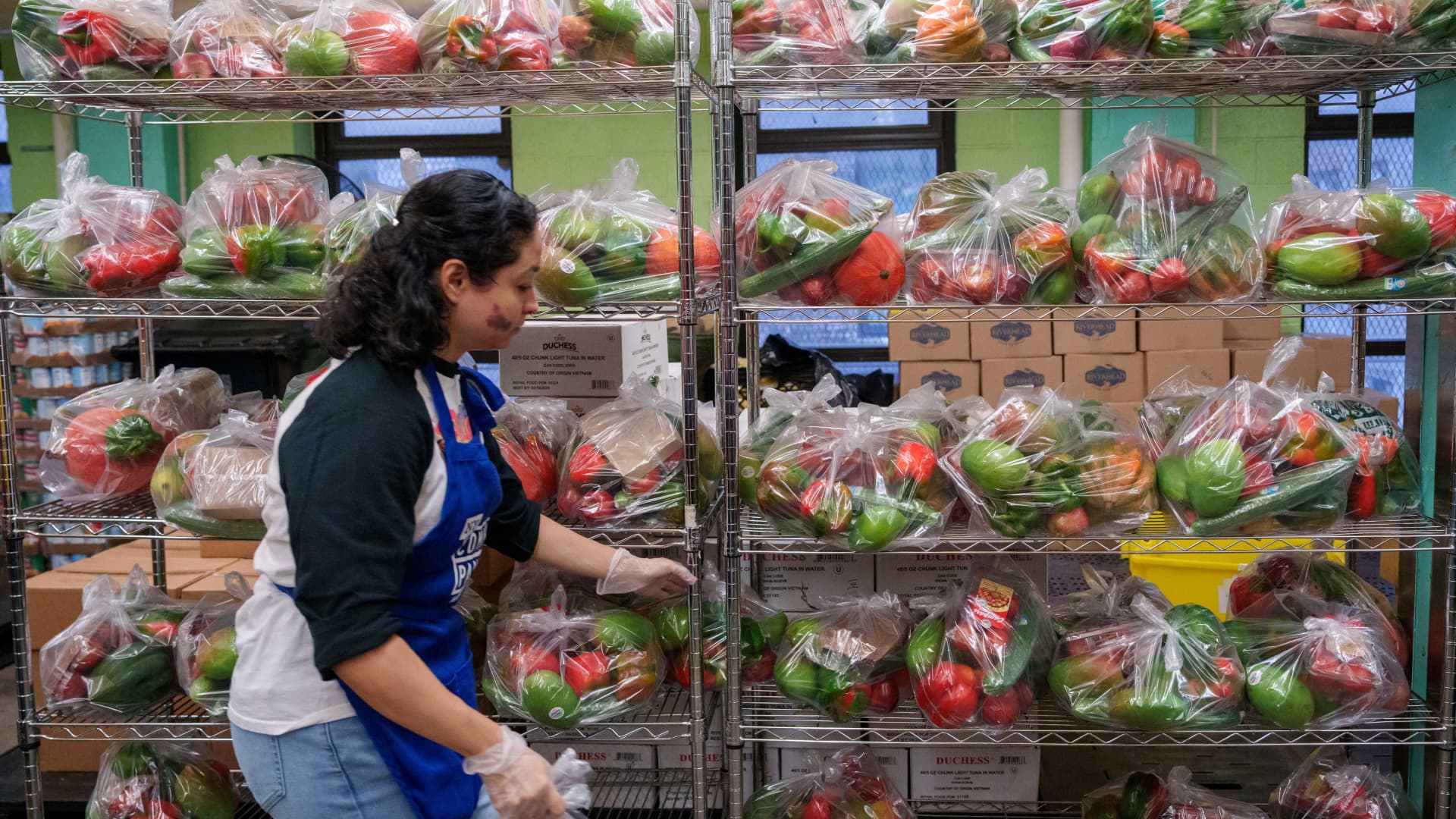
Combatting Hunger: Unveiling SNAP Food Stamps and How America Wastes $400 Billion in Meals Each Year

Millions of Americans face looming fears of hunger as delays in SNAP (Supplemental Nutrition Assistance Program) benefit payments threaten their food security. This anxiety persists despite a federal judge ruling that payments should resume this November. In a country where nearly $400 billion worth of food goes to waste annually, the stakes are high. According to ReFED, a U.S.-based nonprofit focused on food waste, $382 billion of surplus food was produced in 2023 alone.
“Forty percent of food produced globally ends up in landfills,” noted Chris MacAulay, head of North America for Too Good to Go, a marketplace that connects consumers with surplus food from grocery stores and restaurants. “Imagine standing in front of your refrigerator and tossing half of it out-that’s the scale of this waste.” Too Good to Go offers consumers “surprise bags” filled with food that would otherwise be discarded, allowing businesses to recoup some costs by providing discounted meals.
MacAulay emphasized the importance of their service, especially as Americans feel increased pressure on their grocery budgets. “You don’t know what you’re going to get, but you can expect great food at a 50 to 60 percent discount.” As SNAP payment issues arise amidst broader cuts to food assistance driven by past tax reforms, innovative solutions for food waste become more critical.
On a hopeful note, Treasury Secretary Scott Bessent announced payments could start again by Wednesday, but the broader landscape raises concerns. Donation, composting, animal feed, and surplus food marketplaces play vital roles in addressing waste, but MacAulay insists there is no single solution; a multifaceted approach is essential.
The food waste sector is increasingly attracting interest from investors. Effram Kaplan, a managing director at Brown Gibbons Lang & Company, noted, “The amount of transaction activity and interest in the sector is impressive.” He mentioned that while waste management isn’t a new field, its potential for reliable returns is gaining attention, particularly in the U.S., where capital from sophisticated investors has only recently begun to flow.
Various startups are also tackling food waste at both consumer and commercial levels. Mill, for instance, has garnered $100 million to develop a smart kitchen bin that minimizes leftover food waste. Similarly, Metafoodx, with $9.4 million in recent funding, is developing a 3D AI scanner to track food usage and waste in commercial kitchens. Buddy Bockweg, CEO of Vsimple, states that leveraging technology can streamline operations and enhance profitability for waste management firms.
Tyler Frank, founder of Garbage to Garden, launched his composting business with just $300. Today, it serves 50,000 subscribers and is expanding its municipal contracts. “This is a recession-resilient business,” Frank stated, noting the persistent need for waste solutions across economic conditions.
Interestingly, lower-income households tend to waste less food, according to Ben Scharadin, an economics professor at Colby College. “Stricter budget constraints lead to more thoughtful food planning,” Scharadin explained. Consequently, those on SNAP benefits often waste less than their more affluent counterparts. However, he warned that expected SNAP cuts could disrupt the circular economy, pushing consumers towards secondary food markets for lower quality yet affordable options.
Amidst emerging solutions to address food waste, the primary objective must remain clear: reducing waste at its source. Innovative companies must balance their efforts with a commitment to minimize food waste wherever possible. Ultimately, as the national conversation on food security continues, the interaction between meals saved and those at risk of going hungry remains a pressing concern.
Original Source: https://www.cnbc.com/2025/11/02/snap-benefits-hunger-in-america-us-food-waste.html
Category :
Tags:
Publish Date: 2025-11-02 23:47:00