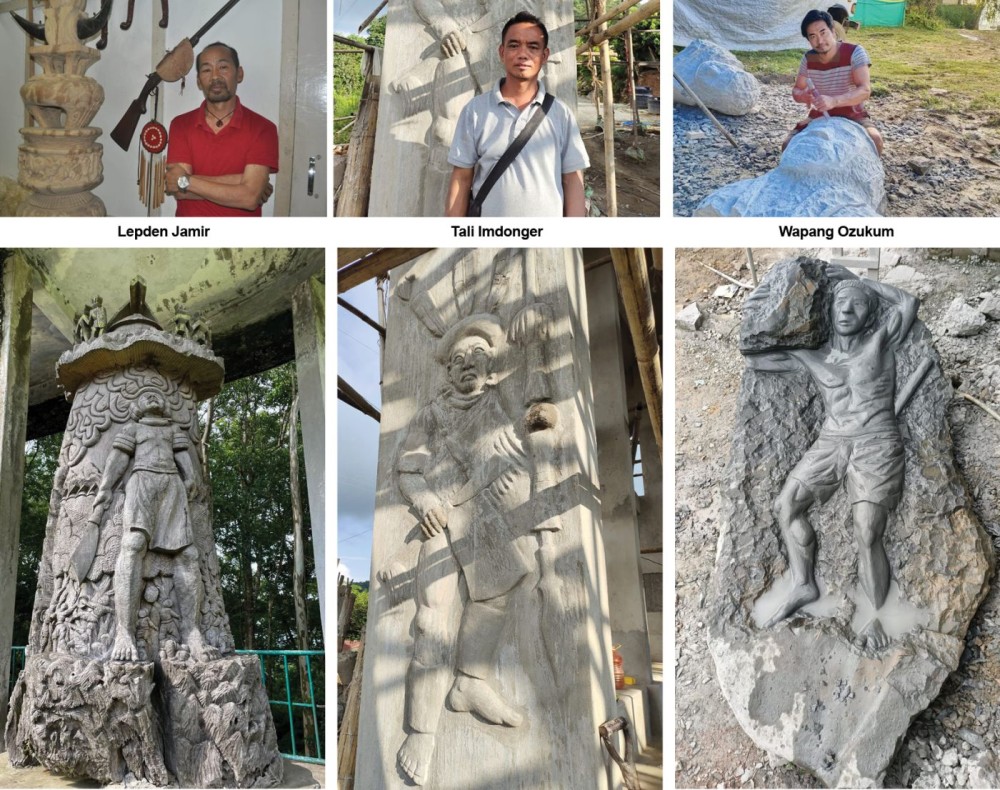

In a backyard in Mokokchung, the rhythmic sound of a chisel striking stone fills the still afternoon air. Amid the dust and debris, 39-year-old Wapang Ozukum patiently chisels away, slowly revealing the shape of a shoulder and hints of a face from the solid rock. For nearly twenty years, Wapang has dedicated his skills to shaping monuments and memorials from stone and wood, preserving the history of Nagaland. “This kind of stonework was not known in our place,” he shares, wiping his hands on a cloth stained with dust. “I discovered it myself.”
Wapang’s journey began in 2013 in Chungtia village, where he made his first significant contribution by sculpting a bust to celebrate the church’s centennial. “No one taught me,” he recalls. “I experimented, failed, and studied until I succeeded.” The stones he uses are sourced from Ungma village, selected for their finer texture that allows for detailed work. To extract these stones, he employs JCB excavators and transports them to a spacious backyard provided by his brother-in-law, as his own yard lacks the space for such large projects. He leads two assistants from the Chang community in the work, though he insists on doing the detailed work himself.
Wapang’s reputation has spread across Nagaland, with his work including public sculptures and memorial busts. His hands, shaped by years of labor, bear the marks of each piece. He created the grand entrance for Nagaland’s first medical college in Kohima, spending nearly a year on the project. Currently, he is carving the main wooden door for P. Shilu Park in Mokokchung, emphasizing that structures meant for public use should resonate with life. Each project takes six months or more, and he has completed around twenty, including the notable bust of Imkongmeren in Longkhum village. “You can’t take on many projects at once,” he explains. “You must be fully immersed. Every curve and line has to come from within.”
Despite his accomplishments, including a Governor’s Award in 2021, Wapang voices concern for the future of his craft. He laments the lack of appreciation for hard labor in Nagaland, observing that many aspire to white-collar jobs while neglecting the value of skilled trades. As a father to a three-year-old, he worries that the younger generation lacks the commitment to pursue this craft.
Another craftsman, Tali Imdonger, 47, is currently working on a monumental gate in Khensa village. He shapes figures that will welcome visitors, ensuring they appear strong and inviting. “This is what you’ll see when you leave the village,” Tali notes, describing his vision for the gate, which he aims to populate with welcoming figures alongside fierce warriors.
Tali’s craftsmanship has also established his name in Nagaland. He began by carving small wooden portraits and sculptures without any formal training, driven solely by passion. Over nearly two decades, he has created more than ten village gates and several monuments, including the Longsa Eagle Club Monument, which he considers his best work. He also carved significant projects like the Ao Naga Morung at Kisama Heritage Village. Like Wapang, Tali faced unexpected challenges; after completing his education, he struggled to secure a government job. Ultimately, he followed his passion for art, which now supports his family.
At 63, Lepden Jamir stands as a philosophical figure in the art community of Nagaland. He describes everything as art, from daily life to emotional expressions. His diverse works include painting, sculpture, and poetry, which he pursued from a young age, drawing traditional motifs. Without formal mentorship, he learned alongside peers but later found his calling by enrolling in fine arts.
Today, Lepden is one of Nagaland’s most recognized artists and a holder of a Governor’s Award. His sculptures reflect Naga folklore and personal philosophy, emphasizing the importance of storytelling in art. He expresses concern over the decline in artistic institutions and critiques, suggesting a need for guidance in nurturing creativity.
Wapang, Tali, and Lepden represent three generations of artisans linked by their dedication to preserving cultural narratives. Despite facing challenges and financial uncertainties, they continue to weave their stories into the very fabric of Nagaland’s cultural landscape. Through their craftsmanship, they embody a memory that may resist fading, declaring that in the end, they are not merely constructing monuments but also crafting lasting legacies of identity.
Original Source: https://www.morungexpress.com/carving-time-the-hands-that-build-memory-in-nagaland
Category: Morung Exclusive , Nagaland
Tags:
Publish Date: 2025-10-24 23:58:00