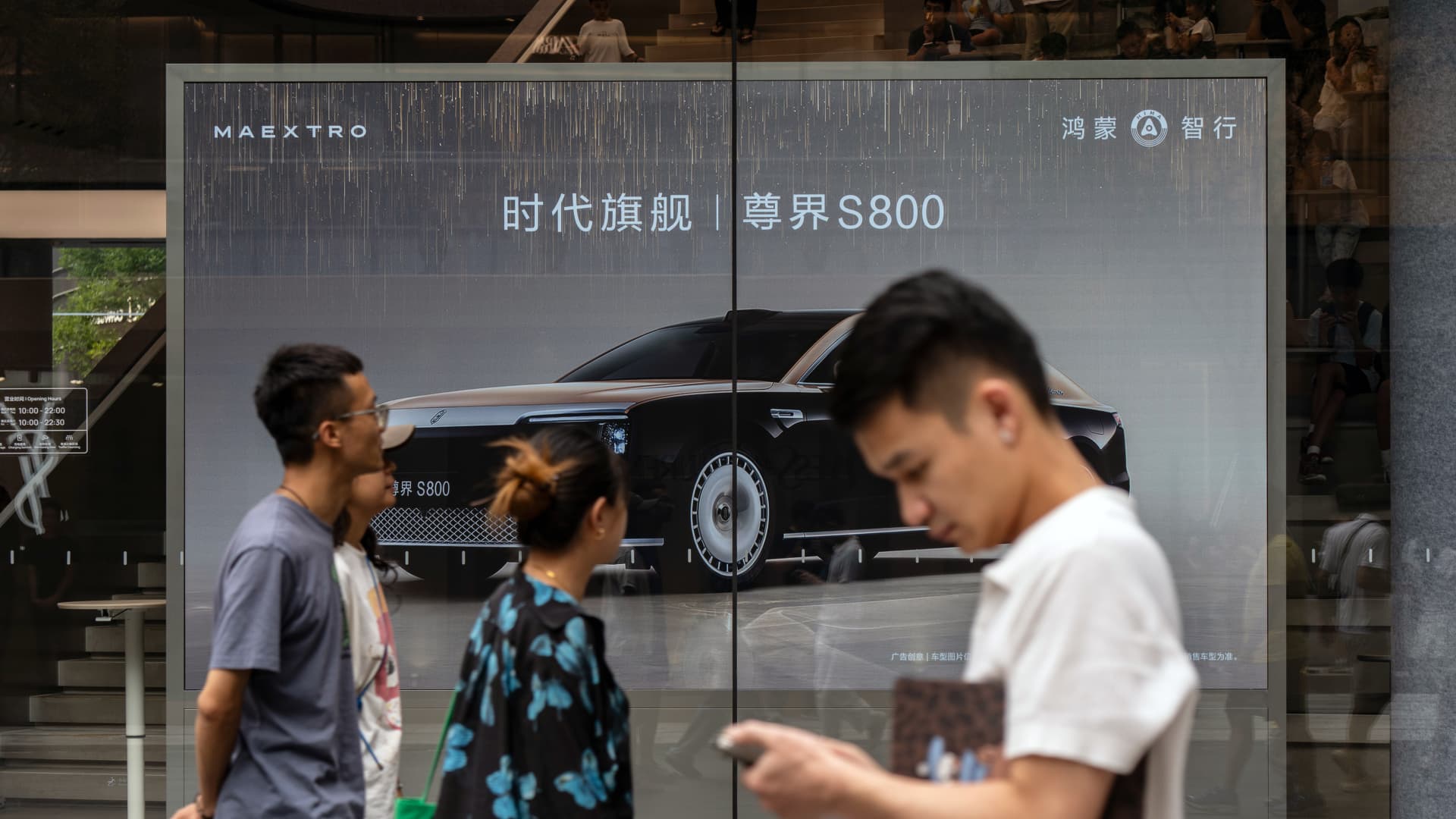

Pedestrians were seen passing a Huawei Technologies Co. flagship store in Shenzhen on October 8, 2025, as new economic data revealed a concerning trend for China. The National Bureau of Statistics reported that consumer prices dropped more than anticipated in September, falling 0.3% year-on-year. This decline surpassed economists’ expectations of a 0.2% decrease and marked an easing from August’s 0.4% drop. Month-on-month, prices saw a modest uptick of 0.1%, falling short of the predicted 0.2% increase.
Core Consumer Price Index (CPI), which excludes volatile food and energy prices, presented a slight silver lining, rising 1.0% from the previous year-the highest growth since February 2024. However, Zhiwei Zhang, president and chief economist at Pinpoint Asset Management, cautioned against premature conclusions about deflationary pressures fading. He noted that renewed trade tensions and uncertain growth outlooks continue to negatively impact demand recovery. “It is too early to conclude that the deflationary pressure is fading at this stage,” Zhang added.
China’s Producer Price Index (PPI) also reflected a downward trend, decreasing 2.3% year-on-year in line with economists’ projections. Nevertheless, the pace of decline has moderated for two consecutive months, with drops narrowing from 2.9% in August and 3.6% in July. This ongoing producer price deflation, lasting nearly three years, has strained profitability for manufacturers, who are grappling with weakened consumer confidence and disruptions attributed to U.S. trade policies.
Weak consumer demand continues to plague China’s economy, which has already been struggling with a long-standing housing downturn, coupled with pressures from U.S. tariffs on exports. Although China’s overall exports have shown growth this year, shipments to the U.S. have witnessed double-digit declines since April. Dong Lijun, a spokesperson for the NBS, explained that the decline in CPI could be partly attributed to the “tail effect” from higher prices last year, asserting that, after adjusting for this factor, consumer prices rose by 0.5% year-on-year.
The report revealed significant price drops in key categories, including food and energy, which fell by 4.4% and 2.7%, respectively. Conversely, industrial consumer goods saw a surge in value; gold and platinum jewelry prices soared by 42.1% and 33.6%, respectively, driven by a global surge in gold demand. Additionally, costs for accommodations and air travel decreased by 1.5% and 1.7%, respectively, as hotels and airlines engaged in aggressive price wars in the lead-up to the Golden Week holiday, which spanned from October 1 to 8.
The recent economic data serves as a stark reminder of the structural challenges facing China as it seeks to rebalance its economy. Alfredo Montufar-Helu, managing director at Ankura Consulting’s GreenPoint Business, emphasized that softening demand, persistent overcapacity, and intense price competition are testing business resilience like never before. As the country navigates these troubled waters, the outlook for recovery remains uncertain, underscoring the need for strategic economic adjustments.
Original Source: https://www.cnbc.com/2025/10/15/china-cpi-ppi-deflation-september-trade-worries.html
Category :
Tags:
Publish Date: 2025-10-15 08:26:00