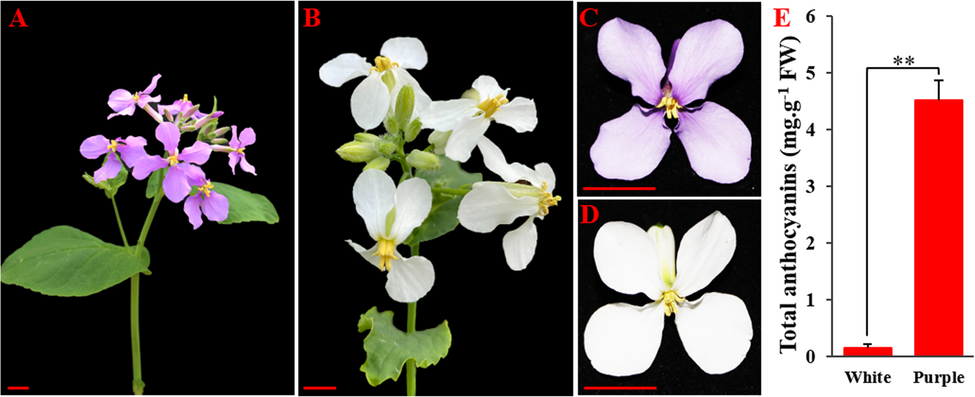
Unveiling Nature’s Spectrum: The Impactful Discovery of the OvANS Gene Behind Stunning Purple Flowers in Orychophragmus Violaceus

In recent years, significant advancements have been made in understanding the complex world of flavonoids and their biosynthesis, which has implications for both plant health and human nutrition. A pivotal study by Koes et al. (2005) highlights flavonoids as vibrant indicators of biochemical regulation and evolutionary adaptation in plants. These compounds are not only responsible for the striking colors of flowers but also play critical roles in attracting pollinators and providing defense against pathogens and herbivores.
Particularly among flowering plants, the intricate relationship between coloration and pollination has been explored extensively. Research led by Stuurman et al. (2004) dissects floral pollination syndromes in petunias, demonstrating how flower traits evolve in accordance with specific pollinator preferences. Their findings underline the evolutionary pressures that shape the physical characteristics of plants, a theme echoed across various studies that examine the functional genomics and metabolomic profiles of species.
Anthocyanins, a subgroup of flavonoids, have garnered attention for their potent antioxidant properties. Zafra-Stone et al. (2007) shed light on how berry anthocyanins can influence human health and disease prevention, suggesting that these compounds may be beneficial when incorporated into diets. The potential health benefits accentuate the importance of studying flavonoid biosynthesis and its regulation in plants.
Research continues to reveal methods of engineering anthocyanin production in plants, as demonstrated by Zhang et al. (2014). Their insights into anthocyanin biosynthesis not only aim to enhance the nutritional quality of crops but also serve a commercial purpose in the agricultural sector. Additionally, Bendokas et al. (2020) discuss anthocyanins’ roles at the mitochondrial level, which further elucidates their impact on plant health.
Significant contributions to mastering metabolic engineering techniques for anthocyanin production have been made in model organisms like Arabidopsis thaliana. Shi and Xie (2014) detail the progress in understanding the metabolic pathways that govern anthocyanin synthesis, and how these insights may enable the enhancement of crops for nutritional and aesthetic purposes.
The regulatory networks that control flavonoid biosynthesis are complex, involving interactions among different transcription factors such as MYB, bHLH, and WD40 proteins. Tohge et al. (2005) and Zhao et al. (2013) have shown that manipulating these interactions can lead to varying levels of flavonoid expression-crucial for both plant development and response to environmental stimuli. These findings have profound implications for breeding programs aimed at improving crop resilience and nutritional value.
As ongoing studies elucidate the regulatory mechanisms behind flavonoid biosynthesis, recent explorations into specific genes provide a pathway for targeted plant breeding. Research by Gonzalez et al. (2008) identifies key transcription factors essential for anthocyanin production, underscoring the significance of genetic control in the yield and quality of crops.
In conclusion, the evolving landscape of flavonoid research promises not only to enrich our understanding of plant biology but also to unlock new avenues for enhancing food quality and health benefits. As scientists continue to piece together the regulatory puzzles governing flavonoid biosynthesis, the potential for practical applications in agriculture and nutrition appears increasingly promising. Through these insights, the vibrant world of flavonoids offers a glimpse into the intricate connections between plant evolution, human health, and sustainable agriculture.
Original Source: https://bmcplantbiol.biomedcentral.com/articles/10.1186/s12870-025-07412-x
Category :
Tags:
Publish Date: 2025-10-09 18:27:00