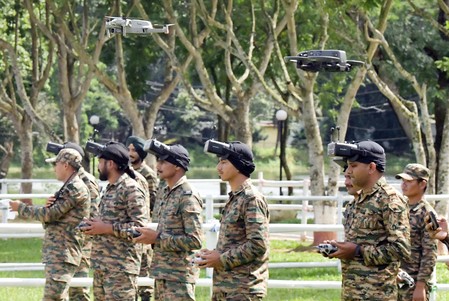

Nearly five months after the successful Operation Sindoor, which showcased the capabilities of the Indian security forces in neutralising around 400 drones launched by Pakistan, the Indian Army has commenced the acquisition of the ‘SAKSHAM’ Counter Unmanned Aerial System (UAS) Grid System, developed in India. Defence officials have stated that this innovative system is designed to detect, track, identify, and neutralise hostile drones and other unmanned aerial systems in real-time, thereby ensuring comprehensive airspace security in what is now termed the Tactical Battlefield Space (TBS). This expanded domain encompasses the Air Littoral, the airspace up to 3,000 metres (10,000 feet) above ground level.
The need for a robust counter-UAS framework was underscored during Operation Sindoor, where the significant hostile UAS activity necessitated swift detection, a coordinated response, and airspace control surpassing traditional ground limits. An official noted that the Indian Army has progressed from its previous Tactical Battle Area (TBA) concept to the broader Tactical Battlefield Space (TBS), acknowledging that future conflicts will involve not only ground combat but also activities in the airspace directly above it.
This updated strategy ensures that airspace up to 3,000 metres remains under the control of ground forces, enabling unimpeded movement for allied aerial assets while simultaneously detecting, tracking, and neutralising adversarial drones and aircraft. In the context of contemporary warfare, as demonstrated in the Russia-Ukraine conflict, the Israel-Palestine situation, and the Israel-Iran conflict, drones have become increasingly pivotal for both surveillance and attack. During Operation Sindoor, the Indian security forces successfully neutralised the nearly 400 drones fired by Pakistan.
The SAKSHAM system, which stands for Situational Awareness for Kinetic Soft and Hard Kill Assets Management, has been conceived as a high-end, modular Command and Control System. It has been developed in partnership with Bharat Electronics Limited (BEL) based in Ghaziabad. SAKSHAM aims to offer integrated situational awareness for counter-UAS operations through an efficient CUAS network grid across the Tactical Battlefield Space. The system seeks to amalgamate data from both friendly and enemy UAS, CUAS sensors, as well as soft and hard kill systems onto a unified GIS-based platform.
Additionally, SAKSHAM will facilitate automated decision support and real-time visualisation for field commanders, featuring a modular, scalable, and flexible architecture that can adapt to evolving UAS threats. Notably, its key capabilities include AI-enabled threat analysis for predictive identification and expedited decision-making.
As a fully indigenous initiative, SAKSHAM aligns with the Indian government’s vision of ‘Aatmanirbhar Bharat’ in defence technology. Developed by BEL, the system integrates AI-driven fusion technologies for future combat scenarios, providing scalability and upgrade potential as the threat landscape changes. To ensure prompt deployment, the project has been greenlit under the Fast Track Procurement (FTP) route, with expectations to roll it out to all field formations within the coming year.
Original Source: https://www.morungexpress.com/saksham-indias-new-eye-in-the-sky-to-neutralise-aerial-threats
Category: India
Tags:
Publish Date: 2025-10-09 16:16:00