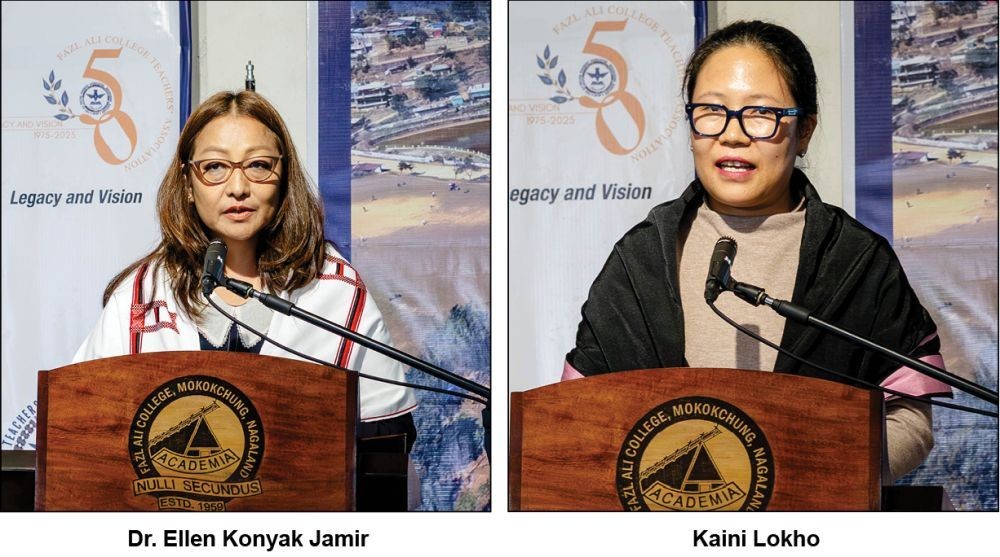

During the Morung Lecture XXII held on September 20 in Mokokchung, Dr. Ellen Konyak Jamir, the Coordinator of the Recover, Restore, and Decolonise (RRaD) initiative, posed critical questions regarding healing historical wounds and restoring cultural integrity. She emphasized that the Naga Repatriation Journey, which started five years ago, transcends the mere physical return of ancestral remains and is instead a call to reclaim and re-examine the foundational elements of Naga identity.
Dr. Jamir highlighted that the Naga community has faced ongoing trauma from decades of conflict and oppression, leading to intergenerational trauma that manifests as anxiety, depression, and social inequality. The repatriation effort has sparked a unified response among the Nagas, prompting them to look beyond divisions and work collectively to reclaim their rightful heritage.
In her address, Jamir urged, “We must neither romanticize the past nor reject it entirely,” stressing the importance of creating narratives that reflect both the historical experience and future aspirations of the Naga people. She regarded repatriation as an essential act of healing rather than simply a recovery process.
The Forum for Naga Reconciliation (FNR) and RRaD are actively working to repatriate 44 skeletal remains from the Pitt Rivers Museum, which houses the world’s largest collection of Naga artifacts, including 219 human remains that have been stored away for community claims.
The repatriation process has elicited mixed reactions; some critics view it as an infringement on sacredness. Kaini Lokho, an Assistant Professor of Political Science at the Asufü Christian Institute, countered this viewpoint, emphasizing that repatriation is vital for healing the historical wounds inflicted by colonial legacies. She argued that the narrative of “letting bygones be bygones” perpetuates victimhood and erases the truths of painful memories.
Lokho questioned the identity of the Naga people, stating, “Who are we if we erase our own truths?” She called for a commitment to the idea of repatriation as a pathway to healing, rather than merely reclaiming artifacts. She pointed out that the Naga people have long been treated as subjects of study within colonial frameworks, and post-1947, they became pawns in India’s national integration agenda, which further fragmented their community.
As the FNR and RRaD progress with their work, Lokho highlighted the importance of fostering dialogues among Naga communities as a means of recognizing shared experiences while appreciating differences. She stressed that institutional support is crucial for sustaining the momentum of this repatriation journey alongside the decolonization of Naga spaces.
Dr. Aküm Longchari, Publisher of The Morung Express, concluded the event by noting the evolution of the repatriation process from ignorance to a serious collective endeavor. Drawing a symbolic connection between the Naga hearth and the themes of decolonization, repatriation, and reconciliation, he underscored that true reconciliation demands both willing participants-the senders and receivers.
Earlier, in his welcome address, Dr. I Wati Imchen, Principal of Fazl Ali College, recalled his own fascination with Naga artifacts during his visit to the Pitt Rivers Museum 21 years ago and encouraged a collective effort to restore Naga history and culture. He urged educational institutions, tribal societies, and student groups to establish museums devoted to preserving Naga cultural artifacts, revealing these educational efforts as pivotal to maintaining cultural identity.
The session included acknowledgments by Dr. Benrithung Patton of the Fazl Ali College Research and Development Cell, while Dr. Limasenla Jamir moderated the important discussions throughout the evening.
Original Source: https://www.morungexpress.com/how-do-we-heal-the-fractures-of-history
Category: Nagaland
Tags:
Publish Date: 2025-09-20 23:46:00