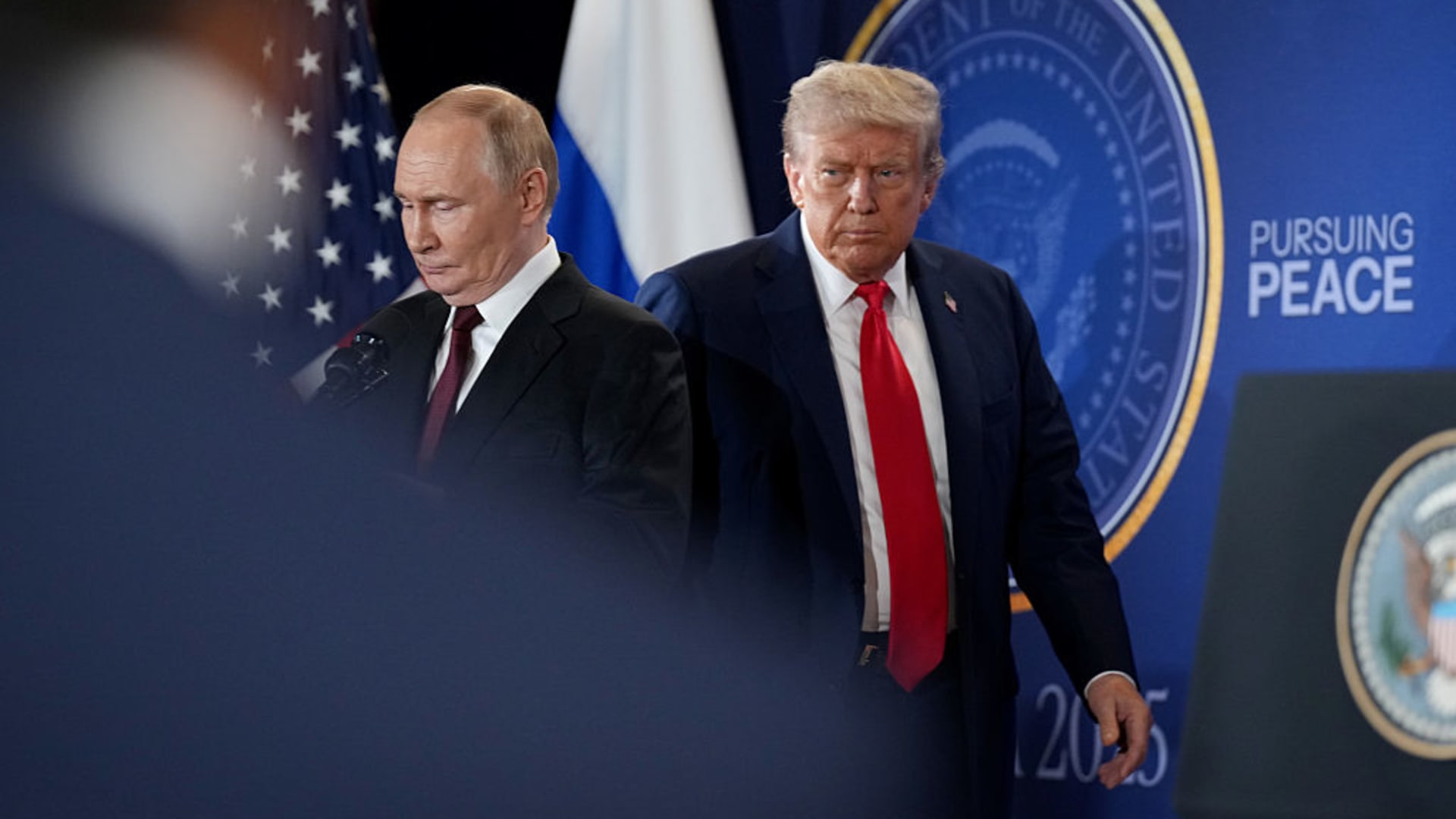

President Donald Trump is adopting a controversial strategy by fostering closer ties with Russian President Vladimir Putin while simultaneously tightening economic measures against India, a key ally. Despite being among the first nations to engage with the Trump administration, India is yet to finalize a crucial deal with the U.S. Further complicating matters, New Delhi is facing a steep 25% tariff on its imports of Russian oil, which is set to take effect later this month. U.S. Treasury Secretary Scott Bessent intensified the rhetoric this week, accusing India of profiting from discounted Russian oil, and warned of additional tariffs on Indian goods.
Bessent stated on CNBC, “We have planned to increase tariffs on India-these are secondary tariffs for buying the sanctioned Russian oil.” His comments came shortly after White House trade advisor Peter Navarro criticized India’s reliance on Russian oil, labeling it “opportunistic” and detrimental to global efforts to isolate Moscow amid the ongoing conflict in Ukraine. Navarro noted, “India acts as a global clearinghouse for Russian oil, converting embargoed crude into high-value exports while providing Moscow the dollars it needs.”
The situation threatens to unravel years of strengthened relations between Washington and New Delhi. India retaliated by claiming it is being unfairly targeted for its oil purchases while highlighting the U.S. and European Union’s continued trade with Russia. Country officials pointed out that U.S. bilateral trade with Russia reached $5.2 billion in 2024, a significant drop from nearly $36 billion in 2021, while trade between India and Russia soared to a record $68.7 billion.
Experts view Trump’s tactics as pressure mechanisms rather than foreign policy strategies. Michael Kugelman, Director of the South Asia Institute at the Wilson Center, argued that India is being unfairly victimized, suggesting, “Trump is clearly using tariffs as a pressure tactic against Russia.” He cited Trump’s frustrations over India’s lack of concessions on agricultural exports as a contributing factor to the strained relations.
Amid the criticism, India’s oil imports from Russia have surged, making it the second-largest buyer of Russian crude, taking in approximately 1.6 million barrels per day in the first half of 2023. In contrast, China remains the largest consumer, importing around 2 million barrels daily. Significantly, the U.S. has not imposed similar tariffs on China’s Russian oil purchases.
Trump’s approach appears selectively stringent, as his administration has signaled a reluctance to impose tariffs on China, which may reflect a desire to avoid jeopardizing upcoming negotiations with Chinese President Xi Jinping. This divergence suggests that the U.S. might extend pressure on India as a bargaining tool to ensure compliance from Russia, according to analysts.
As tensions escalate, the geopolitical landscape remains intricate. Trump’s interactions with Putin, characterized as bordering on friendship, have drawn scrutiny, especially as meaningful dialogue regarding a ceasefire in Ukraine remains elusive. Experts note that Trump’s overarching agenda might revolve around extracting concessions from various trading partners.
In this complex scenario, the U.S. administration’s clear direction regarding China remains ambiguous, with past engagements reflecting a disjointed policy that alternates between competition and potential cooperation. The outcome of these diplomatic maneuvers will have significant implications not only for U.S.-India relations but also in the broader context of global energy dynamics and international alignments.
Original Source: https://www.cnbc.com/2025/08/21/trump-us-policy-china-india-russia.html
Category :
Tags:
Publish Date: 2025-08-21 07:44:00