Unlock the Universe: Discover the Astonishing Power of Lenses That Transform Astronomical Exploration

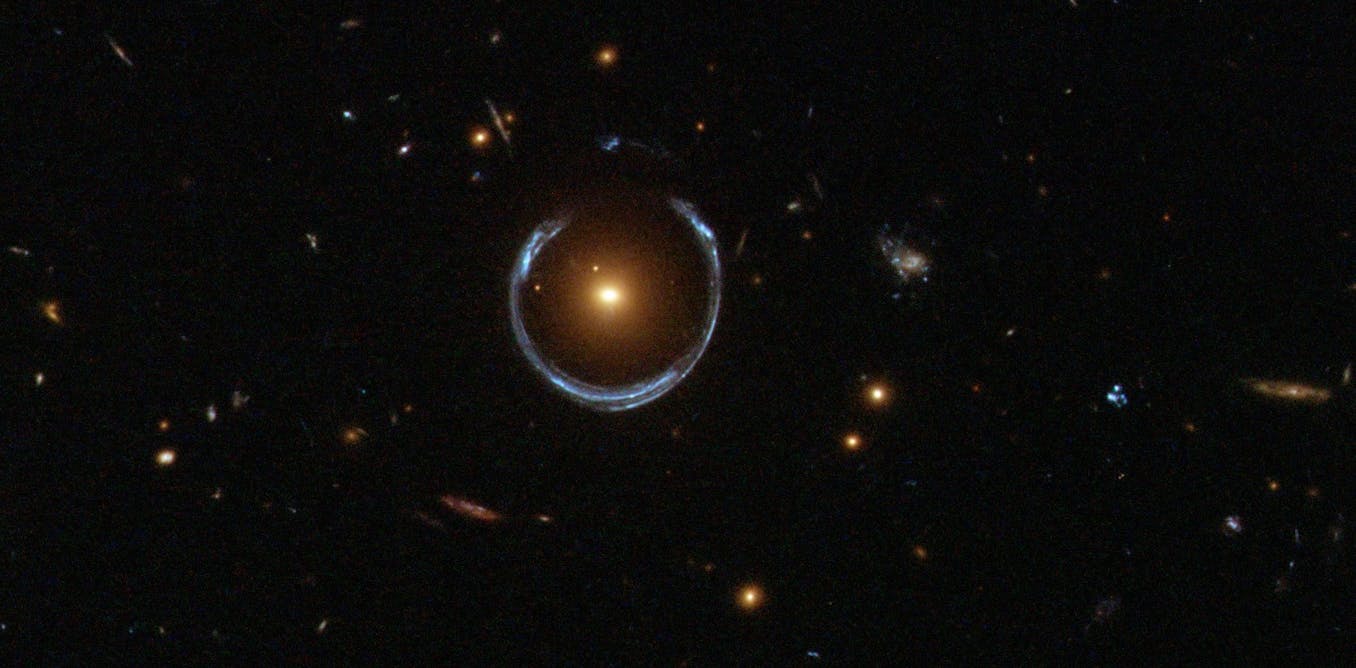
Astronomers are experiencing a transformative era in astrophysics, fueled by the advent of larger and more sophisticated telescopes. Yet, even the most advanced technologies are eclipsed by nature’s own “cosmic magnifying glasses”: strong gravitational lenses. In the past half-century, the discovery of gravitational lenses has skyrocketed from a single observation to thousands, with projections indicating that new telescopes will unveil even more.
Gravitational lenses serve as a breathtaking illustration of Albert Einstein’s theories of gravity. Einstein theorized that mass distorts the very fabric of space, creating a bending effect similar to how a bowling ball depresses a mattress. This phenomenon becomes most pronounced with massive objects, such as galaxies and galaxy clusters. When light from distant celestial bodies passes through the warped space-time around these heavy objects, it is bent and magnified, revealing details that would otherwise remain hidden.
However, not every alignment allows us to witness this stunning effect. Just as a magnifying glass must be positioned correctly for effective viewing, gravitational lensing is only observable when the background source, the foreground galaxy, and Earth align. On these fortunate occasions, telescopes capture distorted yet enhanced views of objects that might otherwise be too faint to observe.
Even Einstein himself doubted the feasibility of observing gravitational lensing, initially envisioning it only around individual stars rather than galaxies. It wasn’t until later that astronomers recognized the sheer massiveness of galaxies and their abundance throughout the universe. Remarkably, gravitational lenses also uncover insights into unseen phenomena, such as dark matter, which composes about 85% of the universe’s total mass. The way gravitational lenses warp light allows scientists to assess the quantities of not just visible matter but also this elusive dark matter.
Furthermore, gravitational lenses are invaluable for mapping galaxy clusters across the cosmos. Understanding the distribution of these clusters is crucial for determining the universe’s shape and density, which informs theories about dark energy-an enigmatic force that drives cosmic expansion.
The lensing effect typically amplifies the brightness of background objects, making them ten to 100 times easier to detect. This enhanced visibility has been pivotal for the James Webb Space Telescope, which leverages gravitational lenses to study the early universe, just a few hundred million years after the Big Bang. These insights are instrumental in reconstructing the history of our own galaxy, the Milky Way, and predicting its future evolution.
Exciting new missions are set to advance our exploration of gravitational lenses further. The European Space Agency’s Euclid telescope, launched in 2023, is expected to capture images of one-third of the sky with unparalleled clarity. Meanwhile, the Vera Rubin Observatory in Chile aims to provide the most comprehensive, time-lapsed view of the southern hemisphere sky. Together, these projects are anticipated to unveil around 100,000 new gravitational lenses-100 times the current tally.
Given the sheer volume of data these telescopes will generate, the daunting task of identifying gravitational lenses cannot rest on scientists alone. Euclid is enlisting citizen scientists to help train artificial intelligence models to recognize these cosmic wonders. By categorizing images, volunteers will empower AI to efficiently sift through vast datasets.
Gravitational lenses not only enrich our understanding of distant galaxies but also serve as essential tools in our quest to comprehend the universe’s deeper mysteries. They are truly the Swiss Army knife in the astronomer’s toolkit, promising a veritable feast of discoveries in the cosmic landscape ahead.
Original Source: https://theconversation.com/the-most-powerful-tool-in-an-astronomers-arsenal-is-a-lens-but-not-the-kind-you-might-think-262630
Category :
Tags:
Publish Date: 2025-08-20 06:26:00