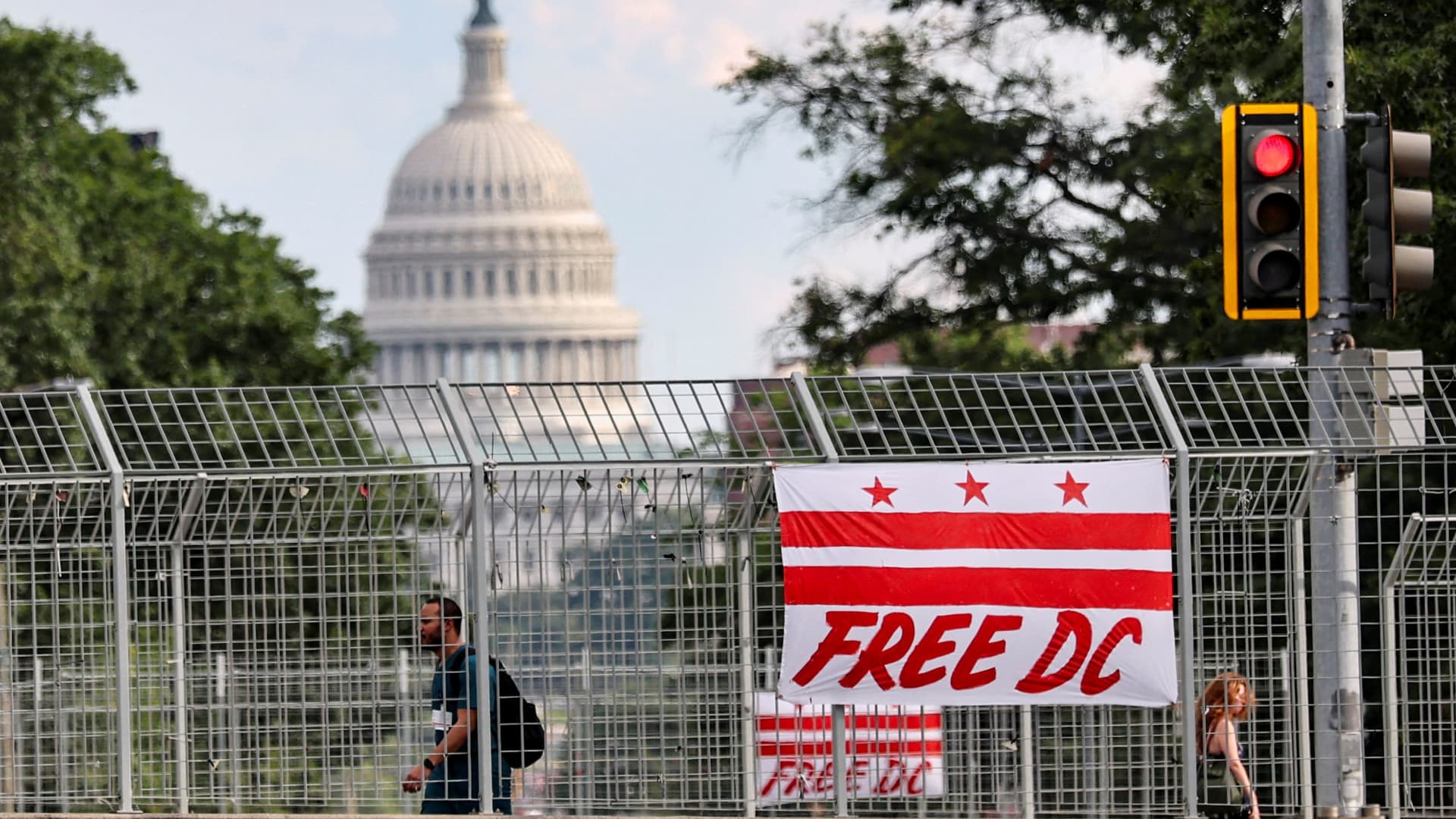

Amid escalating tensions regarding crime in Washington, D.C., President Donald Trump announced an unprecedented move to federalize the city’s police force under the Home Rule Act. This declaration, made on August 12, 2025, coincides with the deployment of hundreds of National Guard members, which Trump described as a necessary step to combat what he termed a city overwhelmed by “violent gangs and bloodthirsty criminals.” However, this alarming narrative clashes with federal data revealing that violent crime rates in D.C. have plummeted to their lowest levels in three decades.
Washington, D.C. Mayor Muriel Bowser responded to the President’s remarks during an MSNBC appearance, asserting, “We are not experiencing a spike in crime. In fact, we’re watching our crime numbers go down.” Nevertheless, a spike in criminal activity was noted in 2023, particularly with a high number of homicides and an increase in carjackings. Yet, recent statistics from the Justice Department indicate a reversal of this trend, showcasing a decline in crime rates.
As Trump’s sweeping actions reverberate through the capital, Bowser criticized his portrayal of the city as “hyperbolic” and “unsettling.” Despite positive data trends, many residents still perceive crime as a significant issue. A Washington Post poll found that 65% of D.C. residents characterized crime in the city as an “extremely serious” or “very serious problem,” reflecting a disconnect between data and public perception.
Further complicating the narrative, a YouGov poll indicated that 34% of Americans believe that murder rates have drastically increased since 1990, which contradicts statistical evidence indicating a decrease in homicide rates across many U.S. cities over recent decades. Bowser highlighted the emotional impact of crime, stating, “It doesn’t matter if crime has gone down if you were a victim,” underscoring the psychological toll of crime irrespective of its statistical trends.
Jeff Asher, a crime data analyst and co-founder of AH Datalytics, noted that public perceptions of crime often lean towards the belief that it is on the rise, regardless of factual data. This sentiment appears particularly pronounced along partisan lines, with Trump leveraging high-crime rhetoric to justify his tough-on-crime stance, often targeting racially diverse, Democratic-run cities to rally voters in suburban areas.
Polling data from the Pew Research Center underscores this divide, revealing that 68% of Republicans view reducing crime as a priority for the President and Congress by 2024, compared to just 47% of Democrats. Asher cautioned against shaping crime policies based on public perception alone, suggesting that effective crime-reduction strategies should be rooted in data while also addressing community feelings of insecurity.
Despite the decline in crime rates, Asher emphasized that concerns remain valid, stating, “We should be trying to see fewer murders, and the D.C. murder rate relative to other large cities remains elevated.” He further warned against complacency in the face of these declines, noting that many American cities still have significant progress to achieve.
As the federal intervention unfolds, the implications for both public safety and perceptions of crime in Washington, D.C. continue to evolve, reflecting a complex interplay of data, policy, and community sentiment.
Original Source: https://www.cnbc.com/2025/08/13/trump-crime-washington-dc-.html
Category :
Tags:
Publish Date: 2025-08-14 15:34:00