
UPSC Essentials introduces its subject-wise quizzes aimed at helping you revise key topics from the syllabus. Today’s focus is on Science and Technology. Check your progress by attempting the quiz.
Click Here to read the UPSC Essentials magazine for July 2025. We welcome your views and suggestions in the comments or at manas.srivastava@indianexpress.com
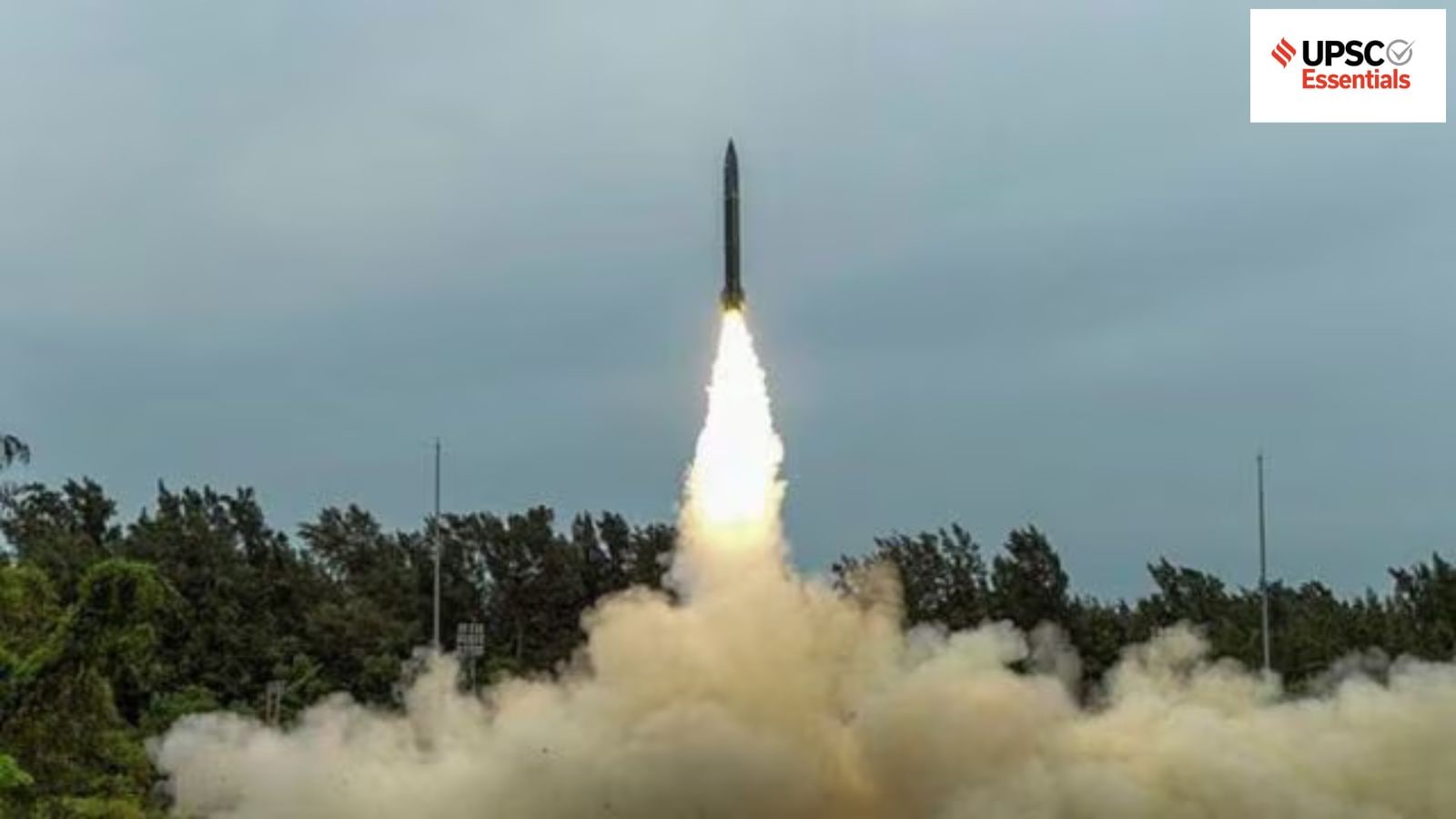
QUESTION 1: Regarding the Pralay missile, consider the following statements:
1. It is an indigenously developed solid propellant quasi-ballistic missile.
2. This missile is capable of carrying multiple types of warheads against various targets.
3. The first test of Pralay was conducted in 2024.
How many of the above statements are correct?
(a) Only one
(b) Only two
(c) All three
(d) None
Explanation: The Defence Research and Development Organisation (DRDO) has successfully conducted two consecutive tests of the Pralay missile from Dr APJ Abdul Kalam island off Odisha. These tests validated the missile’s range capabilities, demonstrating precise accuracy. The Pralay missile is indeed an indigenously-developed solid propellant quasi-ballistic missile equipped with advanced guidance systems and capable of carrying multiple warheads, confirming statements 1 and 2 as correct. However, the first test occurred in December 2021, not 2024, making statement 3 incorrect. Therefore, option (b) is the right answer.
QUESTION 2: In reference to the Synthetic Aperture Radars (SARs) used in NISAR (NASA-ISRO Synthetic Aperture Radar), consider these statements:
1. Both the L-band and S-band radars can penetrate clouds, smoke, rain, or fog, providing a clear view of the Earth in all weather conditions, day or night.
2. The S-band SAR utilizes higher wavelength microwaves, allowing better penetration of tree cover, vegetation, and various terrains like sand or ice.
3. The L-band SAR has a shorter wavelength, which limits its penetration but excels in capturing broader features like crop fields or water bodies.
Determine how many statements are accurate.
(a) Only one
(b) Only two
(c) All three
(d) None
Explanation: NISAR employs both L-band and S-band radars to capture detailed Earth images in various conditions. Both types can indeed see through weather disturbances, affirming statement 1 as true. The L-band SAR uses higher wavelengths and penetrates better than correctly stated in 2, thus making statement 2 incorrect. Meanwhile, the S-band SAR is adept at capturing large features, confirming that statement 3 is also inaccurate. Therefore, option (a) is the correct answer.
QUESTION 3: Consider these pollutant-source pairs:
1. PM 2.5 – Mainly from vehicle emissions and thermal power plants.
2. Nitrogen dioxide – Primarily from burning fossil fuels by vehicles and power plants, as well as industrial activities.
3. Soot – Emitted from vehicle exhaust and wood burning.
How many pairs are accurately matched?
(a) Only one pair
(b) Only two pairs
(c) All three pairs
(d) None
Explanation: Recent studies indicate a significant correlation between prolonged exposure to PM2.5 and increased dementia risk, confirming that statement 1 is correct. Statement 2 regarding nitrogen dioxide also holds true as its long-term exposure raises dementia risks significantly. Additionally, soot, another pollutant stemming from similar sources as mentioned, corroborates statement 3. Hence, option (c) is the accurate answer.
QUESTION 4: The term “hypocenter” in relation to an earthquake refers to:
(a) The starting point of the earthquake beneath the Earth’s surface
(b) The location on the surface where the Earth ruptures
(c) The location from which the seismograph measures the earthquake intensity
(d) The area adjacent to tectonically active regions
Explanation: An earthquake occurs from movement below the Earth’s surface, releasing energy that generates seismic waves. The US Geological Survey defines the hypocenter as the location beneath the surface where this seismic activity initiates. Consequently, option (a) is the accurate choice.
QUESTION 5: Regarding ‘ham’ radio, consider these statements:
1. It serves educational and informational purposes.
2. Communication is restricted to licensed users.
3. In India, individuals below 21 are prohibited from operating ham radios.
Identify which statement(s) are accurate.
(a) 1 and 2 only
(b) 2 only
(c) 2 and 3 only
(d) 1, 2 and 3
Explanation: Ham radio, or amateur radio, is utilized for educational outreach and emergency communication, affirming statements 1 and 2 as true. However, in India, anyone over the age of 12 can operate a ham radio, rendering statement 3 incorrect. Therefore, option (a) is correct.
QUESTION 6: With respect to the Indian Space Research Organisation (ISRO), consider these statements:
1. Established as a successor to INCOSPAR in 1969.
2. It operates under the Department of Space, created in 1972.
3. Its primary mandate includes designing vehicles and satellites to leverage space technology for social development.
4. ISRO functions independently under the Ministry of Science & Technology.
Identify the correct statements.
(a) 1 and 4 only
(b) 1, 2 and 3 only
(c) 2 and 4 only
(d) All of the above
Explanation: ISRO, the national space agency, was indeed founded as a successor to INCOSPAR in 1969. It operates under the Department of Space, which was established in 1972, confirming statements 1 and 2 as correct. Furthermore, ISRO’s mission includes developing space technology for various national objectives, validating statement 3. However, it does not function independently but rather under government oversight, affirming that statement 4 is incorrect. Thus, option (b) is the correct answer.
QUESTION 7: What are Population III stars?
(a) The first stars in the universe
(b) The most recent stars in the universe
(c) The smallest, long-living, dim stars
(d) None of the above
Explanation: Population III stars are the universe’s first stars, formed from primordial matter, and were massive and bright. They eventually exploded, seeding the universe with essential elements. Thus, option (a) is the correct answer.
QUESTION 8: Regarding ‘reionization’, consider these statements:
1. It is a key phenomenon in the universe’s history, enabling indirect study of early stars.
2. Scientists have pinpointed the timeline of the first stars and the reionization process.
Which statements are correct?
(a) 1 only
(b) 2 only
(c) Both 1 and 2
(d) Neither 1 nor 2
Explanation: Reionization marks a pivotal time when neutral hydrogen was ionized by the radiation from the universe’s first massive stars, offering insights into early stellar formation. However, the exact timings are still debated, making option (a) the correct choice.
Stay engaged with UPSC materials and updates by subscribing to our newsletter and joining our Telegram group, IndianExpress UPSC Hub. Follow us on Instagram and X for the latest insights.
Original Source: https://indianexpress.com/article/upsc-current-affairs/upsc-essentials/upsc-essentials-daily-subject-wise-quiz-science-and-technology-week-121-10159582/
Category: UPSC Current Affairs,UPSC Essentials
Tags:
Publish Date: 2025-07-31 07:42:00