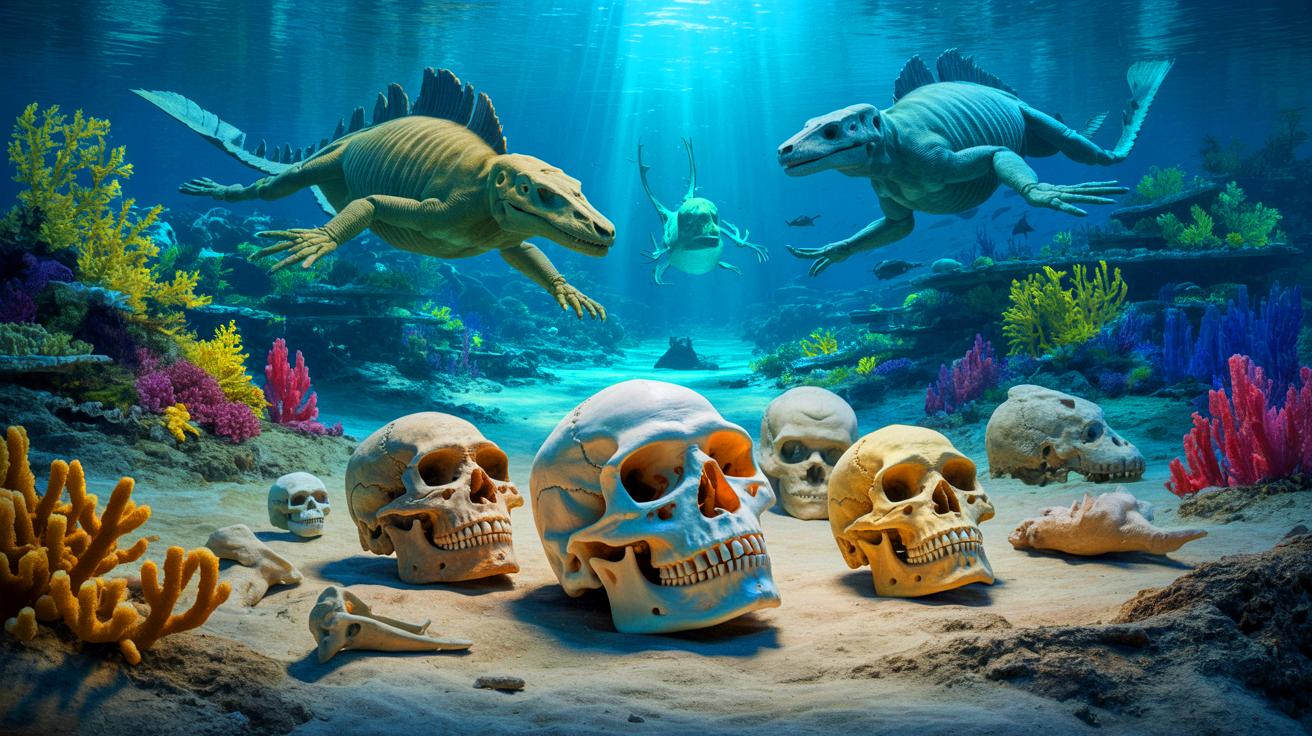
Rediscovering a Lost World: Archaeologists Unearth an Ancient Undersea Realm of Giants and Vanished Humanity!

In a stunning discovery beneath the waters near Indonesia, ancient fossils have unveiled crucial insights into early human life and the diverse ecosystems that once thrived in Southeast Asia. This remarkable find, consisting of over 6,000 specimens-including the remains of Komodo dragons and the extinct Stegodon, a massive elephant-like creature-offers a glimpse into a world that existed more than 140,000 years ago.
The fossils were uncovered during routine reclamation activities by workers dredging near Surabaya, the capital of East Java, when they stumbled upon an astonishing array of relics buried beneath layers of sand and marine deposits. Among the significant finds were two human skull fragments that closely resemble those of Homo erectus, an early human ancestor previously identified at the Sambungmacan site in Java. Researchers employed Optically Stimulated Luminescence (OSL) dating, revealing that these fossils date back to between 162,000 and 119,000 years ago, providing an unprecedented look into ancient biodiversity and ecological dynamics before the area succumbed to rising seas.
Geological analyses further enrich this discovery by revealing an ancient river system, part of the Solo River, which once meandered across the now-submerged Sunda Shelf. Layered sediment records illustrate a vibrant ecosystem that thrived during the late Middle Pleistocene, where various herbivores and predators, including species of deer, roamed a landscape that resembled a savanna more than a dense jungle. This thriving environment was gradually lost to rising sea levels, as glacial melting contributed to an increase of over 394 feet in ocean levels, flooding the plains of Sundaland and altering the connection between the Southeast Asian mainland and its islands.
Perhaps most intriguingly, many of the unearthed animal bones displayed cut marks indicative of deliberate butchery by early hominins. These findings suggest that early humans employed advanced hunting techniques, emphasizing the adaptability and survival skills of Homo erectus. Harold Berghuis, a lead researcher from the University of Leiden, noted that this era was characterized by significant morphological diversity and a high degree of mobility among human populations.
The identification of Homo erectus skull fragments in the Madura Strait broadens our understanding of their geographical distribution and adaptability in diverse environments. These early humans, known for their upright stature and more modern proportions, underscore an evolutionary tale marked by resilience and innovative survival strategies. This accidental discovery by sand miners represents a key moment in the ongoing exploration of early human history in Asia.
Utilizing a combination of archaeological, geological, and paleoenvironmental research, scientists are piecing together this hidden chapter of human evolution, illuminated after millennia under the sea. As we continue to uncover such significant findings, the fossil treasures of Indonesia challenge previous notions and enhance our understanding of ancient human migratory patterns and adaptive strategies.
As the ocean keeps revealing its secrets, this groundbreaking discovery invites reflection on the untold stories of our ancestors, raising questions about how many more lost worlds lie beneath the waves, waiting to reshape our understanding of human history and the environmental forces that have sculpted our planet.
This article is based on verified sources and supported by editorial technologies.
Original Source: https://www.rudebaguette.com/en/2025/07/we-found-a-lost-world-under-the-sea-archaeologists-uncover-140000-year-old-submerged-land-teeming-with-ancient-giants-and-vanished-humans/
Category :
Tags:
Publish Date: 2025-07-20 15:49:00