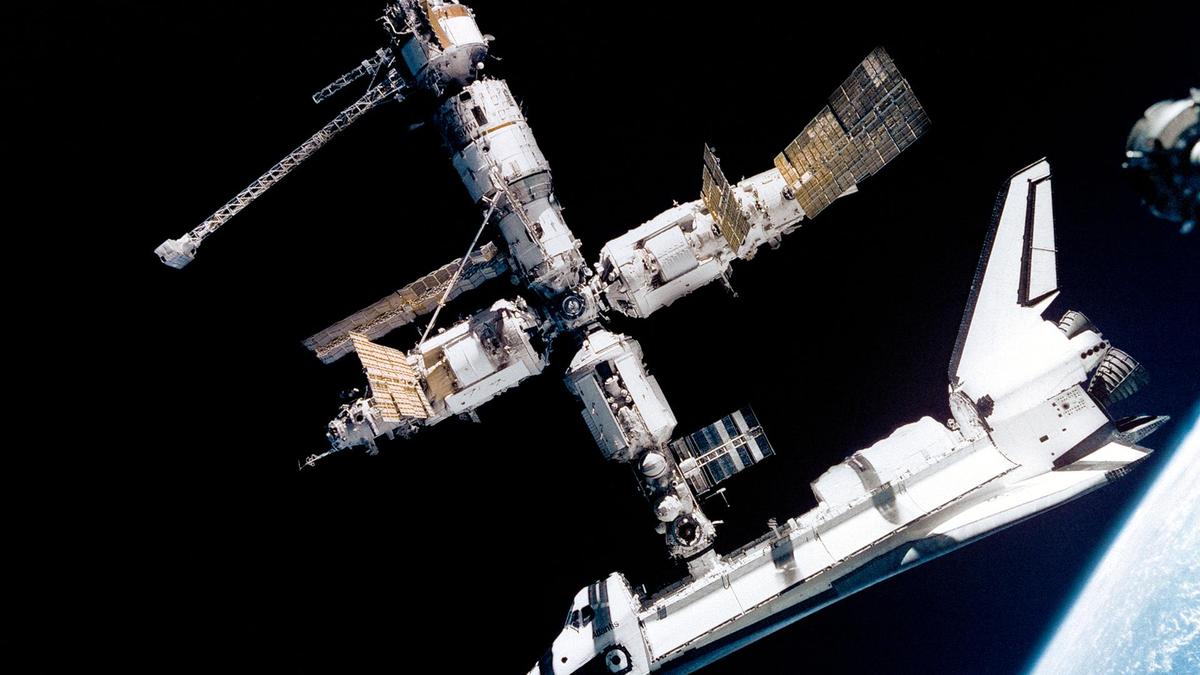

In a historic moment of collaboration between former rivals, NASA and Russia’s space agency marked a significant turning point less than five years after the Cold War’s end. Daniel Goldin, then NASA’s Administrator, hailed this partnership as the dawn of “a new era of friendship and cooperation.” On June 29, 1995, the U.S. space shuttle Atlantis successfully docked with the Russian space station Mir, creating the largest human-made object to orbit Earth at that time. This milestone also coincided with the STS-71 mission, which celebrated the 100th human spaceflight in American history.
The primary goal of the STS-71 mission was the first-ever docking between a space shuttle and the Mir space station. Initially slated for May 1995, the launch was delayed to June to accommodate necessary adjustments on Mir, including crucial spacewalks to reconfigure the station for the upcoming rendezvous. Although the launch faced weather-related setbacks on June 23 and 24, it finally took off on June 27 without issues.
The docking process, despite being groundbreaking, proceeded smoothly. It took only two hours to complete, occurring just two seconds shy of the planned time. Utilizing the R-Bar approach, which allows natural forces to assist in braking the shuttle’s approach, the crew ensured optimal maneuverability. Robert L. Gibson, the mission commander, deftly navigated Atlantis to within 30 feet of Mir, where precise control was essential for a flawless connection. The docking itself was achieved at an altitude of 400 kilometers above Lake Baikal in Russia, with minimal misalignment observed.
Once docked, the astronauts and cosmonauts quickly pivoted to collaborative activities aboard the linked spacecraft, which together weighed nearly 225 tons. Following a warm greeting ceremony, the crew exchanged traditional gifts-Atlantis’s crew offered chocolates and flowers, while the Russian cosmonauts presented bread and salt. This ceremonial exchange symbolized their newfound partnership, further underscored by the arrival of the Mir-19 crew, who took charge of the space station from Mir-18.
Over an intensive 100-hour period, U.S. and Russian teams conducted nearly 15 biomedical and scientific experiments across seven disciplines, from cardiovascular health to microgravity research. Imported samples, including urine, blood, and air, contributed invaluable insights into human health in space. The Mir 18 crew undertook rigorous exercise plans to prepare for their return to Earth after spending over three months in microgravity.
As the mission drew to a close, a farewell ceremony on July 3 was held, leading up to the separation of Atlantis and Mir on July 4. Mir 19 briefly departed the station to capture images of the shuttle separating, an event Gibson poetically described as a “cosmic ballet.” The eight crew members landed safely at Kennedy Space Center on July 7, concluding a mission that lasted 9 days, 19 hours, and 22 minutes. The achievements of STS-71 continue to resonate, highlighting an era where collaboration between former adversaries in the name of science became a reality.
Published – June 29, 2025 12:09 am IST
Categories: Space Exploration, NASA, Russian Space Program
Tags: STS-71, Mir, Space Shuttle, Atlantis, International Cooperation
Original Source: https://www.thehindu.com/children/when-a-us-shuttle-docked-with-a-russian-space-station/article69708658.ece
Category :
Tags:
Publish Date: 2025-06-29 00:09:00