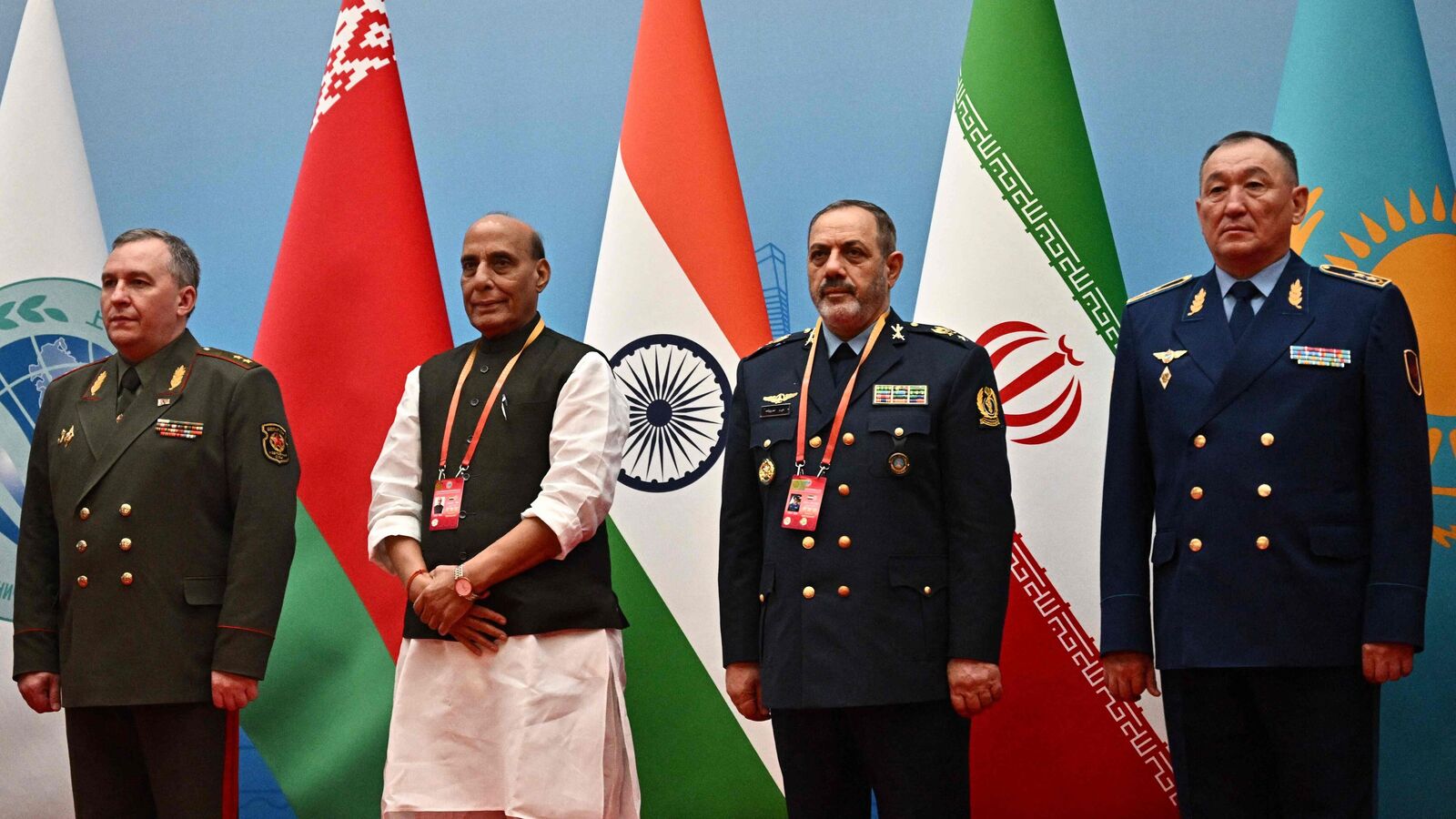
Rajnath Singh’s Bold Stand in China: Rejects SCO Document Ignoring Pahalgam, Highlights Balochistan’s Plight!

Defence Minister Rajnath Singh declined to sign a joint statement at the recent Shanghai Cooperation Organisation (SCO) meeting, citing the absence of a reference to the deadly April 22 Pahalgam terror attack, which claimed the lives of 26 individuals, primarily tourists. Reports from NDTV suggest that the omission of Pahalgam may have been influenced by Pakistan, as China’s leadership in the SCO likely facilitated this exclusion.
The joint statement, while neglecting the Pahalgam attack, controversially mentioned Balochistan, subtly implicating India in fostering unrest in the region. India has consistently rejected Pakistan’s allegations regarding its involvement in Balochistan, insisting that Islamabad should focus on its own domestic issues and cease its support for terrorism.
The summit, hosted in Qingdao, China, is attended by member states including Russia, Pakistan, and China, where they address key regional and international security concerns. In his remarks at the meeting, Singh condemned terrorism, emphasizing the collective responsibility of SCO nations to hold perpetrators and sponsors of such acts accountable.
“We reiterate the need to hold the perpetrators, organizers, financiers, and sponsors of reprehensible acts of terrorism, including cross-border terrorism, accountable and bring them to justice,” Singh stated. He decried all acts of terrorism as unjustifiable, urging a unified stance against this global menace.
Singh specifically highlighted the Pahalgam attack, attributing it to ‘The Resistance Front’ (TRF), a proxy for the UN-designated terrorist organization Lashkar-e-Taiba (LeT). He recounted that the assailants targeted tourists based on religious profiling. “On April 22, 2025, the TRF carried out a heinous attack on innocent tourists in Jammu and Kashmir, resulting in the deaths of 26 civilians, including a Nepali national,” Singh elaborated.
In response to persistent threats, India initiated Operation Sindoor on May 7, 2025, aimed at dismantling cross-border terrorist networks. Singh noted the striking similarity between the Pahalgam attack and previous incidents linked to LeT. “In exercising our right to defend against terrorism, we successfully launched Operation Sindoor to disrupt cross-border terrorism,” he stated.
The Minister reiterated India’s determination to combat terrorism in all its forms, highlighting the transnational nature of the threat. “These threats do not respect national boundaries and require a unified response grounded in mutual trust and transparency,” he argued.
Furthermore, Singh underscored the importance of preemptive measures against radicalization among youth, praising the Regional Anti-Terrorist Structure (RATS) of the SCO for its initiatives. He pointed to a joint statement adopted during India’s chairmanship, which symbolizes a shared commitment among member nations to counter radicalization that leads to terrorism and extremism.
The SCO Defence Ministers’ Meeting, running from June 25 to 26, gathers top defense officials from India, China, Russia, and several Central Asian countries to collaborate on maintaining regional peace and security. Since its establishment in 2001, the SCO has sought to promote stability through dialogue and cooperation. India became a full member in 2017 and chaired the organization in 2023, passing the leadership to China for 2025 under the theme “Upholding the Shanghai Spirit: SCO on the Move.”
The focus on cooperative security mechanisms, counter-terrorism efforts, and regional solidarity underscores the pressing need for nations to unite against the pervasive threat of terrorism that transcends borders.
Original Source: https://www.livemint.com/news/india/in-china-rajnath-singh-refuses-to-sign-sco-document-that-skips-pahalgam-but-mentions-balochistan-report-11750916005317.html
Category :
Tags:
Publish Date: 2025-06-26 11:12:00