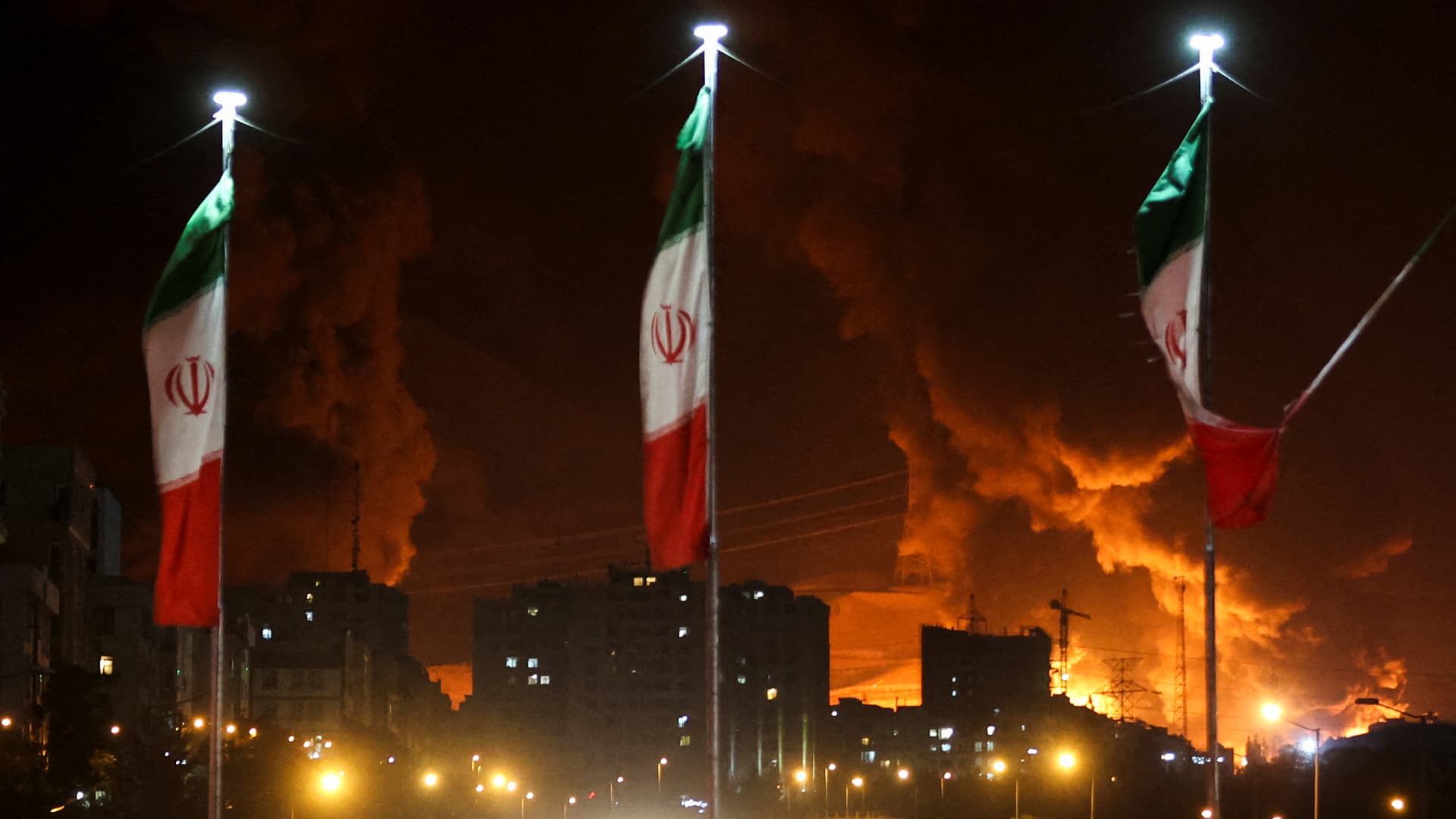

Senior Israeli officials recently indicated that their military operation against Iran could lead to the collapse of the regime, a scenario with significant ramifications for the global oil market. Despite Israel’s ongoing airstrikes against the third-largest crude producer in OPEC for eight days straight, the oil market has displayed notable resilience. Since the attack commenced, oil prices have surged about 10%, yet both U.S. crude and the global benchmark Brent remain under $80 per barrel, largely due to unimpeded oil supply chains.
Energy analysts warn that as the conflict drags on, the risk of a supply disruption increases, potentially triggering a major spike in prices. President Donald Trump has made headlines by threatening Iran’s Supreme Leader Ayatollah Ali Khamenei and is contemplating further actions to dismantle Iran’s nuclear infrastructure. Analysts suggest that Iran’s leadership may retaliate by targeting regional oil facilities if they sense their survival is at stake.
Israel’s primary aim is to undermine Iran’s nuclear capabilities, according to Scott Modell, CEO of Rapidan Energy Group. However, there appears to be an additional objective: to weaken Iran’s security apparatus to the point where domestic opposition could challenge the regime. “They’re not calling it regime change from without; they’re calling it regime change from within,” said Modell, a former CIA officer and Iran specialist.
While Prime Minister Benjamin Netanyahu officially denies that regime change is Israel’s explicit mission, he acknowledges that the ongoing conflict could destabilize Khamenei’s regime. Recently, Defense Minister Israel Katz ordered an escalation of military efforts aimed at “destabilizing the regime” by targeting its core power structures.
Analysts caution against assuming imminent regime collapse in Iran. However, Natasha Kaneva, head of global commodities research at JPMorgan, pointed out that political turmoil in Iran could lead to significantly sustained higher oil prices. Historical precedents highlight that since 1979, major regime changes in oil-producing nations have typically resulted in a spike in oil prices-averaging a 76% increase at peak, with prices stabilizing about 30% higher than pre-crisis levels.
For instance, following the Iranian revolution in 1979, oil prices nearly tripled, contributing to a global economic downturn. More recently, the upheaval in Libya led to a sharp price rise from $93 to $130 per barrel in early 2011, coinciding with the European debt crisis.
If a regime change were to occur in Iran, it would likely have a more profound impact on global oil markets than the 2011 Libyan situation given Iran’s significant production capacity. “We need to observe credible signs that the state is faltering before the market seriously considers the possibility of losing over three million barrels a day,” Modell explained.
Moreover, if Iran perceives its regime is under existential threat, it could retaliate by targeting regional energy facilities, as noted by Helima Croft of RBC Capital Markets. Iran might also attempt to mine the strategically vital Strait of Hormuz, through which nearly 20% of the world’s oil is transported. Reports have indicated aggressive Iranian efforts to disrupt maritime navigation, raising concerns among international shipping interests.
Rapidan analysts estimate a 70% likelihood of U.S. airstrikes on Iran’s nuclear facilities, which could result in an immediate oil price increase of $4 to $6 per barrel. However, there remains a 30% chance that Iran might retaliate against energy infrastructure, potentially driving oil prices above $100 per barrel if tensions escalate significantly.
As conflicts unfold in the region, the oil market remains on high alert, reflecting both the geopolitical dynamics at play and the potential for widespread economic consequences.
Original Source: https://www.cnbc.com/2025/06/21/how-regime-change-in-iran-could-affect-global-oil-prices.html
Category :
Tags:
Publish Date: 2025-06-21 18:14:00